Skip to content
New

Shopify launched Agentic Storefronts. We make AI agents recommend you - not just list you.

See the Shopify integration
Tru Commerce

INSIGHTS

Notes from the agentic commerce frontline.

Weekly. Numbers-first. The deals, the protocol shifts, the brand moves we think you should know about.

weekly·numbers-first·no fluff

229 articles · Page 6 of 13

Citation Rank & Share of Voice · Sep 15, 2026

The Breadcrumb Myth — Category Path Is Hygiene, Not Leverage

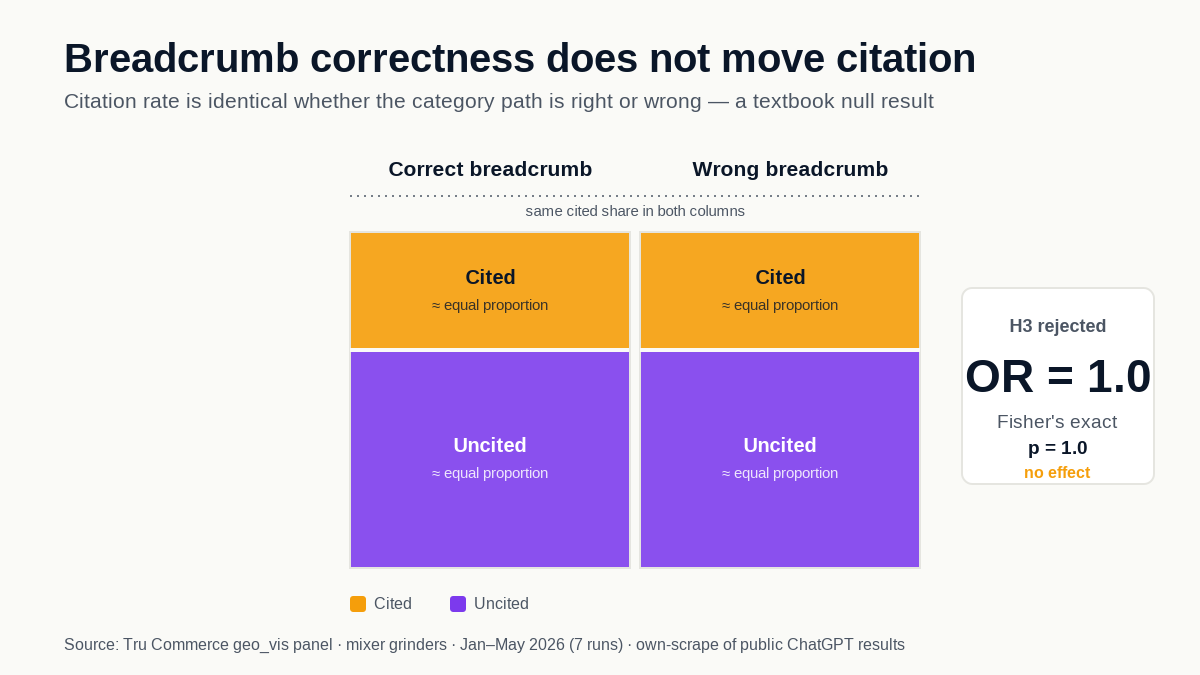
One of the most repeated theories in AI shopping is that a 'wrong' category breadcrumb quietly suppresses your citations. We tested it on a locked panel and the theory collapsed: the odds ratio between breadcrumb-correctness and being cited was 1.0, with a Fisher's exact p of 1.0 — no association at all. Correct categorization is basic hygiene. It is not a visibility lever. Here is the test, why the intuition is wrong, and the three levers that actually move the needle.

Citation Rank & Share of Voice · Sep 15, 2026

The Variant-Fragmentation Myth — Consolidating Listings Can Hurt Your AI Visibility

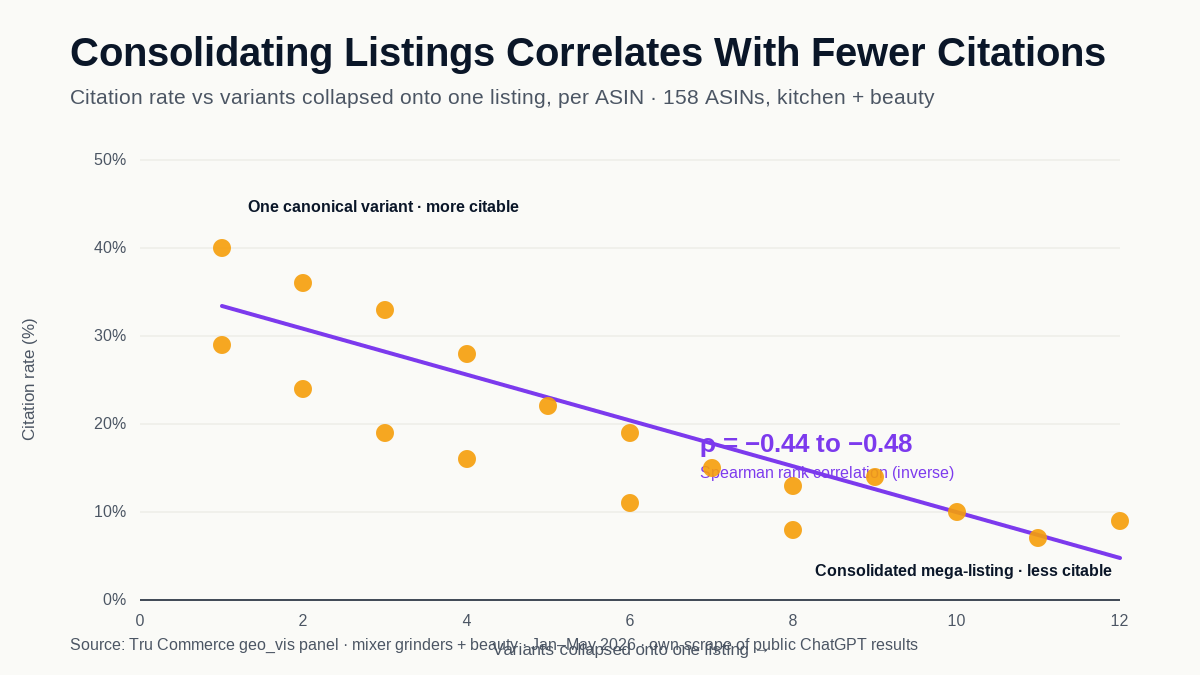
One of the most repeated PDP recipes says merge your color, size, and pack variants onto a single listing to concentrate authority. In our locked-panel data, consolidation ran the wrong way: the more variants a brand collapsed onto one listing, the lower its AI citation rate (Spearman ρ = −0.44 to −0.48). The tidy hypothesis that fewer listings win was disproven across 158 ASINs. Here is the data, the honest correlational caveat, and the reframed play — promote one canonical variant instead of collapsing everything.

Vertical Playbooks · Sep 12, 2026

The Broken Carousel — AI Shopping Is Half-Built in Beauty, and That's the Opening

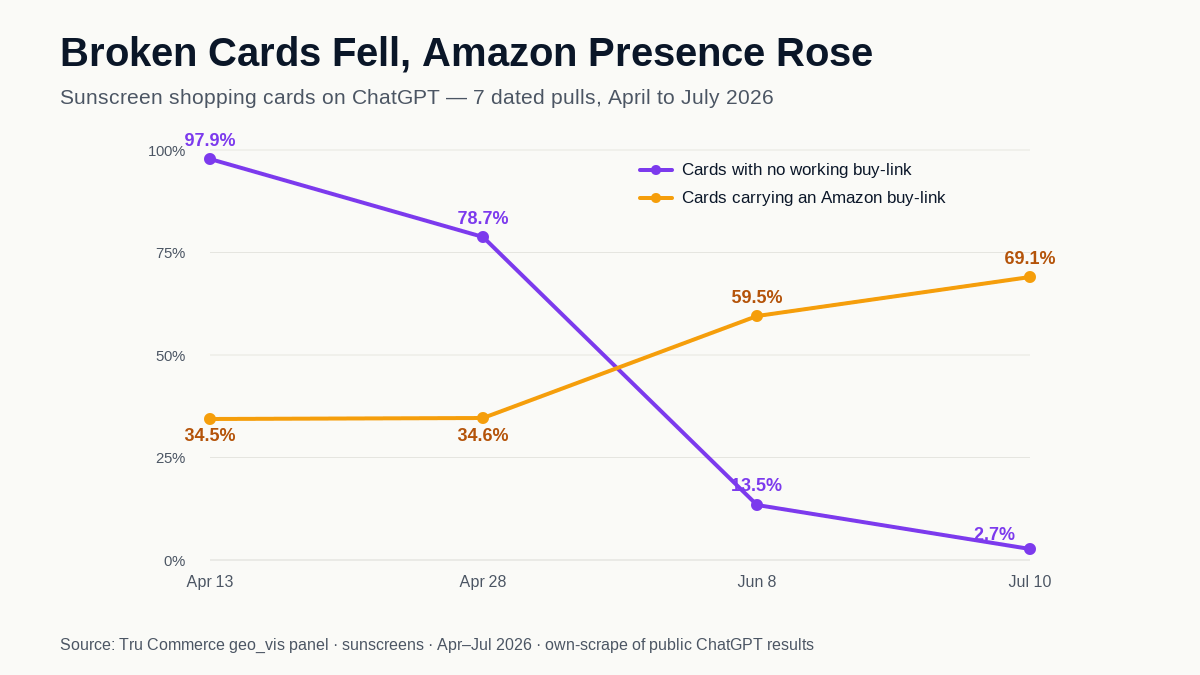
In a young AI-shopping category, the shelf itself is broken before ranking ever matters. In April, 97.9% of sunscreen cards in our locked panel had no working buy-link, and the links that did resolve pointed at obscure cross-border dropshippers, not the largest marketplace. By July the shelf had healed to 2.7% broken and the marketplace rode 69% of cards. The first battle in an emerging category is not citation or ranking — it is the data integrity of the carousel, and it is winnable right now.

Citation Rank & Share of Voice · Sep 12, 2026

Product Type Determines Destiny — Some Categories Are 15x More Citable

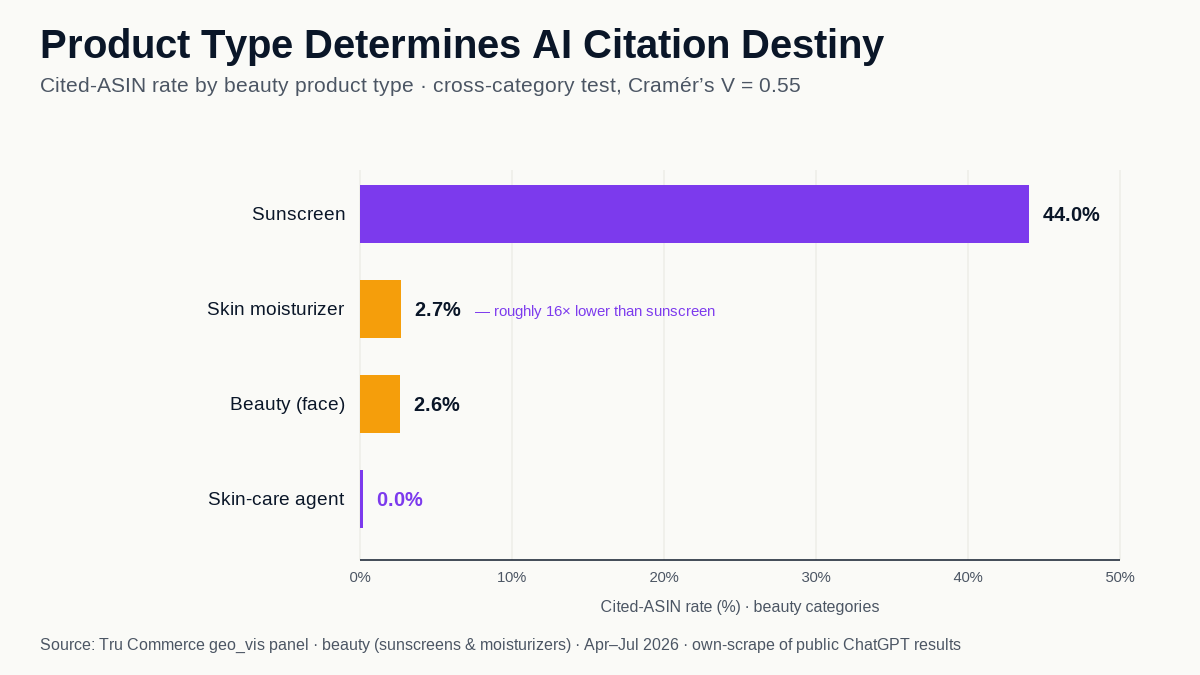
Citability is not evenly distributed across a catalogue. In our beauty panel, sunscreen ASINs are cited by ChatGPT at roughly 16 times the rate of moisturizers (44.0% vs 2.7%), and the association between product type and citation is statistically strong (Cramér's V = 0.55). Which category you lead with is itself a visibility lever — and most AEO programs pick it by revenue instead of by structure.

Insights · Sep 10, 2026

Why a Single AI Visibility Score Is a Vanity Metric

An AI visibility score is a single number meant to summarise how often AI assistants surface your brand. The problem is not the arithmetic — it is that one number hides the two things that decide whether you get the sale. Being named is not being recommended, and one run is not a measurement. Here is what to demand from any score before it goes in a board deck, including ours.

Citation Rank & Share of Voice · Sep 10, 2026

Measurement Is the Moat — Why Every AI-Visibility Number Lies Without a Locked Prompt Set

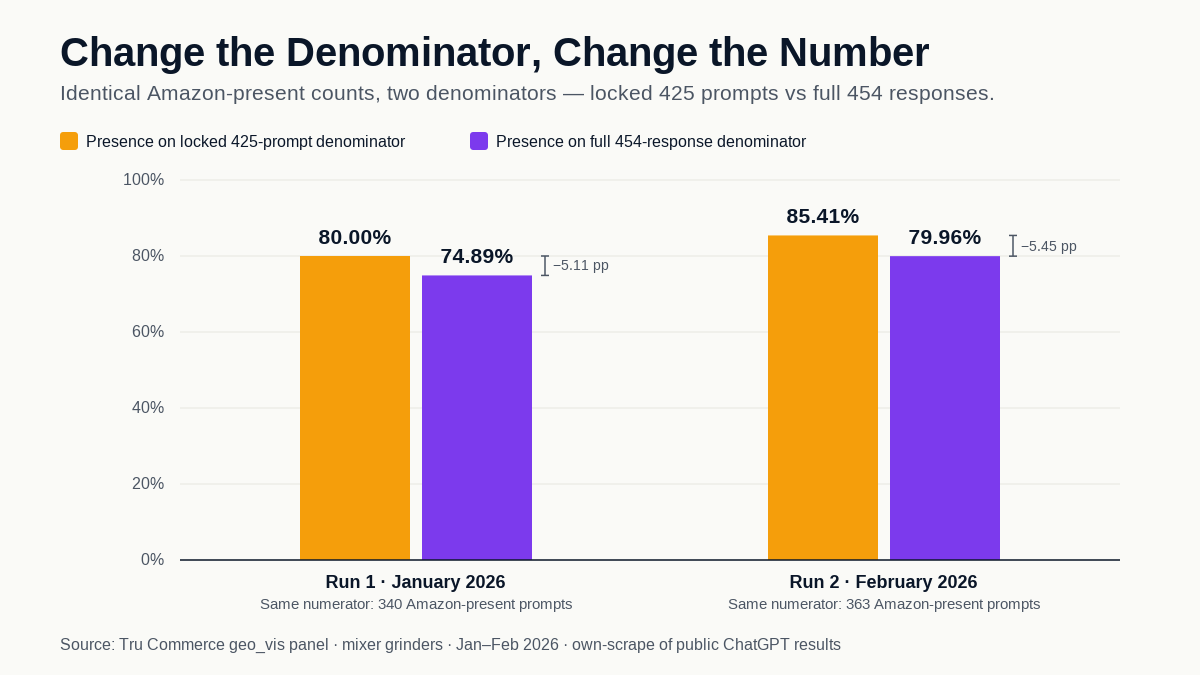
The same Amazon-present count reads 80% on a locked 425-prompt denominator and 74.89% on a full 454-response one — the number moves five points on the denominator alone. Add runs with zero cards, partial card coverage, and a position metric that swings from 0.41 to 1.41 depending on where you start counting, and most AI-visibility dashboards are quietly reporting fiction. This piece shows the exact ways a number lies, includes a correction we owe our own data, and gives the validity checklist that has to run before any figure ships.

Citation Rank & Share of Voice · Sep 10, 2026

The Long Tail Is Where You Lose — Regional and Use-Case Queries Are the Leak

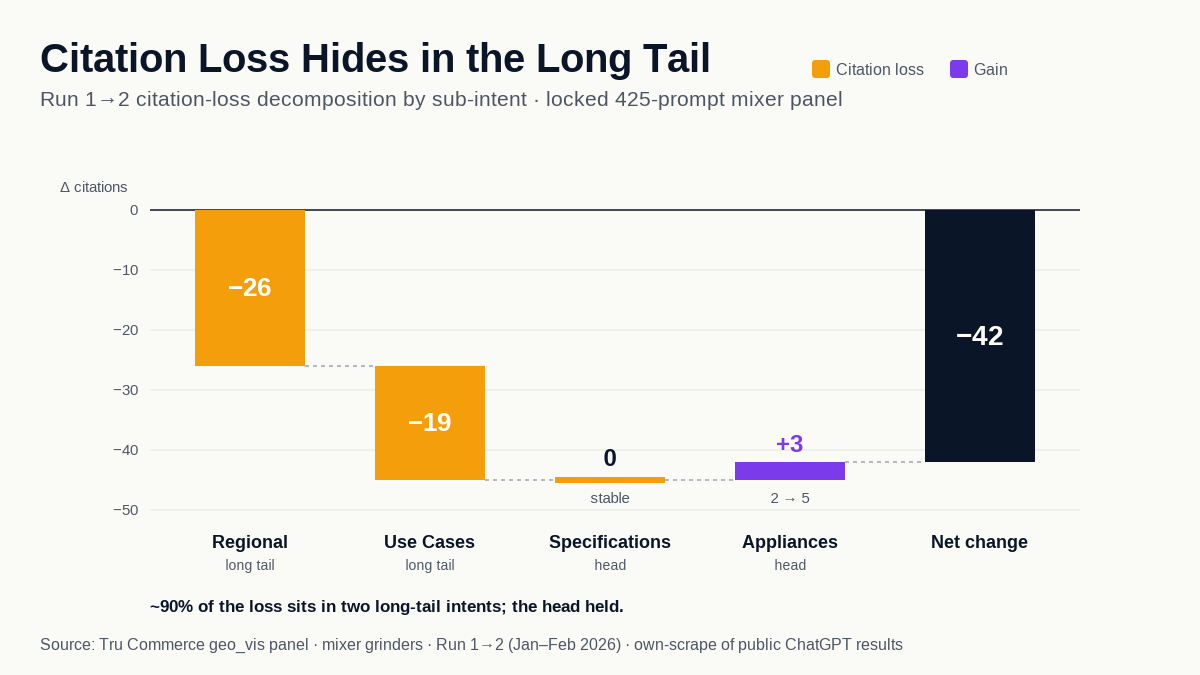
When we decomposed AI citation loss by sub-intent between two early runs, almost all of it lived in the long tail: regional queries contributed a drop of 26 and use-case queries 19, while spec queries stayed stable and appliance queries even gained. Hero terms held; the tail leaked. This piece shows why the model retrieves differently for 'mixie for dhokla batter' than for a spec query, and why you defend the tail before the head.

Citation Rank & Share of Voice · Sep 9, 2026

Out of Stock Is an Invisibility Switch — Availability Beats Cleverness in AI Shopping

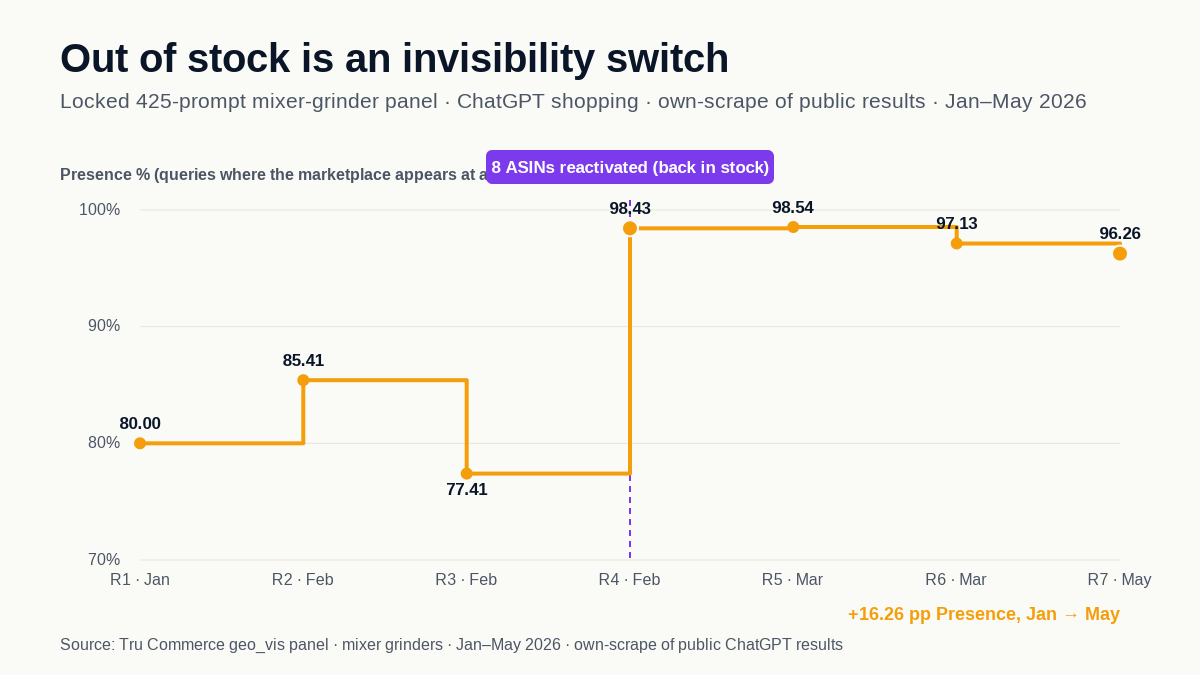
When a product goes out of stock, AI shopping does not down-rank it — it silently deletes it from the answer. In our locked mixer-grinder panel, the largest marketplace's Presence jumped from 80% to 96.26% (+16.26 points) across seven monthly pulls, and the step-change lands exactly when 8 previously lapsed ASINs returned to stock. Availability is not an operations problem hiding downstream of visibility; it is the first gate of visibility. With ChatGPT product feeds live since June 2026, feed and stock hygiene are now visibility infrastructure.

Citation Rank & Share of Voice · Sep 8, 2026

Reviews Are the Eligibility Gate — You Don't Get Cited Until You Cross the Threshold

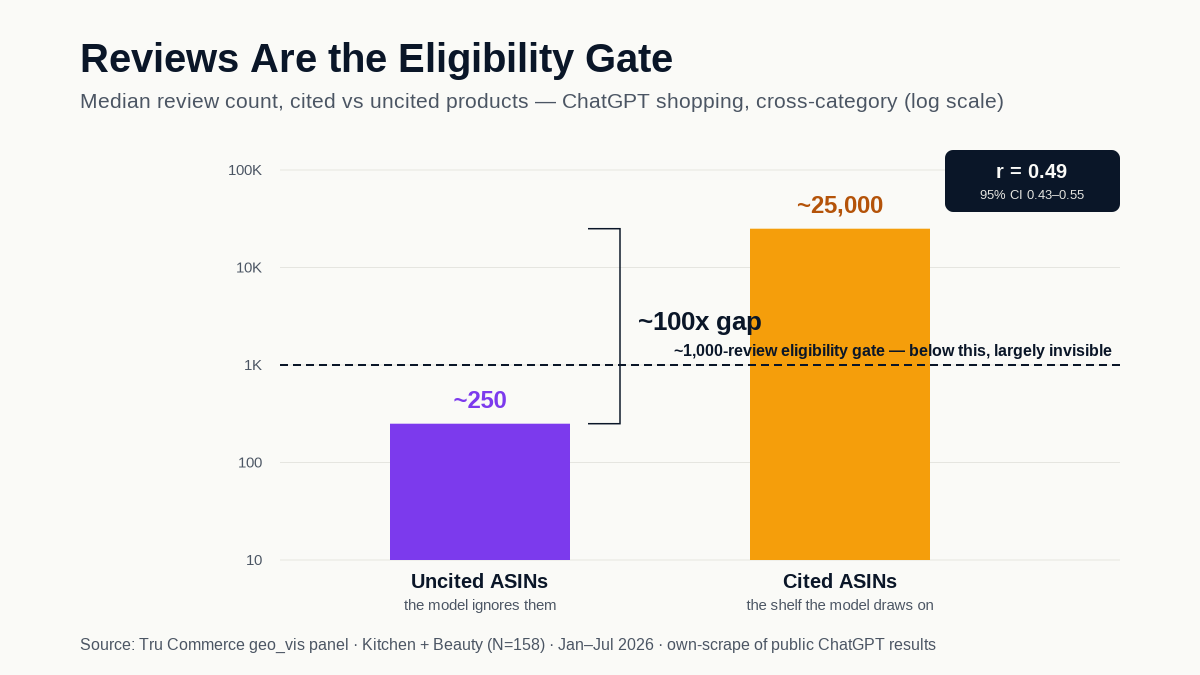
Review count is the strongest single predictor of whether a product gets cited in ChatGPT shopping answers (r = 0.49). The products the model cites carry a median of ~25,000 reviews; the ones it ignores sit around ~250 — a roughly 100x gap. Below about 1,000 reviews a product is largely invisible to the citation layer, no matter how good the listing is. Reviews are not a tiebreaker. They are the gate you cross to be eligible at all.

AI Search Visibility · Sep 4, 2026

Criteo Prompt Smart Ads: 2,000 Brands on ChatGPT and a 4x Spend Lift

Criteo was the first ad-tech partner inside OpenAI's ChatGPT ads pilot. Its Prompt Smart Ads product auto-generates creatives and context hints matched to how people actually prompt - here is what it is, the numbers behind it, and what its creative reports teach every advertiser.

Citation Rank & Share of Voice · Sep 3, 2026

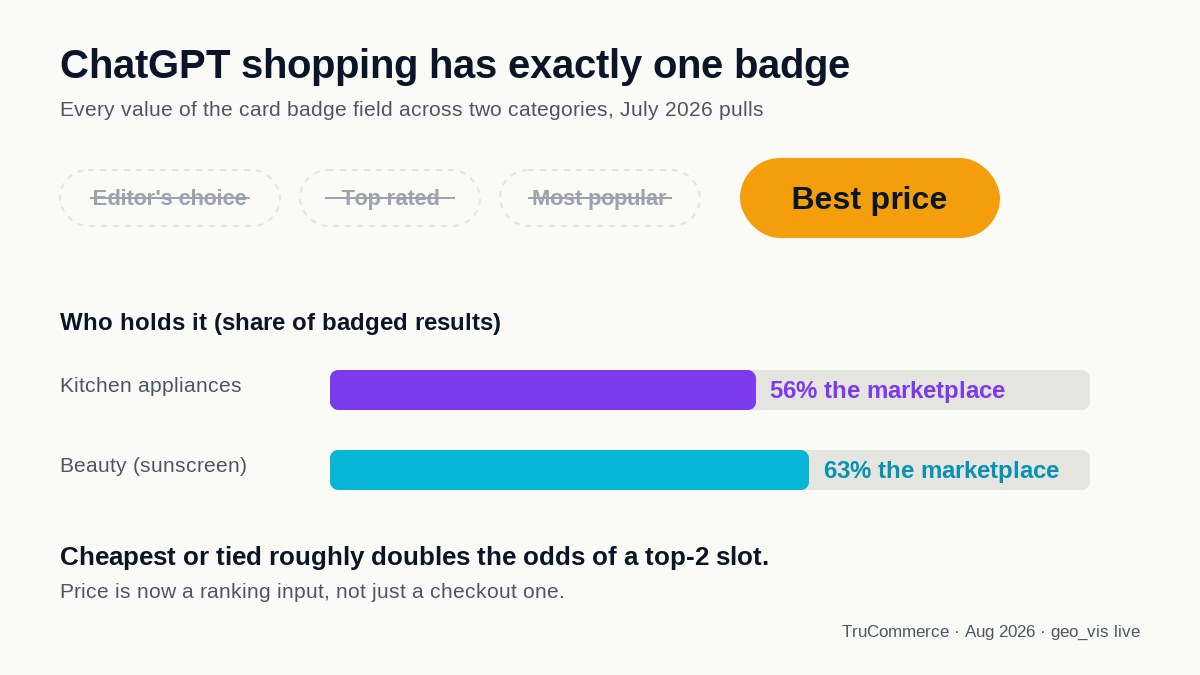
The Cheapest Product Wins — ChatGPT's Only Badge Is 'Best Price'

ChatGPT shopping ships exactly one product badge. Not Editor's choice, not Top rated — Best price. In our tracked categories the largest marketplace holds it on 56% of badged kitchen results and 63% in beauty, and holding the cheapest-or-tied offer roughly doubles a product's odds of a top-2 slot. Price has quietly moved from a conversion lever to a distribution lever: the model compares every offer before the shopper sees any of them. Here is the live data, the mechanism, and what a repricing strategy that stops at the buy box is missing.

Citation Rank & Share of Voice · Sep 1, 2026

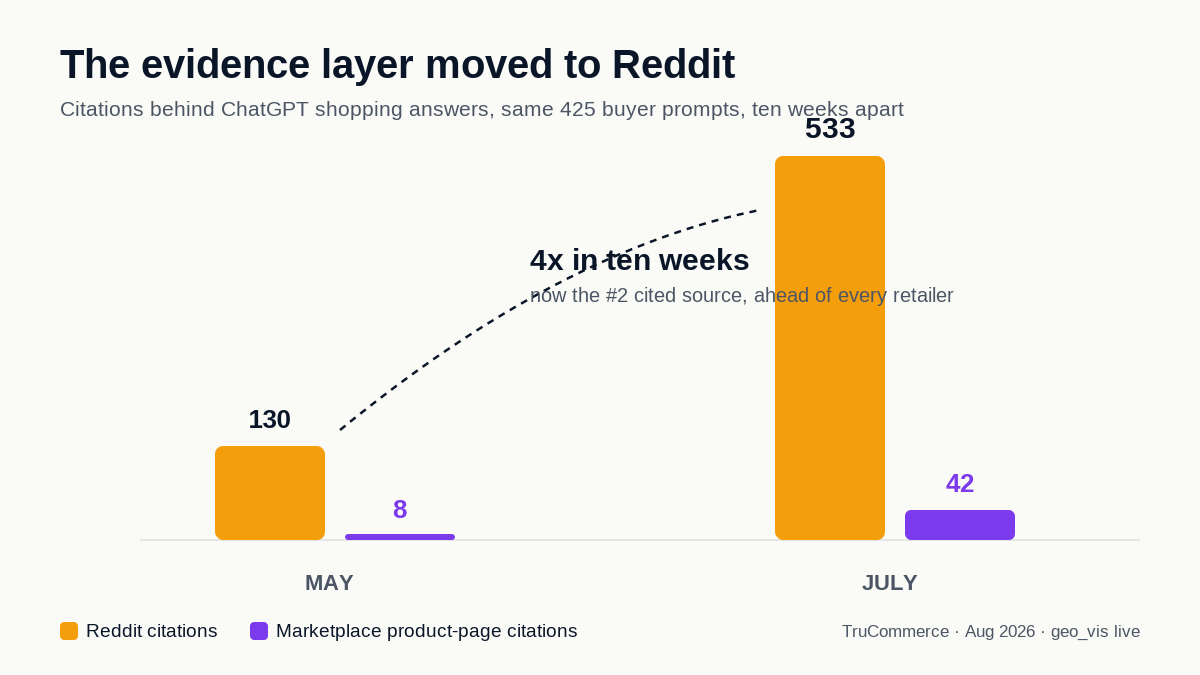
Reddit Is the New PDP — Where AI Shopping Actually Gets Its Evidence

Over ten weeks of locked-panel measurement, Reddit citations in ChatGPT shopping answers grew 4x to become the #2 cited source in the category — ahead of every retailer. Product pages, including the marketplace's own, stayed under 1 source in 25. The page you control most is the page the model trusts least. Here is the data on where the evidence layer actually lives, why threads beat product pages, and what a brand can do about a layer it cannot buy.

AI Search Visibility · Aug 29, 2026

ChatGPT Ads by Industry: Which Categories Fit, Ranked

Not every industry belongs on ChatGPT ads yet. We rank seven categories by conversational fit and economics, from DTC ecommerce at the top to the ones that should wait, with a full playbook linked for each.

Subscribe

Get the issue Monday morning.