
The Breadcrumb Myth — Category Path Is Hygiene, Not Leverage
One of the most repeated theories in AI shopping is that a 'wrong' category breadcrumb quietly suppresses your citations. We tested it on a locked panel and the theory collapsed: the odds ratio between breadcrumb-correctness and being cited was 1.0, with a Fisher's exact p of 1.0 — no association at all. Correct categorization is basic hygiene. It is not a visibility lever. Here is the test, why the intuition is wrong, and the three levers that actually move the needle.
Viren Inaniyan · September 15, 2026 · Citation Rank & Share of Voice
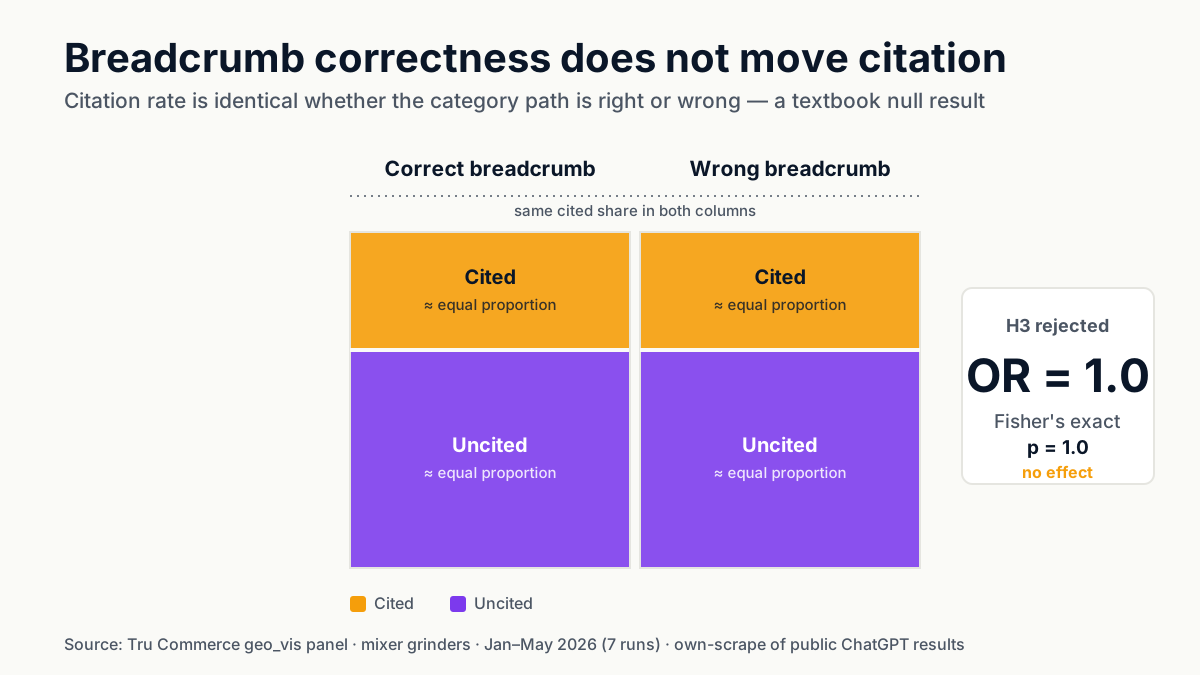
One of the most repeated theories in AI shopping is that a "wrong" category breadcrumb quietly suppresses your citations — that if the model sees your product filed under the wrong tree, it stops trusting you. We tested it on a locked panel, and the theory collapsed. The odds of being cited were the same whether the breadcrumb was right or wrong: odds ratio 1.0, Fisher's exact p = 1.0. No association at all. Correct categorization is hygiene worth doing. It is not a visibility lever — and mistaking one for the other costs you the levers that are.
A catalog operations lead at a marketplace seller asked us recently, half-apologetically, whether their AI visibility problem was "just" a categorization issue — a few hundred SKUs filed under a loose or legacy category tree, quietly being punished for it. It is a reasonable worry, and it is one of the most common we hear, because it feels mechanical and fixable. The honest answer is the one we could only give because we had measured it: the breadcrumb is almost certainly not your problem, and the weeks you would spend re-filing the catalog are weeks not spent on the things that are.
This is the fourteenth piece in our Winning in AI Visibility with Amazon series, built on the same measurement spine as the rest: a locked panel of 425 real buyer prompts (mixer grinders) re-run monthly against ChatGPT's shopping surface and stored in our geo_vis schema. When a claim in this series survives that panel, we say so; when it dies on it, we say that too. This one dies.
The test that killed the theory
We stated the folklore as a formal hypothesis — call it H3: a product filed under the wrong category breadcrumb is less likely to be cited. Then we cut the panel two ways. For each product we recorded whether its category path was correct or wrong, and whether it was cited in the answer. That gives a 2×2 contingency table — cited versus uncited, by correct versus wrong breadcrumb — and a clean statistical test of whether the two are related.
| Hypothesis | Verdict | Statistic |
|---|---|---|
| H3 · Wrong breadcrumb → uncited | ❌ Rejected | Odds ratio = 1.0, Fisher's exact p = 1.0 |
| H1 · More reviews → cited | ✅ Supported | r = 0.49, CI [0.43, 0.55] |
| H9 · Citation rate varies by product type | ✅ Supported | Cramér's V = 0.55 |
An odds ratio of 1.0 means the odds of being cited are identical in both columns. A Fisher's exact p of 1.0 means there is no evidence whatsoever of an association — this is about as flat a null result as a test can return. Whatever decides which products ChatGPT cites, the category breadcrumb is not detectably part of it.
Two qualifications keep this honest. First, an absence of effect at this sample size is not a mathematical proof that the effect is exactly zero everywhere, in every category, forever; it is strong evidence that in a high-competition category, tested cleanly, there is nothing there to find. Given the theory was being sold as a primary lever, "no detectable effect at all" is the finding that matters. Second — and this is the part people skip — hygiene and leverage are different questions. A correct breadcrumb still helps a marketplace's own on-site browse and search, its filtering, and keeping a listing in the right shelf and eligible. Our test says the breadcrumb does not move AI citation. It does not say the breadcrumb is worthless. Do it. Just don't expect it to buy you visibility.
Why the intuition is wrong
The theory feels right because it borrows from an older mental model: classic search, where taxonomy and structured metadata were genuine ranking inputs. In that world, filing a product correctly helped a crawler understand and rank it. So it seems natural that an AI would behave the same way, only more so.
But that is not how the shopping surface retrieves. When a shopper asks "which mixer survives daily idli batter," the model does not walk your category tree looking for a correctly filed appliance. It rewrites the question into plain use-case language and then pulls comparative, experience-dense text that answers it — reviews, buying guides, community threads — and assembles a recommendation from that. Your breadcrumb is a piece of internal catalog metadata the shopper never sees and the retrieval step barely touches. The evidence the model cites lives outside your listing entirely, which is the whole argument of our two-layer model: what gets recommended and what gets cited are decided in different places, and the category field sits in neither of the places that decide.
There is a live temptation to over-manage the PDP right now precisely because the platform keeps tightening it — the mid-2026 move to constrain listing-title length is the visible example. When your controllable fields shrink, every remaining field starts to feel load-bearing. The breadcrumb is the clearest case where that instinct misfires: it is fully under your control, which is exactly why it is so tempting to believe it must matter, and exactly why it is easy to waste a quarter on it.
What actually moves the needle
If the breadcrumb is a dead lever, here are the live ones — each one measured on the same panel, each one written up in this series.
Eligibility comes first. The scarce, high-value event is being cited at all. When a retailer product page is cited, it wins the top card 86.03% of the time — the highest hit rate of any content type we measure. The bottleneck is not ranking once cited; it is clearing the eligibility gate. The strongest predictor of clearing it is review depth: cited products carried a median of roughly 25,000 reviews against roughly 250 for uncited ones (r = 0.49). That is the real version of the story people tell themselves about the breadcrumb — a listing-level factor that genuinely gates citation — and we walk through it in Reviews Are the Eligibility Gate and the broader 86% rule on eligibility.
Price is the biggest single ranking lever. Being cheapest-or-tied roughly doubles a product's odds of a top-2 slot — 51.1% versus a baseline around 25% — the largest single-lever effect in our data. On a surface whose only badge is "Best price," price has quietly moved from a checkout lever to a distribution one. That is the subject of The Cheapest Product Wins.
The evidence lives in the conversation, not your catalog. Over ten weeks, Reddit citations grew to make Reddit the #1 cited domain in the category, while amazon.in fell out of the top 20 cited sources — even as its buy links stayed on more than 60% of shopping cards. The model justifies its picks from community threads and buying guides, which is why Reddit is the new PDP. No amount of re-filing your category tree touches that layer.
Put plainly: reviews decide whether you can be cited, price decides whether you rank once you are on the shelf, and the evidence layer decides how the model justifies recommending you. The breadcrumb decides none of the three.
What it means for marketplaces and for D2C brands
If you sell on a marketplace, run categorization as maintenance, not as an AI-visibility project. Keep it correct — it earns its keep in on-site browse and filtering — but do not put it on the visibility roadmap, and do not let a "fix the categories" initiative crowd out review-building, availability, and price discipline. When you audit a catalog for AI visibility, the category field is a checkbox, not a chapter. Track your citation rank and share of voice against a locked prompt set instead, and let the data name the lever.
If you run a D2C brand, the same discipline applies with an extra trap. Your own site's taxonomy and your marketplace listings' categories feel like the most improvable thing you own, because you own them completely. That control is seductive and mostly beside the point. The model is reading third-party threads and guides about your category and comparing your price against every offer of your product it can find. Spend where the model actually looks.
What not to do
Do not launch a catalog-wide re-categorization sprint in the name of AI visibility. It is expensive, it is slow, and our data says it buys you nothing on the citation layer. Do not let a vendor sell it to you as a primary lever — H3 is exactly the kind of intuitive-but-false claim that survives in decks because nobody tested it against a locked panel. And do not confuse the two questions: "is my catalog filed correctly?" and "why isn't the model citing me?" are different questions with different answers, and answering the first does not answer the second.
The measurement habit
The reason we can say any of this with a straight face is that we stated the theory as a hypothesis and let a locked prompt set decide it, rather than reasoning from what feels mechanical. That is the whole habit: write down the claim, define the cut, re-run it on a consistent panel with a stated denominator, and be willing to publish the null. A one-off audit that "fixed the categories" and saw visibility drift upward for unrelated reasons would have confirmed the myth forever. The panel is what tells you the arrow you drew was never connected to the outcome.
If you want that discipline pointed at your own catalog — the real levers separated from the folklore, on your categories and your prompts — book a demo.
The breadcrumb is worth getting right for the same reason a tidy stockroom is worth having. Just don't mistake tidiness for traction.
Next in the series: The AI Re-Crawl Lag — why your PDP fix takes weeks to surface, and why you should measure propagation, not the edit.
FAQ
In our locked-panel test there was no measurable effect. The odds of being cited were identical whether the category breadcrumb was correct or wrong (odds ratio 1.0, Fisher's exact p = 1.0). Correct categorization is worth doing, but treat it as hygiene, not as a way to win AI citations.
No. A correct breadcrumb still matters for a marketplace's own on-site browse and search, for filtering, and for keeping a listing eligible and in the right shelf. It just isn't the lever that decides whether ChatGPT cites or recommends you. Do it as basic maintenance and spend your effort on the levers that move.
Three things, in order of leverage: eligibility (enough reviews and reliable availability so you can be cited and recommended at all), price competitiveness (cheapest-or-tied roughly doubles top-2 odds), and presence in the evidence layer — the community threads and buying guides the model actually cites.
Sources
Continue reading
October 12, 2026
How a Claude shopping agent picks products
Anthropic ships no ranking layer. A Claude for Commerce shopping agent reads compact catalog rows of 70 to 120 characters that the merchant's own search returns, adds only server-issued ids to the cart, and never sees the checkout URL. Claude in Chrome reads the page and asks before buying. What is documented, what is not, and who filled the gap.
October 12, 2026
Claude commerce agents: what a merchant has to build
Anthropic's blueprint of 2 September 2026 hands a merchant's engineers a shopping agent, a merchant agent and an 11-method backend contract, and leaves payments, authorization, ranking and fraud to the deployment. The three runtime paths, where MCP enters, Shopify's UCP implementation, and what to build first.
October 12, 2026
Claude for Commerce explained: what Anthropic shipped
Anthropic published its commerce agents blueprint on 2 September 2026: a shopping agent and a merchant agent as open-source reference code, payment left to the merchant. What shipped, who is named, what the 35% figure describes, and what is still missing.