
Reviews Are the Eligibility Gate — You Don't Get Cited Until You Cross the Threshold
Review count is the strongest single predictor of whether a product gets cited in ChatGPT shopping answers (r = 0.49). The products the model cites carry a median of ~25,000 reviews; the ones it ignores sit around ~250 — a roughly 100x gap. Below about 1,000 reviews a product is largely invisible to the citation layer, no matter how good the listing is. Reviews are not a tiebreaker. They are the gate you cross to be eligible at all.
Viren Inaniyan · September 8, 2026 · Citation Rank & Share of Voice
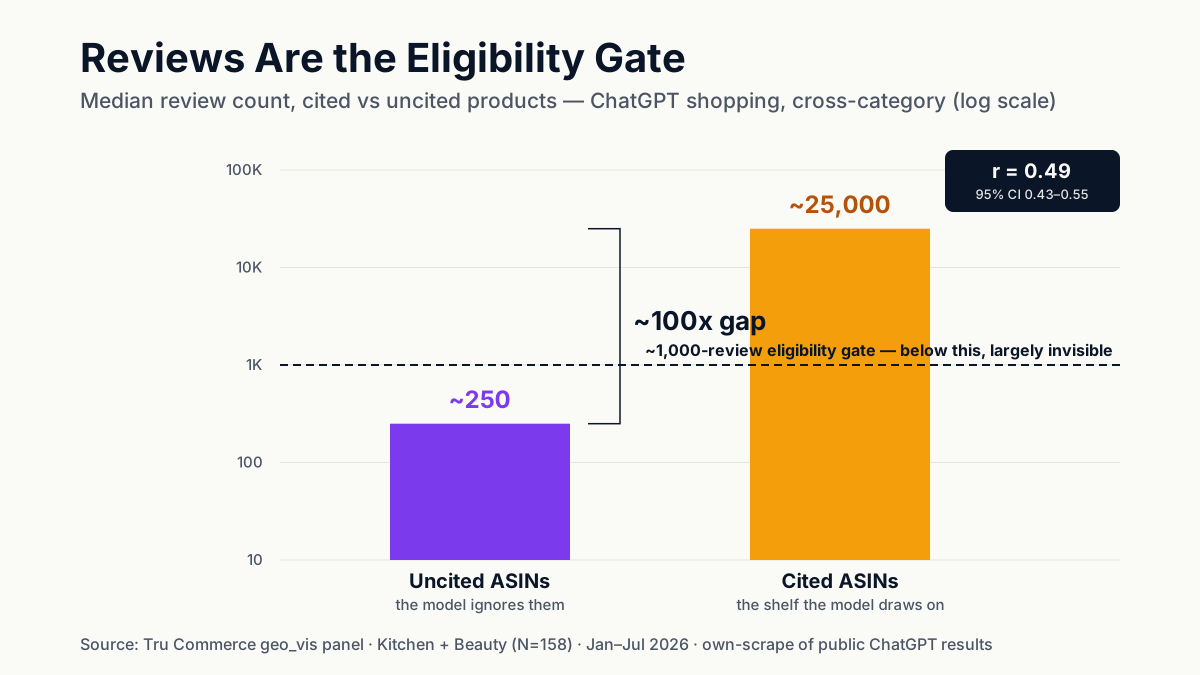
Every optimization guide treats reviews as a conversion lever — social proof that nudges an undecided shopper. In AI shopping they do something earlier and harder. Review count is the strongest single predictor of whether ChatGPT cites a product at all: a correlation of r = 0.49, with the cited shelf carrying a median of ~25,000 reviews against ~250 for the products the model ignores. That is not a tiebreaker. That is a gate, and most products are on the wrong side of it.
A brand manager at a mid-market appliance company asked us, half-frustrated, why a product they were proud of — good specs, clean listing, competitive price — simply never surfaced in ChatGPT's recommendations while an older, blander competitor did. We pulled both products' review counts on the call. Theirs: a few hundred. The competitor's: tens of thousands. That single number explained more than the rest of the audit combined.
This is the sixth piece in our Winning in AI Visibility with Amazon series, built on the same measurement spine as the rest: a locked panel of 425 real buyer prompts (mixer grinders) re-run monthly against ChatGPT's shopping surface and stored in our geo_vis schema, plus a cross-category expansion into beauty used specifically to test which levers hold up when you change the category underneath them.
The number: reviews predict citation
To separate real levers from folklore, we ran a falsification test across two very different categories — kitchen appliances and beauty — starting at N=50 products and re-running at N=158. Five hypotheses went in. The one about reviews came out the strongest.
The correlation between an ASIN's review count and whether ChatGPT cites it is r = 0.49, with a 95% confidence interval of 0.43 to 0.55. For a single, noisy, real-world signal measured across two unrelated categories, that is a large and stable effect. It survived the category swap, which is exactly the test most "optimization tips" fail.
The medians make it concrete:
| Group | Median review count | What the model does |
|---|---|---|
| Cited ASINs | ~25,000 | Treated as a citable, recommendable option |
| Uncited ASINs | ~250 | Largely absent from the recommendation set |
| Gap | ~100x | The distance between the two shelves |
A roughly hundred-fold gap in review depth separates the products the model draws on from the products it passes over. And the practical reading of the distribution is blunt: below about 1,000 reviews, a product is largely invisible to the citation layer — regardless of how good the listing, the price, or the imagery is. Above it, other signals start to matter. Below it, they mostly don't get a chance to.
Why it behaves like a gate, not a dial
The instinct is to read a correlation as a dial — more reviews, proportionally more visibility, all the way up. The data reads more like a threshold with a long flat floor. Under ~1k reviews, adding a few hundred more changes almost nothing. Cross the threshold and the product becomes eligible for everything else — price, evidence, position — to act on.
The mechanism is retrieval, not vanity. When ChatGPT assembles a shopping answer, it is choosing which products it can stand behind and which sources justify them. Review depth is the single cheapest proxy a model has for "this product is real, established, and low-risk to recommend." A product with 25,000 reviews has a settled reputation the model can compress into a recommendation; a product with 250 is statistically indistinguishable from a launch that might be a mistake. The model is not rewarding the reviews themselves. It is using them as a confidence signal about the product behind them — and confidence is what gates whether a product is safe to name at all.
This is why review depth sits upstream of the levers we have covered earlier in this series. It is the eligibility test that runs before ranking begins.
The two-layer picture: reviews gate, price ranks
This piece is the eligibility half of a story whose ranking half we have already told. In the two-layer model we separated placement (what gets recommended) from citation (what gets attributed). Review depth is the clearest determinant of the citation layer we have measured — it decides whether the model treats you as evidence-worthy at all.
And eligibility, not ranking, is where the scarcity is. Our 86% Rule finding is the other half of this coin: once a retailer product page is cited, it wins the top card roughly 86% of the time — the highest hit rate of any content type on the surface. Read the two findings together and the strategy writes itself. Winning position once you're on the shelf is nearly automatic. Getting onto the shelf is the hard part, and review depth is the gate that decides it.
Contrast that with the lever from the previous piece: price. Being the cheapest-or-tied offer roughly doubles a product's odds of a top-2 slot — a huge effect, but a ranking effect. Price sorts the products that are already eligible. Reviews decide who is eligible to be sorted. A razor-sharp price on a 200-review listing still loses, because it never clears the gate. The order of operations matters: cross the eligibility threshold first, then compete on price and evidence.
What this means if you sell on marketplaces
The uncomfortable part is that review depth is the slowest lever in this entire series to move. You cannot reprice your way across it overnight the way you can with the Best-price badge, and you cannot seed it in a few weeks the way community evidence can be seeded. It compounds, or it doesn't.
Which is precisely why it is worth budgeting for as infrastructure rather than treating as a byproduct:
Instrument review depth as a visibility metric, not a CX one. Most teams watch star rating and ignore review count, because rating drives conversion and count doesn't obviously do anything. In AI shopping, count is the eligibility variable. Track it per hero ASIN against the ~1k threshold, and treat crossing it as a visibility milestone.
Run a legitimate review-generation program. Post-purchase follow-up, packaging inserts that ask honestly, verified-buyer flows, proactive support that converts a good experience into a written one. None of it is clever; all of it compounds. This is the lever competitors find hardest to copy because it cannot be bought.
Consolidate demand behind fewer canonical products. Splitting sales across many thin variants splits review depth too, and thin listings never clear the gate. Concentrating your best product's reviews onto one canonical page does more for eligibility than perfecting five listings that each sit under a thousand.
What this means if you run a D2C brand
For a D2C brand the gate is steeper, because your own storefront almost never carries marketplace-scale review depth. Your .com might have a few hundred reviews on its bestseller; the marketplace listing of the same product might have twenty thousand. The model sees both, and the review-depth signal points at the marketplace, not at you.
Two implications follow. First, your marketplace presence is not a distribution afterthought — for AI eligibility it may be your strongest asset, because that is where your review depth actually lives. Second, the reviews scattered across your channels are an asset you are probably fragmenting. Every place your product is sold accumulates its own shallow pool; none of them crosses the gate alone. Knowing where your review depth is concentrated, and steering demand to reinforce it rather than dilute it, is now a visibility decision, not just a merchandising one.
What not to do
Do not try to buy the gate. Incentivised reviews, review swaps, and outright fakes violate marketplace policy, and detection is both aggressive and improving. The downside is not just removal of the fake reviews — it is suppression of the listing, which is the opposite of eligibility.
And do not mistake the threshold for a target to game. The ~1k figure is where invisibility ends, not where you stop. The cited shelf's median is ~25,000 for a reason: the products the model trusts most are the ones with reputations too deep to fake. The honest, slow program is the only one that reaches that shelf — and the fact that it is slow is the whole reason it is defensible once you are there. This is the lever your competitor cannot copy next quarter.
One qualification keeps this honest. Review depth is the strongest single predictor of citation we measure, but it is not the only gate. In the same cross-category test, product category itself set a hard ceiling — some categories are cited 15–20x more readily than others, independent of any individual listing's reviews. Reviews get you eligible within a category. They cannot lift you into a category the model has structurally decided to under-cite. That interaction is the subject of a later piece.
The measurement habit
The discipline is the same one that runs through this whole series: a locked prompt set for your category, re-run on a schedule, with the results joined back to product-level attributes. For this lever, join your cited-versus-uncited outcome to each product's review count and watch two things — the gap between your cited and uncited medians, and how many of your hero ASINs sit below the ~1,000 threshold. The first tells you whether reviews are gating you specifically. The second is a to-do list ranked by how close each product is to becoming eligible at all. If you want that measured against your own catalog rather than our panel, book a demo and we will run your ASINs through it.
Reviews are the least glamorous lever in AI visibility and the hardest to fake, which are the same fact stated twice. The badge is a quarter's work. The evidence layer is a season's. Review depth is a reputation's — and it is the gate everything else waits behind.
Next in the series: Out-of-Stock Is an Invisibility Switch — how a single availability lapse silently deletes a product from AI answers, and why availability beats cleverness.
FAQ
In our cross-category measurement the products ChatGPT cites carry a median of about 25,000 reviews, while the ones it skips sit around 250. The practical threshold is roughly 1,000: below it, products are largely invisible to the citation layer no matter how well the listing is built. There is no exact cutoff the model publishes, but review depth is the strongest single predictor we measure (r = 0.49).
Mostly whether you appear. Review count gates eligibility — whether the model treats your product as a citable, recommendable option at all. Once a product is in the answer, position is decided by other signals, chiefly price competitiveness. Reviews get you onto the shelf; price and evidence decide where you sit on it.
No — and you shouldn't try. Fake or incentivised reviews violate marketplace policy and platform detection is aggressive. Review depth is earned slowly, which is exactly why it is defensible: it is the hardest lever in this series for a competitor to copy. Treat a reviews program as multi-quarter infrastructure, not a campaign.
Sources
Continue reading
October 12, 2026
How a Claude shopping agent picks products
Anthropic ships no ranking layer. A Claude for Commerce shopping agent reads compact catalog rows of 70 to 120 characters that the merchant's own search returns, adds only server-issued ids to the cart, and never sees the checkout URL. Claude in Chrome reads the page and asks before buying. What is documented, what is not, and who filled the gap.
October 12, 2026
Claude commerce agents: what a merchant has to build
Anthropic's blueprint of 2 September 2026 hands a merchant's engineers a shopping agent, a merchant agent and an 11-method backend contract, and leaves payments, authorization, ranking and fraud to the deployment. The three runtime paths, where MCP enters, Shopify's UCP implementation, and what to build first.
October 12, 2026
Claude for Commerce explained: what Anthropic shipped
Anthropic published its commerce agents blueprint on 2 September 2026: a shopping agent and a merchant agent as open-source reference code, payment left to the merchant. What shipped, who is named, what the 35% figure describes, and what is still missing.