
The Variant-Fragmentation Myth — Consolidating Listings Can Hurt Your AI Visibility
One of the most repeated PDP recipes says merge your color, size, and pack variants onto a single listing to concentrate authority. In our locked-panel data, consolidation ran the wrong way: the more variants a brand collapsed onto one listing, the lower its AI citation rate (Spearman ρ = −0.44 to −0.48). The tidy hypothesis that fewer listings win was disproven across 158 ASINs. Here is the data, the honest correlational caveat, and the reframed play — promote one canonical variant instead of collapsing everything.
Viren Inaniyan · September 15, 2026 · Citation Rank & Share of Voice
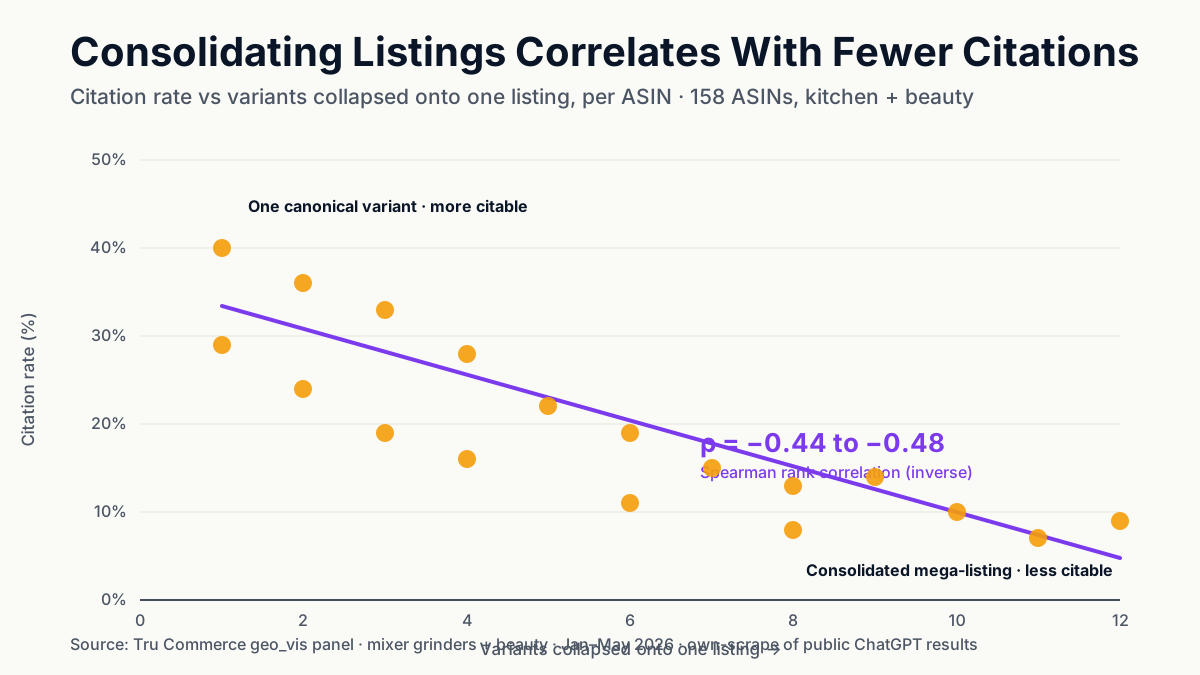
One of the most repeated product-page recipes says merge your variants — colors, sizes, pack counts — onto a single listing to concentrate authority. We ran that recipe as a formal hypothesis against a locked measurement panel, and it failed. The more variants a brand collapsed onto one listing, the lower its AI citation rate. This is the data on why "fewer, consolidated listings win" is backwards for AI shopping, the honest caveat that keeps it from being overclaimed, and the reframed play that actually works.
A catalog lead at a D2C brand asked us recently whether they should follow the standard advice and consolidate their fragmented variant listings before pushing into AI shopping — "one strong page instead of twelve weak ones." It is a reasonable instinct, and it is what nearly every marketplace-SEO guide recommends. It is also, on our data, the wrong move for the thing they were trying to fix.
This is the thirteenth piece in our Winning in AI Visibility with Amazon series, built on the same measurement spine as the rest: a locked panel of 425 real buyer prompts (mixer grinders) re-run monthly against ChatGPT's shopping surface and stored in our geo_vis schema, plus a cross-category expansion into beauty for the falsification tests below.
We tested the recipe as a hypothesis — and it broke
Most "best practice" survives because nobody measures it. We had a locked panel and a citation graph, so we could turn the consolidation recipe into a testable claim: the more you consolidate variants onto one listing, the more likely that listing is to be cited. We labelled it H5 and ran it.
It did not survive. The relationship between how many variants a brand collapses onto a single listing and that listing's citation rate came back inverse — Spearman ρ = −0.44 to −0.48, holding across a re-run that expanded the sample to 158 ASINs spanning kitchen and beauty. The tidy hypothesis predicted a positive slope. The data drew a negative one.
| Hypothesis (H5) | Prediction | Verdict | Statistic |
|---|---|---|---|
| Consolidating variants onto one listing lifts citation | positive correlation | Disproven — inverse | ρ = −0.44 to −0.48 |
| Sample | — | kitchen + beauty | 158 ASINs |
Two things are worth saying plainly before anyone over-reads that number. First, ρ around −0.46 is a real, moderate relationship — not noise, not a rounding artifact — and it points the opposite way to the folklore. Second, it is a correlation, and correlation is exactly where this kind of advice usually goes to die of overconfidence. We will hold that caveat open rather than close it.
Why the tidy story is wrong: the model reads at the variant level
The consolidation recipe is inherited from classic SEO, where merging thin pages concentrates link equity onto one URL that then ranks. That mental model assumes the ranking system resolves everything up to a single parent page and judges that.
AI shopping does not work that way. OpenAI's shopping surface ranks on per-offer feed identifiers — it sees each variant as its own candidate, not as a child folded under a parent you have tidied. There is no "authority" flowing up to a consolidated listing to be concentrated. There is a set of individual surfaces, and the question the retrieval system asks about each one is narrow: is this specific thing citable?
That is where consolidation quietly costs you. Citation is gated by signals that live on the surface being cited — chiefly review depth and product-type fit, which we covered in the 86% rule. When you collapse a dozen variants onto one parent, you are not concentrating a citation signal; you are, at best, leaving it unchanged and, at worst, blending strong and weak variants into a single surface whose evidence reads as muddier than the sharpest variant would on its own.
Eligibility is the scarce thing consolidation spends
The reason this matters more in AI shopping than it did in search is the shape of the funnel. When a retailer product page is cited at all, it wins the top card 86.03% of the time — the highest rank-1 hit rate of any content type we measure. Getting cited is the hard, scarce, decisive step; ranking once cited is nearly automatic.
So the number of your surfaces that are eligible to be cited is not a housekeeping detail — it is the whole game. Any move that reduces your count of citable, review-dense surfaces is expensive precisely because each surviving surface has to clear the same eligibility bar alone. Consolidation reduces that count by design. That is the mechanism behind the negative slope: fewer independent shots at the eligibility gate, on surfaces that are no easier to cite than before.
And you cannot lean on placement volume to cover the gap. As we showed in the two-layer model, amazon.in appears as a buy-link on 61.48% of shopping cards while supplying only 0.78% of all citations. Being everywhere in the placement layer does nothing for the citation layer that consolidation actually touches. The citation graph is a separate scoreboard, and it is the one consolidation plays on.
The honest caveat: this is correlational
Here is the qualification that keeps this piece from being just another confident recipe pointed the other way.
We measured a correlation, not a controlled experiment. The most likely confound is one we have documented elsewhere in this series: reviews are the real eligibility gate (H1, r = 0.49; cited ASINs carry roughly 25,000 median reviews versus about 250 for uncited ones). Mature, established products often sit on a single clean variant and carry deep review counts — so a single-variant, heavily-reviewed listing may get cited because of the reviews, with the low variant count merely coming along for the ride. In that reading, consolidation is not causing anything; review depth is doing the work and variant count is a passenger.
We take that seriously, and it changes the instruction we give. We are not telling you to shatter a listing into a dozen fragments and expect citations to climb — nothing in the data promises that, and the reverse-causation risk is real. What the data does justify is the narrower, safer claim: consolidation is not the visibility lever it is sold as. If your reason for merging variants is conversion, catalog hygiene, or ad efficiency, fine — those are legitimate. Just do not do it for AI visibility, because on our measurement it trends the wrong way and, at best, does nothing.
What to do instead: promote one canonical variant
The reframe is not "fragment everything." It is promote one canonical variant.
Pick the single variant that best represents the product — the most-reviewed, most-searched, cleanly specified one — and make that surface the one you feed, keep in stock, and point demand at. You get the review concentration the consolidation story promised, on a real citable surface the model can actually resolve, without collapsing your other variants into a blended parent whose evidence reads muddy.
If you sell on marketplaces: stop treating variant consolidation as an AI-visibility task. Identify your canonical variant per product, verify it clears the review threshold, and track its citation rate on a locked prompt set. Let merchandising decide the rest.
If you run a D2C brand: the same logic applies to your own catalog architecture and your feeds. A single strong PDP per product, richly reviewed and cleanly specified, beats both a bloated all-in-one page and a scatter of thin duplicates. Feed the model one clear answer per product.
What not to do: do not consolidate variants and log it as an AEO win — you will have spent your eligible-surface count on a move that our data says trends against citation. And do not swing to the opposite error and fragment for its own sake; the finding is correlational, and fragmentation buys you nothing on its own. The point is a canonical surface, not a count of surfaces.
This is also a reminder that inherited PDP recipes need re-testing for the AI surface, not porting wholesale. The category-breadcrumb rule met the same fate in our tests — the "wrong category" theory turned out to be hygiene, not leverage (H3, odds ratio 1.0). Two of the most-cited "fix your PDP" levers, on measurement, do not move citation at all.
The measurement habit
Same discipline as the rest of this series. Turn your own best practices into hypotheses, then run them against a locked prompt set with a stated denominator and watch the citation rate per surface, not the neatness of your catalog. Consolidation is easy to justify in a slide and easy to falsify in a panel — and the panel is the only one of those two that the model reads. If you want to see whether a recipe helps your category before you rebuild your listings around it, that is exactly what our citation-rank tracking is for. Book a demo and bring the recipe you were about to follow.
The best PDP practices of the click era were written for a system that resolved everything up to one page. AI shopping resolves down to each variant. Test the recipe before you trust it — this one pointed backwards.
Next in the series: The Breadcrumb Myth — why the "wrong category" theory is hygiene, not leverage.
FAQ
Our data does not support it. We tested variant consolidation as a formal hypothesis against a locked prompt panel and found the opposite of the expected effect — the more variants a brand collapsed onto a single listing, the lower that listing's citation rate (Spearman ρ = −0.44 to −0.48). Consolidation is a merchandising and conversion decision; treat it as neutral-to-negative for citation, not as a visibility lever.
No. The finding is correlational, not a licence to fragment. The workable play is to promote one canonical variant — a single, well-reviewed, cleanly specified surface the model can cite — rather than either collapsing everything onto one parent or scattering thin duplicates. One clear citable page beats one crowded one.
Because AI shopping reads at the variant level, not the parent level. OpenAI's shopping surface ranks on per-offer feed identifiers, so it sees each variant as its own candidate. And citation is gated by review depth and product-type fit, not by how neatly a catalog is nested — so merging variants can dilute the review signal on the surface that actually gets cited.
Sources
Continue reading
October 12, 2026
How a Claude shopping agent picks products
Anthropic ships no ranking layer. A Claude for Commerce shopping agent reads compact catalog rows of 70 to 120 characters that the merchant's own search returns, adds only server-issued ids to the cart, and never sees the checkout URL. Claude in Chrome reads the page and asks before buying. What is documented, what is not, and who filled the gap.
October 12, 2026
Claude commerce agents: what a merchant has to build
Anthropic's blueprint of 2 September 2026 hands a merchant's engineers a shopping agent, a merchant agent and an 11-method backend contract, and leaves payments, authorization, ranking and fraud to the deployment. The three runtime paths, where MCP enters, Shopify's UCP implementation, and what to build first.
October 12, 2026
Claude for Commerce explained: what Anthropic shipped
Anthropic published its commerce agents blueprint on 2 September 2026: a shopping agent and a merchant agent as open-source reference code, payment left to the merchant. What shipped, who is named, what the 35% figure describes, and what is still missing.