
The Broken Carousel — AI Shopping Is Half-Built in Beauty, and That's the Opening
In a young AI-shopping category, the shelf itself is broken before ranking ever matters. In April, 97.9% of sunscreen cards in our locked panel had no working buy-link, and the links that did resolve pointed at obscure cross-border dropshippers, not the largest marketplace. By July the shelf had healed to 2.7% broken and the marketplace rode 69% of cards. The first battle in an emerging category is not citation or ranking — it is the data integrity of the carousel, and it is winnable right now.
Viren Inaniyan · September 12, 2026 · Vertical Playbooks
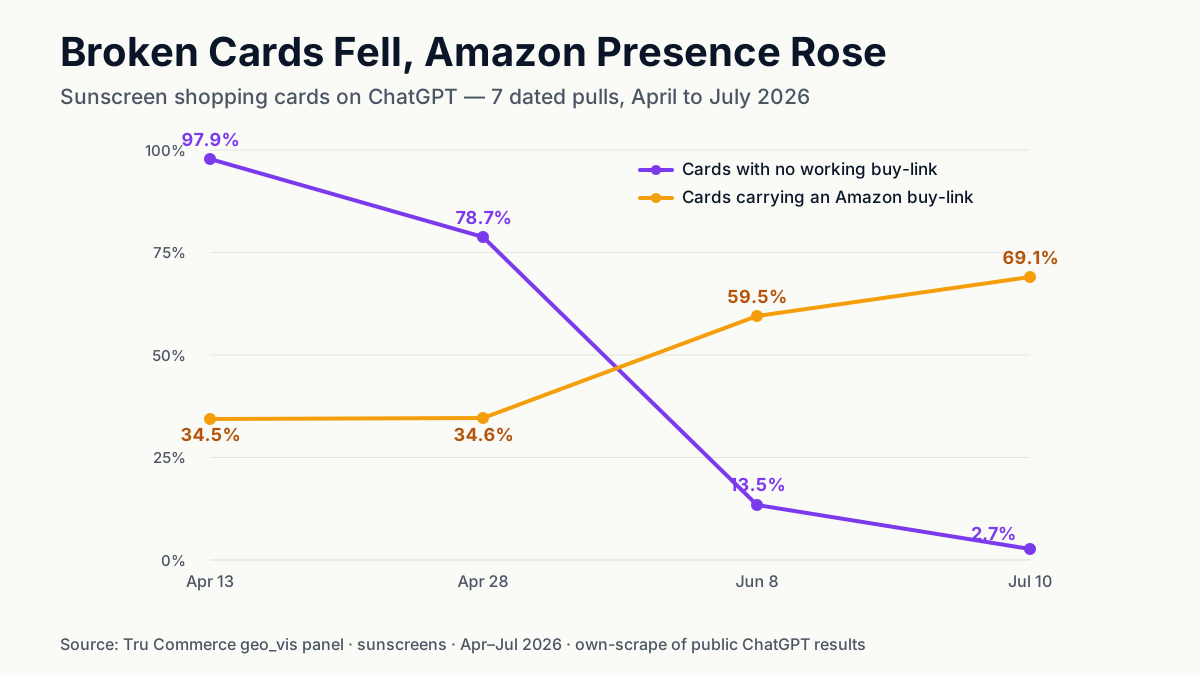
In a young AI-shopping category the shelf breaks before ranking ever matters. In our first sunscreen pull, 97.9% of the product cards ChatGPT rendered had no working buy-link — the marketplace name was present, the link was null — and the links that did resolve pointed at obscure cross-border dropshippers rather than the largest marketplace. Three months later the shelf had healed: 2.7% broken, and the marketplace riding 69% of cards. The lesson beauty teaches is that the first battle in an emerging category is not citation and not ranking. It is the data integrity of the carousel itself — and that is precisely the opening.
A beauty founder asked us on a call recently why ChatGPT kept surfacing their sunscreen next to sellers they had never heard of, on links that half the time went nowhere. "Is the model broken, or are we?" Neither, exactly. The category is young, the shelf underneath the answer is half-built, and that is a very different problem from the one mature categories have. This piece is the data on what a half-built shelf looks like, why it happens, and why it is the cleanest opening a disciplined brand has been handed in AI shopping so far.
This is the eleventh piece in our Winning in AI Visibility with Amazon series, and it runs on the same measurement spine as the rest: a locked panel of 425 real buyer prompts (mixer grinders) re-run monthly and stored in our geo_vis schema, extended here to a beauty panel — sunscreens and sun protection — captured across seven dated pulls between April 13 and July 10, 2026, totalling 5,182 shopping cards and 45,773 citations. Beauty is where we watched a category come online in real time, and it behaves nothing like kitchen appliances did.
The carousel was broken — then it wasn't
Mixer grinders showed us a citation problem sitting on top of a healthy shelf. Sunscreens showed us a broken shelf. In the earliest pull, ChatGPT rendered product cards for sunscreens the way it always does — image, name, price, a marketplace label — but the actual buy-link was missing on almost every one.
Here is the arc, per pull, cleaned to the four dated captures that anchor it:
| Pull date | Cards | % cards with no working buy-link | % cards carrying an Amazon buy-link |
|---|---|---|---|
| 2026-04-13 | 1,430 | 97.9 | 34.5 |
| 2026-04-28 | 489 | 78.7 | 34.6 |
| 2026-06-08 | 518 | 13.5 | 59.5 |
| 2026-07-10 | 1,131 | 2.7 | 69.1 |
On April 13, 97.9% of sunscreen cards had no working buy-link. Not a wrong link — no link. The shopper was shown a product, a price and a brand, and could do nothing with any of it. This is not a ranking failure and not the citation gap we described in the two-layer model. It is carousel data integrity: the pipe that turns a product into something purchasable was simply not connected yet.
Over three months it connected. No-buy-link cards fell 97.9% → 78.7% → 13.5% → 2.7%, and as they fell, cards carrying an Amazon buy-link rose in near-lockstep, 34.5% → 69.1%. The two lines cross. A category healed in public, and we happened to be pointing a locked panel at it while it did.
Who owns the shelf while it's broken
The most instructive part is not that the shelf broke. It is who filled it while it was broken.
When the model renders a card but cannot resolve a buy-link from an authoritative feed, it back-fills from whatever feed it can resolve. On the sunscreen shelf, that meant obscure cross-border dropshippers. Counting every offer across the panel:
| Marketplace (sunscreen offers) | Offers |
|---|---|
| amazon.in | 1,301 |
| flipkart | 732 |
| distacart | 715 |
| tira | 650 |
| silkrute | 468 |
| pushmycart | 372 |
Three names most shoppers have never heard of — distacart, silkrute, pushmycart — held 1,555 offers between them, more than amazon.in's 1,301. In a healthy category the largest marketplace would not be out-offered by a trio of dropshippers. In a broken one, low-authority feeds rush the vacuum, because the model takes the buy-link it can get.
This is where the news hook matters. Our teardown of chatgpt.com/shopping found OpenAI building out a roster of direct feed partners — the merchants whose catalogues resolve cleanly into working, first-class buy-links. The largest marketplace is conspicuously not on that list. So in a category where the feed layer is still forming, the difference between a resolved buy-link and a null one comes down to feed coverage, and the sellers with the tightest coverage — even tiny ones — take the offer slot. That is not a branding problem. It is plumbing, and plumbing is fixable.
The two-layer split holds — beauty is no exception
Once the shelf healed, beauty settled into exactly the pattern kitchen taught us. The marketplace is strong in the buy-link layer and near-absent in the citation layer:
| Category | Cards | % cards w/ Amazon buy-link | Citations | Amazon citation share |
|---|---|---|---|---|
| Sunscreens | 5,182 | 36.3% | 45,773 | 1.47% |
| Moisturizers | 2,087 | 35.1% | 10,173 | 3.06% |
Roughly 35–36% placement, 1–3% citation, in both sub-categories. The marketplace wins the buy-link and is barely cited to justify it. And the citation layer belongs, as it does across this series, to community and D2C: the most-cited sunscreen domains are Google, Nykaa, The Derma Co, Reddit, Myntra, 1mg, YouTube, and a run of D2C brand sites — Mamaearth, The Deconstruct. The largest marketplace does not appear in the top fifteen at all. If Reddit is the new PDP in kitchen, in beauty it is Reddit plus a wall of D2C editorial.
That split tells a brand where to spend. Fixing the shelf — feed coverage, buy-link resolution, price parity — is what wins the placement layer. Editorial and community seeding is what wins the citation layer. They are different budgets aimed at different problems, and conflating them is how teams waste both.
Why the shelf breaks in emerging categories
The mechanism is worth stating plainly, because it predicts which categories to expect this in and when the opening closes.
A shopping card is assembled from two different sources. The description of a product — what it is, what it costs, what it looks like — the model can construct from broad web knowledge, which is abundant for any product with a marketing footprint. The transaction — a live, resolvable buy-link tied to a real offer — has to come from a structured merchant feed. In a mature category those feeds are dense and old; in a young one they are sparse and new. So the model can render a beautiful, confident card and still have nothing to link it to. It shows the product and back-fills the buy-link from the thinnest feed that resolves.
This is also why the same category can look 15–20× more citable than its neighbour: category structure sets the ceiling, a pattern we unpack in product-type determines AI-citation destiny. Sunscreen drew 4.5× the citation volume of moisturizer in the same window (45,773 vs 10,173). A brand does not get to choose whether its category is young — but it does get to choose to move first while the shelf is still forming.
Two qualifications keep this honest
First, the healing was not our doing, and we should not claim it. Feed coverage improving across a category is the marketplace's engineering and OpenAI's feed onboarding working over a quarter; our panel measured the arc, it did not cause it. What a brand controls is its own feed's coverage and parity — whether it is among the offers that resolve cleanly when the model reaches for a buy-link.
Second, the panel is not perfectly smooth. One April pull returned a zero-Amazon, low-broken-link snapshot that reads like a different region or configuration; we treat it as an outlier and exclude it from the arc above. Several pulls are small-N (74 to 518 cards) and will carry more noise than the 1,000-plus-card anchor pulls. The 97.9% → 2.7% trajectory is robust across the dated captures; the exact intermediate percentages should be read as a trend, not as decimals to bank on. Honest measurement means saying which numbers are load-bearing and which are texture — these are texture.
What to do about it
If you sell on marketplaces: treat carousel integrity as a top-line KPI, ahead of ranking. Audit buy-link resolution on a locked prompt set weekly. A card that renders your product with a null buy-link is invisible revenue, and a card that resolves to a dropshipper instead of your listing is revenue handed to someone else. Close feed coverage and price parity and you directly displace the low-authority sellers filling your gaps — the 1,555 dropshipper offers above are a target, not a fact of nature. Price parity does double duty here, because the cheapest offer wins the shelf once the links resolve.
If you run a D2C brand: the opening is time-boxed. While a category's shelf is half-built, presence in it is cheap because almost no one is competing for it deliberately. Get your feed clean and your offers resolvable now, before the plumbing finishes and the placement layer settles into incumbents. And run the two budgets in parallel: feed hygiene for placement, editorial and community for the citation layer you cannot buy.
What not to do: do not wait for the category to "mature" before you show up, and do not read a broken shelf as proof the surface does not matter yet. The brands that fixed their feeds during the broken window are the ones riding 69% of cards now. Waiting for a tidy shelf means arriving after the opening has closed.
The measurement habit
The discipline is the same one this series preaches everywhere, with one metric moved to the front. For an emerging category, the first number on the dashboard is not presence or position — it is the share of cards in your locked panel that carry a working buy-link to you, tracked per pull. Watch it heal, watch who fills the gaps while it does, and watch your own feed's coverage against that trend. Share of Voice makes the layer visible; the habit of re-running a locked set on a schedule is what turns a one-time audit into a moat.
The shelf breaking is not the bad news it looks like. A broken shelf is a shelf with no incumbents. That is the cleanest opening AI shopping has offered a disciplined brand — and it is open right now, in exactly the categories most people are still ignoring. Book a demo if you want to see your category's shelf the way the model assembles it.
Next in the series: Measurement Is the Moat — why every AI-visibility number lies without a locked prompt set and a stated denominator.
FAQ
In an emerging category the product feed is incomplete, so the model renders a card from what it knows about a product while the buy-link resolves to null or to whatever low-authority feed it can reach. In our earliest sunscreen pull, 97.9% of cards had no working buy-link. This is a data-integrity failure of the carousel, not a ranking decision — and it repairs as feed coverage improves.
Whoever the model can resolve. On the sunscreen shelf, cross-border dropshippers — distacart, silkrute, pushmycart — held 1,555 offers between them, more than amazon.in's 1,301, precisely because they back-filled the gaps. Closing feed coverage and price parity directly displaces them; it is a concrete, winnable lever unique to young categories.
For placement, yes; for citation, no. In our data the marketplace is a buy-link on roughly 36% of sunscreen cards but under 1.5% of citations. The beauty citation layer is owned by marketplaces like Nykaa and Myntra, D2C brand sites, and community — Reddit and YouTube. To influence how the model justifies a recommendation, the plays are D2C-style editorial and community seeding, not marketplace product pages.
Sources
Continue reading
October 12, 2026
How a Claude shopping agent picks products
Anthropic ships no ranking layer. A Claude for Commerce shopping agent reads compact catalog rows of 70 to 120 characters that the merchant's own search returns, adds only server-issued ids to the cart, and never sees the checkout URL. Claude in Chrome reads the page and asks before buying. What is documented, what is not, and who filled the gap.
October 12, 2026
Claude commerce agents: what a merchant has to build
Anthropic's blueprint of 2 September 2026 hands a merchant's engineers a shopping agent, a merchant agent and an 11-method backend contract, and leaves payments, authorization, ranking and fraud to the deployment. The three runtime paths, where MCP enters, Shopify's UCP implementation, and what to build first.
October 12, 2026
Claude for Commerce explained: what Anthropic shipped
Anthropic published its commerce agents blueprint on 2 September 2026: a shopping agent and a merchant agent as open-source reference code, payment left to the merchant. What shipped, who is named, what the 35% figure describes, and what is still missing.