
Out of Stock Is an Invisibility Switch — Availability Beats Cleverness in AI Shopping
When a product goes out of stock, AI shopping does not down-rank it — it silently deletes it from the answer. In our locked mixer-grinder panel, the largest marketplace's Presence jumped from 80% to 96.26% (+16.26 points) across seven monthly pulls, and the step-change lands exactly when 8 previously lapsed ASINs returned to stock. Availability is not an operations problem hiding downstream of visibility; it is the first gate of visibility. With ChatGPT product feeds live since June 2026, feed and stock hygiene are now visibility infrastructure.
Viren Inaniyan · September 9, 2026 · Citation Rank & Share of Voice
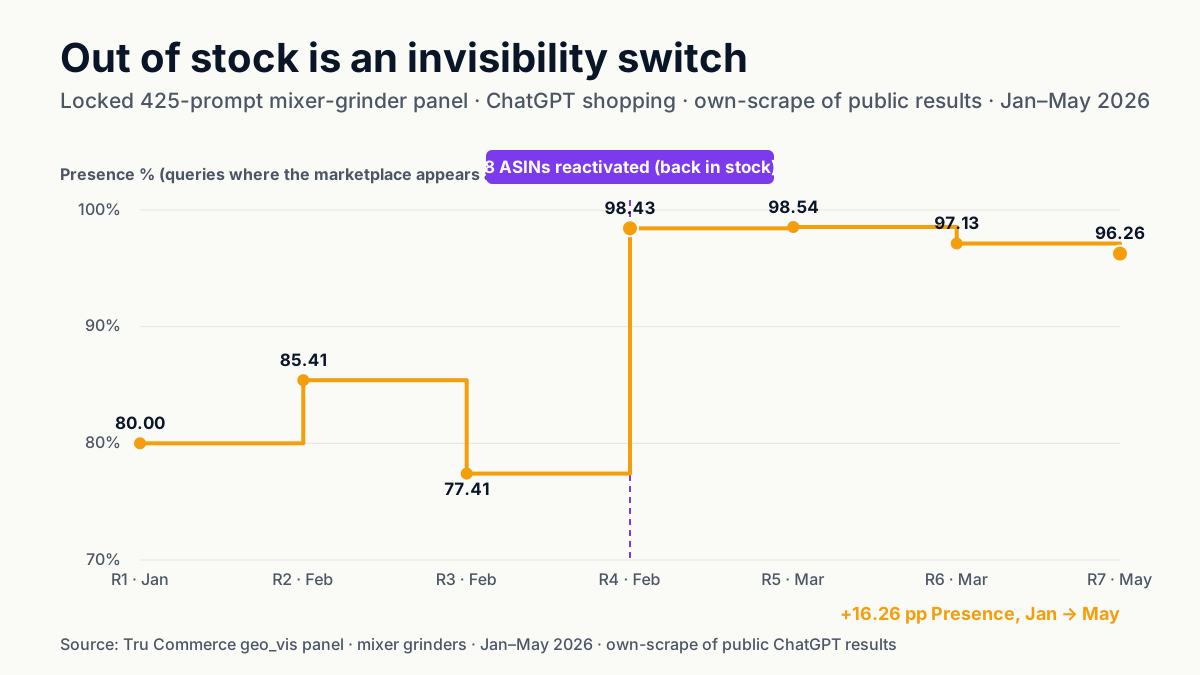
A product that is out of stock does not rank lower in AI shopping. It vanishes. Seven monthly pulls of a locked buyer-prompt panel show the largest marketplace's Presence climbing from 80% to 96.26% — and the step-change lands exactly when eight previously lapsed products came back in stock. Availability is not a problem downstream of visibility. It is the first gate of visibility, and with ChatGPT product feeds now live, it is the cheapest one to fix.
A supply-chain lead at a home-appliance brand asked us, half-joking, whether AI shopping "cares" about stock — "the model just recommends the best product, right, and we sort out fulfilment after?" This piece is the long answer, and it is not comforting. On the surfaces we measure, the model does not recommend the best product. It recommends the best available product, and it decides what is available before anyone sees the shelf. The cleverest listing in the category is worth exactly nothing the week it shows as out of stock.
This is the seventh piece in our Winning in AI Visibility with Amazon series, built on the same measurement spine as the rest: a locked panel of 425 real buyer prompts (mixer grinders) re-run monthly, stored in our geo_vis schema. For this piece we look at the full longitudinal record — seven pulls between January and May 2026 — against ChatGPT's shopping surface.
What the availability switch looks like in data
Presence is the plainest metric we track: the share of buyer queries where the marketplace appears at any rank. Not how high, not how often it wins — just whether it is on the shelf at all. Here is Presence for the marketplace across all seven pulls.
| Pull | Window | Presence % |
|---|---|---|
| Run 1 | January | 80.00 |
| Run 2 | February | 85.41 |
| Run 3 | February | 77.41 |
| Run 4 | February | 98.43 |
| Run 5 | March | 98.54 |
| Run 6 | March | 97.13 |
| Run 7 | May | 96.26 |
Start to finish, that is a move from 80.00% to 96.26% — +16.26 points. But the average hides the story; the shape tells it. Presence drifts in the low-to-mid 80s for the first three pulls, then steps up almost twenty points in a single run and holds in the high 90s for the rest of the window. That is not the signature of a gradual content or ranking improvement, which shows up as a slope. It is the signature of a switch being flipped.
The switch was stock. Between the early pulls and Run 4, 8 ASINs that had been lapsing in and out of availability returned to stock and stayed there. Coverage closed, and Presence jumped to match. Nothing else in the measurement moved in that window with the timing or the magnitude to explain a sixteen-point step.
Deletion, not demotion — why this is easy to miss
The mechanism is worth stating precisely, because it changes what you monitor.
When a product ranks lower, you can see it. It is still on the shelf, just further down, and every rank-tracking tool ever built is designed to catch exactly that movement. Out of stock does something different. The model does not place an unavailable product at slot nine instead of slot two — it removes the product from the answer. From the shopper's side there is no trace: they see a clean, confident shortlist of things they can actually buy. From the brand's side there is no alarm: a rank tracker measuring the products still on the shelf reports business as usual, because the item that vanished is no longer in the sample it measures.
This is why we call it an invisibility switch rather than a ranking penalty. A penalty is a position you can see and argue with. A switch is binary and silent. You do not slide down the shelf; you leave it, and the tooling most teams rely on is structurally blind to a product that is gone rather than merely lower.
Two qualifications keep this honest. First, the +16.26-point figure is a Presence gain, not a position gain: once a product is present, its average buy-link position held near the ~1.87 baseline we have measured all series. The switch decides whether you appear, not where — those are different levers, and this piece is only about the first. Second, Run 3 dips before the step, and part of that dip is a coverage artifact of that particular pull rather than a real availability loss. The signal is the sustained step from Run 4 onward, not the single wobble before it.
Why availability is the first gate, above cleverness
It helps to line the levers up in the order the model applies them.
Earlier in this series we showed that being cited at all is what wins the recommendation — a cited product page takes the top slot roughly 86% of the time, which is why eligibility beats ranking. We showed that price acts as a distribution lever, not just a checkout one, roughly doubling the odds of a top-two slot. And we showed that the evidence the model trusts lives off your own pages, in community threads rather than product pages.
Availability sits above all of those. Price cannot win a slot for a product the model will not surface. A perfect spec table and a wall of reviews cannot make an unavailable item eligible. The evidence layer cannot cite you into an answer you have removed yourself from. Every clever lever in the series operates on products that clear the availability gate first. Out of stock does not weaken those levers; it switches off the surface they act on.
That is what makes it the cheapest visibility gain we measured all year. There was no content to write, no threads to seed, no repricing to negotiate. The model already wanted to recommend these products — they matched real buyer queries, they had the reviews, they had the price. They were simply not buyable, so they were not shown. Closing the stock gap did not persuade the model of anything. It just stopped hiding the answer it had already reached.
The news hook: feeds turned availability into a direct signal
Until recently, the model inferred availability by crawling — a slow, lossy signal, often weeks stale. That changed on June 2, 2026, when ChatGPT product feeds went live. A feed sends price, availability, and variant state directly, and the model reads it instead of guessing.
The upside is real: accurate feeds mean faster, cleaner presence for products that are genuinely in stock. The exposure is equally real. A feed that says out of stock removes you immediately and reliably — no crawl lag to hide behind, no ambiguity for the model to resolve in your favour. Variant state that is wrong, a price that is stale, an availability flag that lags your actual warehouse: each is now a direct instruction to the surface about whether to show you. Feed hygiene has quietly become visibility infrastructure. It is no longer back-office plumbing that fulfilment worries about after marketing has won the recommendation; it is an input to whether the recommendation happens at all.
What this means for you
If you sell on marketplaces: treat stock coverage on your visibility-critical ASINs as a visibility metric, not just an operations one. The products that matter most here are the ones the model already likes — well-reviewed, well-priced, well-matched to real queries — because those are the ones whose disappearance costs you the most. An availability gap on a hero ASIN is a visibility outage, and right now almost no one has an alarm wired to it.
If you run a D2C brand: your feed is now part of your storefront's front door. Audit what you are actually sending ChatGPT and the other agentic surfaces — availability flags, variant states, price — with the same seriousness you audit your ad feeds. Channel inconsistency that was tolerable in the click era (a variant marked unavailable in one feed, in stock elsewhere) now silently removes you from answers you never see. Map where your product's availability signal is being read before assuming your site's "in stock" is the version the model sees.
What not to do: do not spend on cleverness while a stock gap is open. We regularly see teams commissioning content, seeding communities, and tuning listings for products that show as unavailable during the very weeks that work is meant to pay off. That is optimising a shelf you have deleted yourself from. Fix availability first — it is the cheapest sixteen points you will ever get — then let the other levers work on a product that can actually be recommended. This same recover-the-basics pattern is what drove the marketplace's citation-shelf reversal: the fastest gains came not from new tactics but from closing gaps the surface was quietly punishing.
The measurement habit
The discipline is the same as everywhere in this series, with one addition. Run a locked prompt set for your category on a schedule, and track Presence per pull — the share of queries where you appear at all — separately from position and citation. Then cross-reference Presence dips against your own stock and feed history. When Presence drops as a step rather than a slope, availability is the first place to look, because a step is what a switch looks like. Watch our Visibility Score and Citation Rank trend lines together: when presence falls while everything else holds, you are almost always looking at a stock or feed gap, not a ranking problem — and the fix is measured in warehouse days, not content quarters.
Out of stock is the quietest way to lose in AI shopping, because it does not look like losing. The shelf still renders, the answer still sounds confident, and your rank tracker still says you are fine. The only way to see the switch is to measure whether you are on the shelf at all — and then to keep the products the model already wants firmly, boringly, in stock. Availability beats cleverness. Book a demo if you want to see where your own switch is currently set.
Next in the series: The Long-Tail Is Where You Lose — why regional and use-case queries leak visibility first, and why you should defend them before your hero terms.
FAQ
In our data it disappears. AI shopping treats unavailability as a reason to omit the product from the answer, not to place it further down. That is why the loss is easy to miss: a rank tracker measuring the products still on the shelf shows nothing wrong, while the unavailable items have silently left the shelf altogether.
In our locked mixer-grinder panel, the marketplace's Presence — the share of buyer queries where it appeared at any rank — rose from 80.00% to 96.26% across the measurement window, +16.26 points, with the jump concentrated at the pull where 8 lapsed ASINs came back in stock. It was the largest, cheapest single move we recorded, because the model already wanted to recommend those products; they were just unavailable.
Since product feeds launched on June 2, 2026, the availability signal you send is read directly rather than inferred from a crawl. A stale or out-of-stock feed entry now removes you from the answer faster and more reliably than before. Feed hygiene — accurate price, stock, and variant state — has become a visibility input, which is why we treat it as infrastructure rather than plumbing.
Sources
Continue reading
October 12, 2026
How a Claude shopping agent picks products
Anthropic ships no ranking layer. A Claude for Commerce shopping agent reads compact catalog rows of 70 to 120 characters that the merchant's own search returns, adds only server-issued ids to the cart, and never sees the checkout URL. Claude in Chrome reads the page and asks before buying. What is documented, what is not, and who filled the gap.
October 12, 2026
Claude commerce agents: what a merchant has to build
Anthropic's blueprint of 2 September 2026 hands a merchant's engineers a shopping agent, a merchant agent and an 11-method backend contract, and leaves payments, authorization, ranking and fraud to the deployment. The three runtime paths, where MCP enters, Shopify's UCP implementation, and what to build first.
October 12, 2026
Claude for Commerce explained: what Anthropic shipped
Anthropic published its commerce agents blueprint on 2 September 2026: a shopping agent and a merchant agent as open-source reference code, payment left to the merchant. What shipped, who is named, what the 35% figure describes, and what is still missing.