
PRODUCTS · AI SHOPPING ASSISTANT
An AI shopping assistant
that closes the sale.
An AI shopping assistant is a conversational sales agent that recommends products from your catalog and completes checkout inside the chat. Text or voice. You stay the merchant of record and the customer data stays yours.
See it live
Question to checkout. One conversation
The widget sits on your store. Shoppers ask, the agent sells, checkout happens inside the chat.
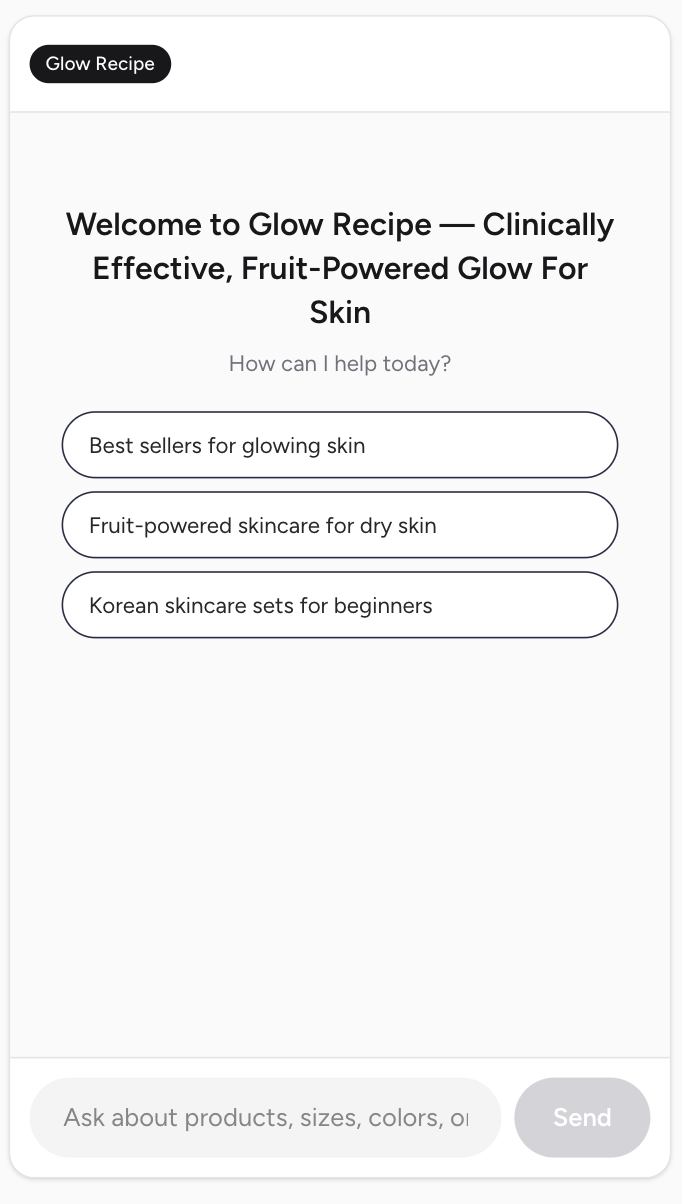
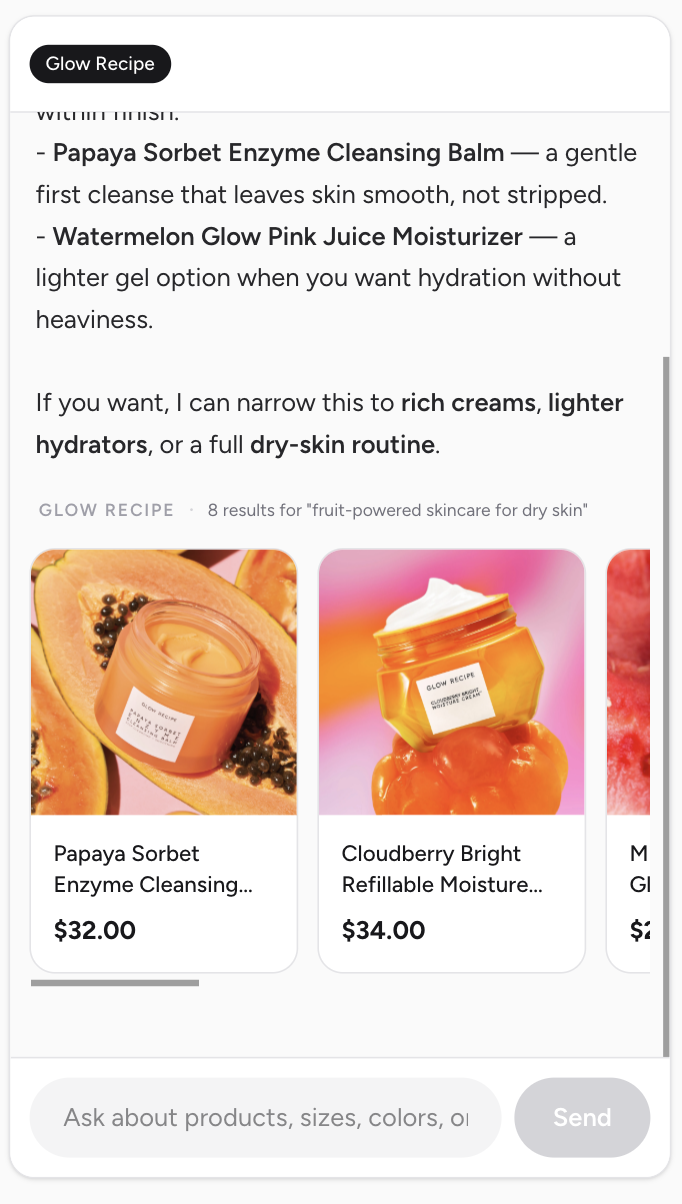
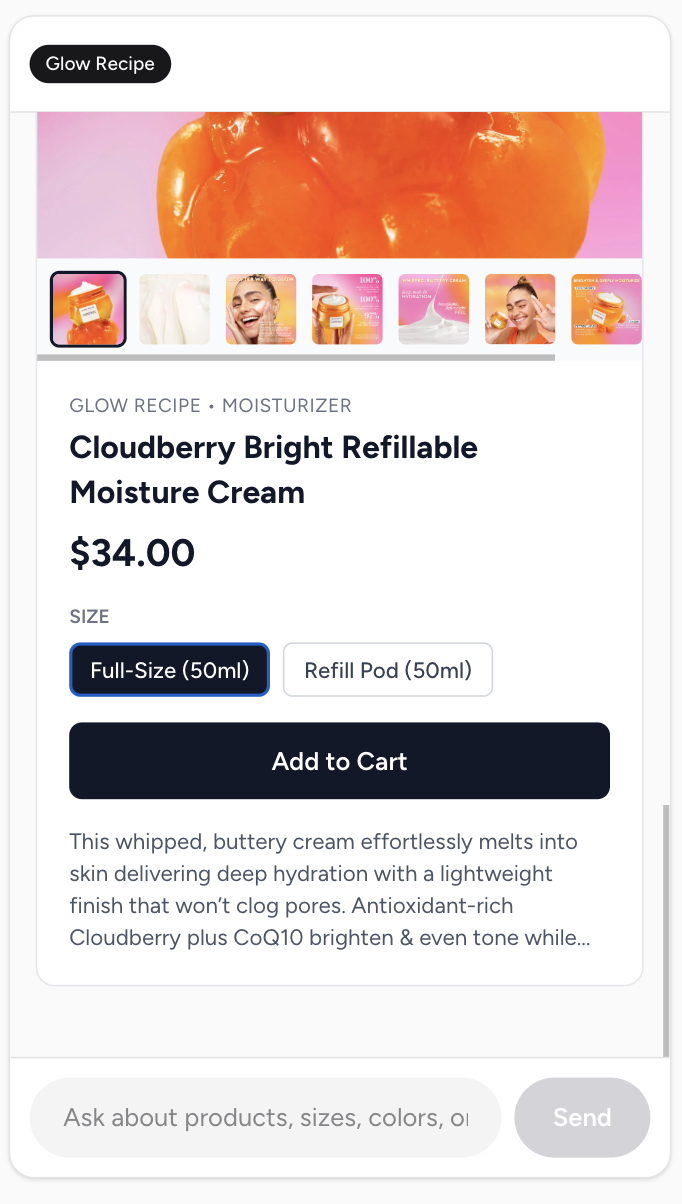
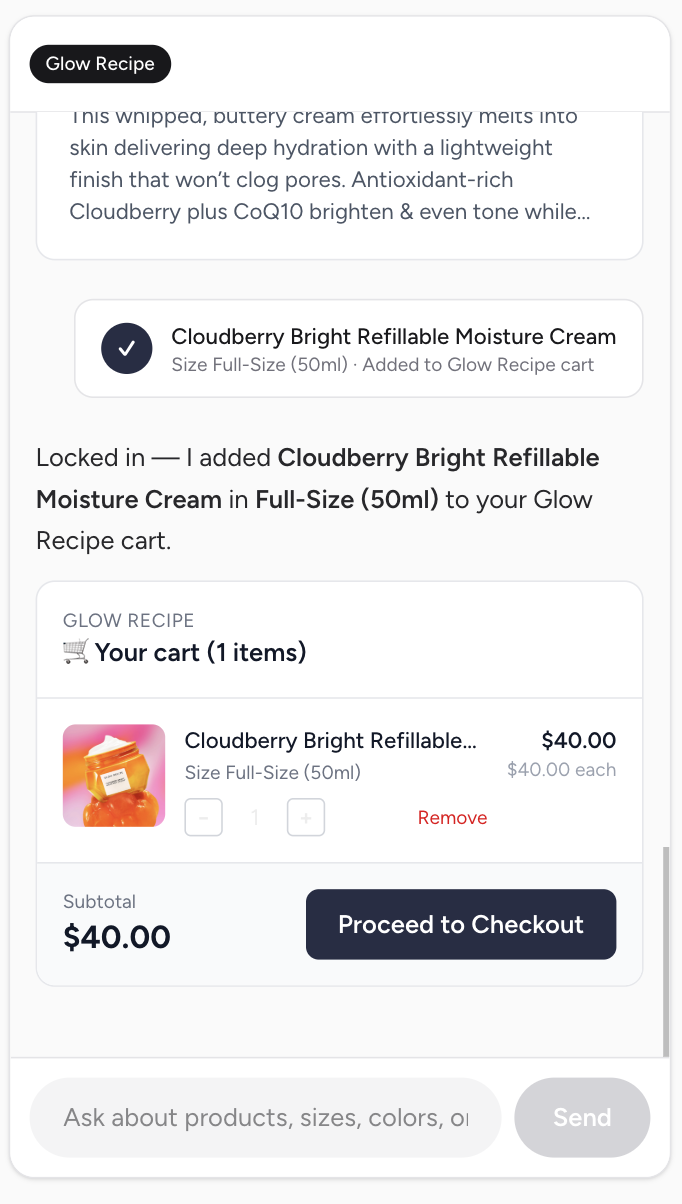
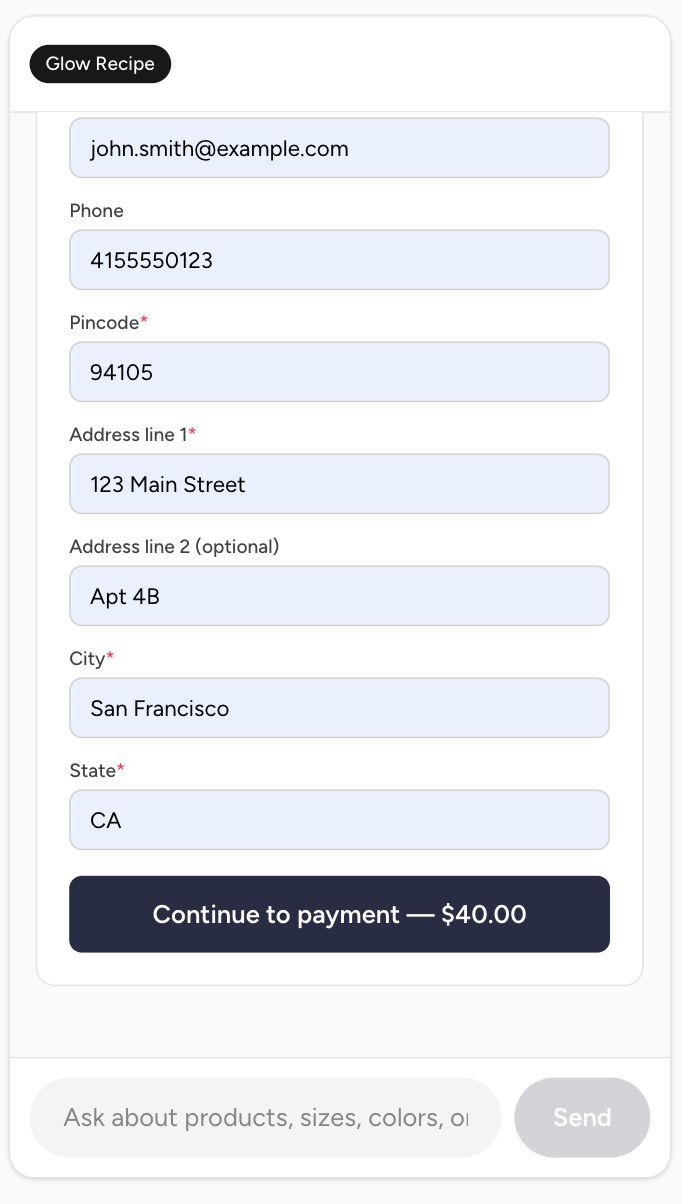
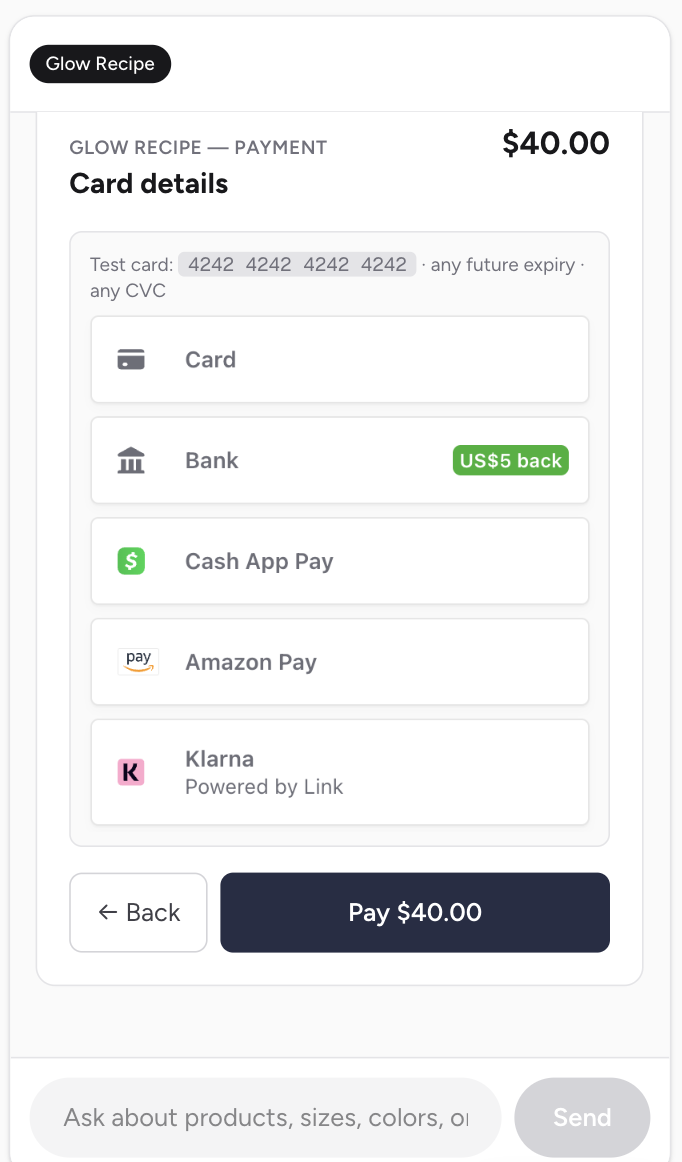
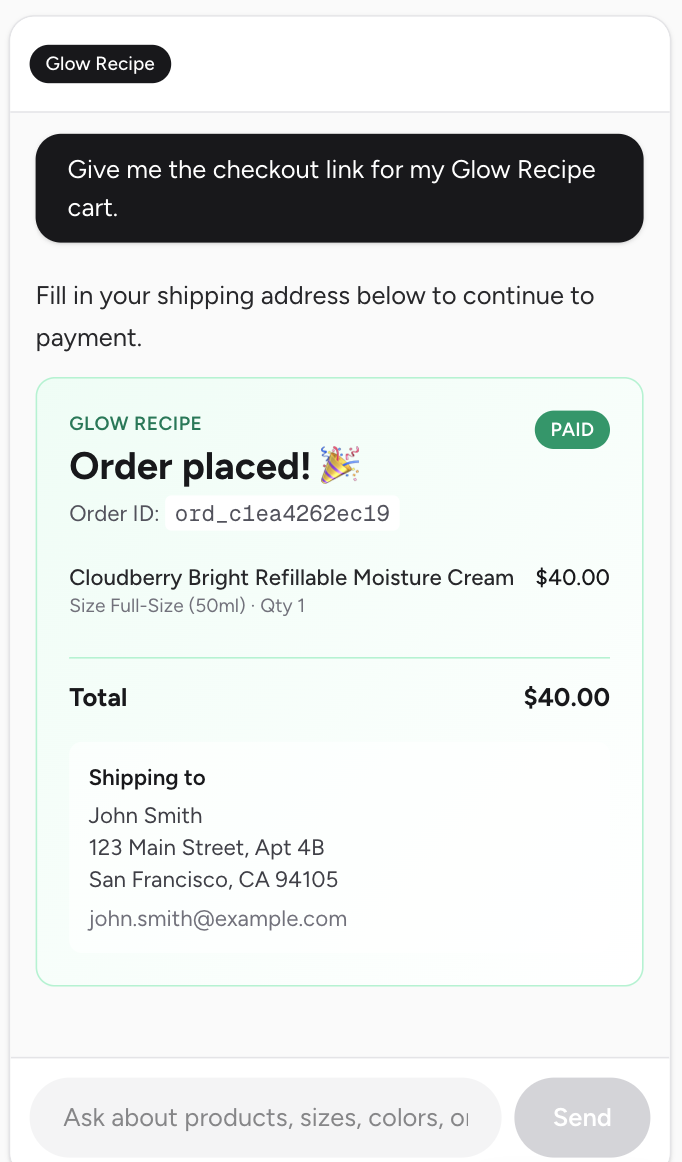
Welcome
Capabilities
A sales agent, not a search bar.
Catalog-aware recommendations
Understands your full product graph. Cross-sells from real purchase patterns.
In-chat checkout
Cart, discounts, payment. All inside the conversation. No redirects.
Brand voice + guardrails
Your tone, your rules. Knows when to sell, when to stop, when to hand off.
Live analytics
Every conversation, conversion path, and revenue number. In real time.
How it works
Live in 48 hours
01
Connect your store
Shopify, WooCommerce, Magento, custom. Auto-detected in 30 seconds.
02
Configure your agent
Brand voice, product rules, checkout flow. We handle the rest.
03
Go live
One script tag. The assistant is live and reporting to your dashboard.
The primer
What an AI shopping assistant actually is
An AI shopping assistant is a conversational sales agent that recommends products from your catalog and completes checkout inside the chat. Shoppers describe what they want in plain language; the assistant narrows the options the way a good associate would, builds the cart, and takes the payment - text or voice, without leaving the conversation. It is not a support bot bolted onto a help widget. It is the selling motion itself.
AI shopping assistant vs. chatbot vs. search bar
A search bar returns a list and leaves the shopper to do the work. A chatbot answers “where’s my order?” A shopping assistant does the job a floor associate does: it asks the clarifying question, reasons over the catalog, recommends the two or three products that fit, handles the objection, and closes. The difference shows up in the numbers. Adobe Analytics put AI-referred visits to US retail sites at a 60% higher conversion rate than non-AI traffic in July 2026, the eleventh month in a row ahead (Digital Commerce 360, 19 August 2026) - the gap between browsing and being sold to.
Why in-chat checkout is the whole point
Most “AI ecommerce assistant” tools stop at the recommendation and bounce the shopper to a product page or a desktop cart. That handoff is where the lift leaks out. When the cart, the discount code, and the payment all happen inside the conversation, the shopper never re-enters the funnel - so the intent you earned in the chat is the intent that checks out. That is why we built checkout into the assistant instead of linking away from it.
What you keep: the customer, the data, the margin
The assistant runs on your domain, under your brand, on your pricing rules. You stay the merchant of record. Every conversation, email, and order is yours - nothing is handed to a third-party marketplace or an AI provider, and nothing is used to train someone else’s model. You set the tone, the approved topics, and the point where the agent stops selling and hands off to a human. It is a channel you own, not a channel that owns your customer.
Does it work with my platform?
Yes. The assistant connects to Shopify, WooCommerce, Magento, BigCommerce, and custom storefronts with a single script tag and no developer time. Most brands are live within 48 hours - connect the store, set the brand voice and rules, and turn it on. From there it reports every conversion path and revenue number back to your dashboard in real time.
Measured, not claimed
What 90 days actually looks like
Every vendor in this category publishes a lift. None publishes the funnel underneath it. This is one live deployment, all seven steps, read from its own dashboard on 24 September 2026. Associative, not causal: there was no holdout arm.
| STEP | SESSIONS | SHARE |
|---|---|---|
| Widget loaded (distinct browsers) | 5,580 | - |
| Sessions | 1,455 | 26.1% of browsers |
| Sent a message | 1,332 | 100% of the funnel below |
| Ran a search | 732 | 55.0% |
| Viewed a product | 278 | 20.9% |
| Added to cart | 97 | 7.3% |
| Started checkout | 92 | 6.9% |
| Paid | 6 | 0.5% |
₹171.61
Total model spend across the 90 days, over 1,115 model turns. The merchant's payment processing fees were more than three times that.
~3,000 turns
Served by deterministic fast paths at zero model cost, against 1,115 that needed generation. A fast path cannot hallucinate.
128 of 134
Errors that were our own bugs, not infrastructure. We publish the classes and the last-seen dates.
The 7.3% on that table is the add-to-cart rate, not a conversion rate. We say so because it is exactly the row a headline gets taken from. Read the full breakdown, including the three places our own instrumentation is wrong.
Before you buy
The questions every buyer asks
We answered these with published vendor data, our own citation corpus and what comes up on evaluation calls. Competitors named, their numbers quoted verbatim. No pitch in any of them.
It does four jobs. Most teams buy it for one
Conversion is the job on the invoice. Agent demand, pre and post-sale support, and the queries your site search never sees are the three that decide whether it pays for itself.
What it actually takes to deploy one
Nine questions that set your timeline: API wrappers, attribute enrichment, location-bound inventory, who holds the index, post-sale scope, SLA, and what to measure.
What is an AI shopping assistant, and how is it different from a chatbot?
Four products get sold under one name. A chatbot deflects, an assistant sells, site search retrieves, and an external agent decides the shortlist before a shopper reaches you.
Do they actually lift conversion?
Every published claim in the category, quoted verbatim and checked. Rep AI, Envive, Alhena and Gorgias measure four different things and only one publishes its attribution window.
Which assistants do the AI engines themselves cite?
324 citations, 64 domains, five engines, three countries. The engines barely agree, and 36.4% of what they quote is a vendor ranking itself.
How do you stop one recommending sold-out or wrong-variant products?
Six failure modes, the cause of each, and a 12-case QA battery. None of them is fixed in the system prompt.
Go deeper
Selling on-site is half the job
The same shoppers are also asking ChatGPT, Gemini, and Perplexity what to buy. These are the pieces that cover that side.
Citation Rank
Where your brand ranks when ChatGPT, Gemini, Perplexity, Rufus, Copilot, and Claude answer category queries. Free scan in 24 hours.
Visibility Score
One number for how findable your brand is to AI agents - presence, share, sentiment, and structured data combined, benchmarked to your category.
MyMuse case study
GA4 reported AI revenue of ₹11.5K/mo. The real number was ₹81.2K/mo - a 7× attribution gap surfaced over 12 months.
Free Citation Rank scan
Drop your URL, get your rank across six AI surfaces in 24 hours - plus three prescriptive recommendations.
Common questions
An AI shopping assistant is a conversational sales agent that recommends products from a store's catalog and completes checkout inside the chat. Unlike a support chatbot, it does the job of a floor associate: it clarifies intent, narrows options, handles objections, and closes the sale - in text or voice.
Chatbots answer support tickets. This is a sales agent. It recommends products, builds carts, and completes transactions inside the conversation.
Yes. Shopify, WooCommerce, Magento, BigCommerce, and custom platforms. No developer needed.
Fully. You set brand voice, approved topics, pricing rules, and escalation triggers.
Yes. Same agent handles text and voice. Shoppers can talk to your store.
You do. The agent runs on your domain. We never share data with AI providers.
Tru Commerce publishes pricing openly - see the current tiers at trucommerce.ai/pricing. No sales call required to see them.