
Reddit Is the New PDP — Where AI Shopping Actually Gets Its Evidence
Over ten weeks of locked-panel measurement, Reddit citations in ChatGPT shopping answers grew 4x to become the #2 cited source in the category — ahead of every retailer. Product pages, including the marketplace's own, stayed under 1 source in 25. The page you control most is the page the model trusts least. Here is the data on where the evidence layer actually lives, why threads beat product pages, and what a brand can do about a layer it cannot buy.
Viren Inaniyan · September 1, 2026 · Citation Rank & Share of Voice
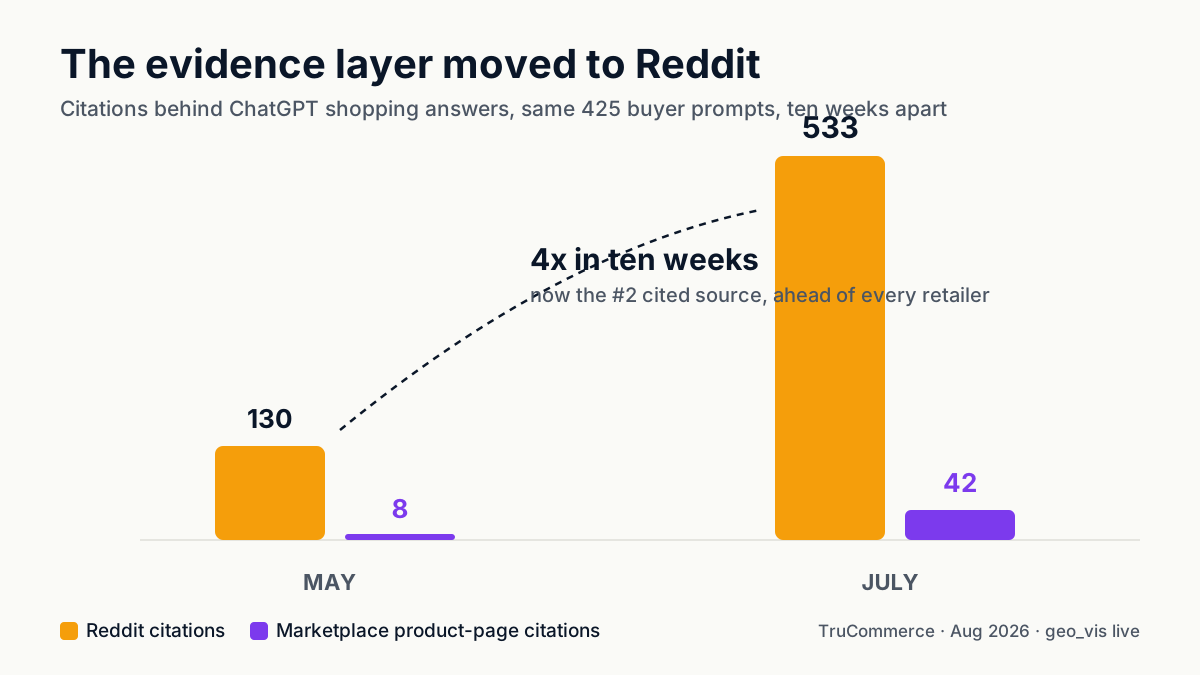
Your product page is where you tell your story. It is almost never where the AI gets its evidence. Ten weeks of locked-panel measurement in one high-competition category shows the evidence layer concentrating in exactly the place brands control least: community threads. Reddit citations grew 4x and took the #2 slot in the citation graph. Product pages — including the biggest marketplace's own — stayed under 1 source in 25.
A question we hear on sales calls, in some form, at least weekly: "We rank #1 on Google and our listings are optimized. Why does ChatGPT keep recommending someone else?" The honest answer is that the assistant is not reading what you think it is reading. This piece shows, with live data, what it actually reads.
This is the fourth piece in our Winning in AI Visibility with Amazon series, built on the same measurement spine as the first three: a locked panel of 425 real buyer prompts in the mixer-grinder category (India), re-run monthly against ChatGPT's shopping surface and stored in our geo_vis schema.
What changed in ten weeks
We compare the same panel at two pulls, May 12 and July 23, and count citations by domain.
| May 12 | July 23 | Change | |
|---|---|---|---|
| Reddit citations | 130 | 533 | 4.1x |
| Reddit's rank among cited domains | #3 | #2 | ahead of every retailer |
| Marketplace's own citations (amazon.in) | 8 | 42 | recovered, still ~0.4% of graph |
| Total citations in graph | 4,373 | 9,608 | shelf expansion |
Two things are true at once. The marketplace's buy links sit on more than 60% of the shopping cards in the same answers — placement is strong and improving. And its own pages are close to invisible as evidence — the sources the model cites to justify those recommendations. The recommendation and the justification come from different places. We wrote about that split as the two-layer model; this piece is about who owns the second layer.
The answer, increasingly, is community. Not editorial. Not retail. Threads.
Why threads beat product pages
The mechanism is not mysterious, and it is worth stating plainly because it predicts what to do about it.
A product page answers the question "what is this product?" Specifications, claims, images, price. It is a first-person document with an obvious incentive, and the model treats it accordingly.
A thread answers the question the buyer actually asked. "Which mixer survives daily idli batter?" is a comparative, experiential question. The best answer to it names two or three products, disagrees a little, mentions what broke after six months, and comes from people with no stake in the sale. That is not just credible content. It is content in the shape of the query — and after the model rewrites a shopper's query into plain use-case language (covered in our query fan-out piece), the thread matches the rewritten question far better than any spec sheet can.
So the model's preference for Reddit is not a quirk to be patched around. It is the retrieval system working as designed: pulling comparative, experience-dense, third-party text to justify a comparative, experience-seeking question.
The graph is volatile — which means it is winnable
The same ten-week window rewired the rest of the citation graph. Eight of the top fifteen cited domains in July were not in May's top fifteen. Niche affiliates rose and fell. National news domains entered. Most interestingly for brands: manufacturer-owned domains — brand sites, not marketplace listings — broke into the top fifteen for the first time, at an all-time-peak volume.
Volatility is the strategic fact here. Google's first page in a mature category barely moves quarter to quarter; the cost of displacing an incumbent is enormous. A citation graph where half the leaderboard turns over in ten weeks has no entrenched incumbents. Presence in it is being set right now, and it is being set cheaply, because almost no brand is competing for it deliberately.
What this means if you run a D2C brand
The marketplace framing translates directly, and the D2C version is arguably more urgent.
Your website and your marketplace listings are your placement layer. You control them fully, and they are almost never cited. Reddit threads, buying guides, review sites, and comparison posts about your category are the citation layer. You control none of them, and they decide how the model justifies its recommendations — which, per our eligibility data, is most of what decides whether you appear at all.
Three moves, in order of leverage:
1. Be findable where your category is discussed. Search Reddit for your category's recurring questions. If your brand is absent from the threads the model is citing, you are absent from the evidence base. Participation must be real: founders and product people answering technical questions honestly, disclosed, useful. Astroturfing is both against the rules and — because the model weighs engagement and thread quality — mostly ineffective.
2. Give owners somewhere to report long-term experience. The single highest-value content in a thread is the six-months-later report. Brands sit on this material in support tickets and review responses and do nothing public with it. Communities, ambassador programs, and honest "what broke and what we fixed" posts convert private experience into citable evidence.
3. Feed the adjacent citers. Buying guides and review sites in the graph need products to test and data to cite. Most have no relationship with the brands they rank. A review unit and a spec sheet is often all it takes to move from absent to cited.
What not to do: buy placements and undisclosed mentions. Beyond the platform and legal risk, our data shows the graph churns fast enough that purchased position decays in weeks, while genuinely useful threads keep accumulating citations for months.
The measurement habit
None of this is manageable without measurement, and the measurement is simple to specify: a locked prompt set for your category, re-run on a schedule, with the citation graph tracked by domain — yours, community, editorial, competitor. Watch two numbers: your share of the graph, and the graph's churn. The first tells you whether you are becoming evidence. The second tells you how much time you have.
The page you control most is the page the model trusts least. The place you control least is where it goes for proof. That asymmetry is uncomfortable, but it is also the clearest brief a brand has been handed in years: go earn a presence in the conversation about you.
Next in the series: The Cheapest Product Wins — ChatGPT's only badge is "Best price," and what that does to ranking.
AI-driven revenue is often bigger than your analytics admit: MyMuse's GA4 showed ₹11.5K/mo from AI channels while real AI revenue was ₹81.2K/mo, a 7× gap - read the MyMuse case study. Track your own mentions with Citation Rank.
Continue reading
October 12, 2026
How a Claude shopping agent picks products
Anthropic ships no ranking layer. A Claude for Commerce shopping agent reads compact catalog rows of 70 to 120 characters that the merchant's own search returns, adds only server-issued ids to the cart, and never sees the checkout URL. Claude in Chrome reads the page and asks before buying. What is documented, what is not, and who filled the gap.
October 12, 2026
Claude commerce agents: what a merchant has to build
Anthropic's blueprint of 2 September 2026 hands a merchant's engineers a shopping agent, a merchant agent and an 11-method backend contract, and leaves payments, authorization, ranking and fraud to the deployment. The three runtime paths, where MCP enters, Shopify's UCP implementation, and what to build first.
October 12, 2026
Claude for Commerce explained: what Anthropic shipped
Anthropic published its commerce agents blueprint on 2 September 2026: a shopping agent and a merchant agent as open-source reference code, payment left to the merchant. What shipped, who is named, what the 35% figure describes, and what is still missing.