
The Cheapest Product Wins — ChatGPT's Only Badge Is 'Best Price'
ChatGPT shopping ships exactly one product badge. Not Editor's choice, not Top rated — Best price. In our tracked categories the largest marketplace holds it on 56% of badged kitchen results and 63% in beauty, and holding the cheapest-or-tied offer roughly doubles a product's odds of a top-2 slot. Price has quietly moved from a conversion lever to a distribution lever: the model compares every offer before the shopper sees any of them. Here is the live data, the mechanism, and what a repricing strategy that stops at the buy box is missing.
Viren Inaniyan · September 3, 2026 · Citation Rank & Share of Voice
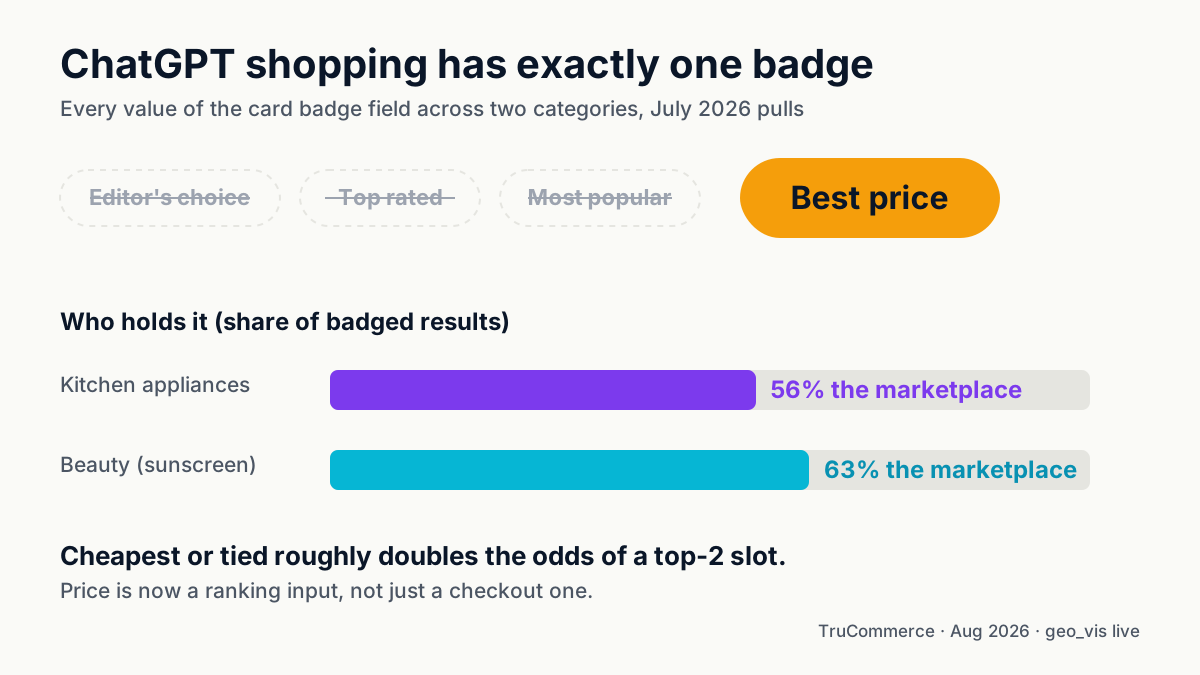
ChatGPT shopping has exactly one badge. Not Editor's choice. Not Top rated. Best price. That single design decision tells you more about how AI shopping ranks products than most optimization guides, and the live data behind it says price has changed jobs: it used to close sales, now it also decides who gets recommended at all.
A pricing lead at a D2C brand asked us recently whether AI shopping changes anything for repricing, "or is it just another storefront." This piece is the long answer. The short one: your repricing engine is currently optimizing for a buy box the shopper may never reach, on a surface where the ranking decision has already priced-compared you against every alternative.
This is the fifth piece in our Winning in AI Visibility with Amazon series, on the same spine as the rest: a locked panel of 425 real buyer prompts (mixer grinders, India) re-run monthly, plus the beauty-category expansion, all in our geo_vis schema.
One badge, and who wins it
Inspecting the raw payload of every shopping card in our July pulls, the tag field takes exactly one value anywhere it appears: "Best price." There is no other badge on the surface. OpenAI could have shipped Top rated, Most popular, Editor's pick. It shipped a price badge, alone.
Who holds it, in the two categories we track:
| Category (July pull) | Badged cards | Carrying the marketplace's offer | Share |
|---|---|---|---|
| Kitchen appliances (mixers) | 511 | 288 | 56% |
| Beauty (sunscreens) | 490 | 309 | 63% |
Badges move click-through in every shopping interface ever measured, which makes this the most concentrated high-value placement on the surface — and one almost nobody tracks, because it does not exist in any traditional rank-tracking tool.
Price as a ranking input: the doubling effect
The badge is the visible half. The invisible half is what price does to position.
Across the 411 July cards where the marketplace's offer was cheapest or tied, 51.1% sat in the top two slots — against a baseline around 25% if position ignored price. Being the sharp offer roughly doubles the odds of a top-2 slot. No other single lever in our measurement — review depth, data coverage, content type — moves position that much on its own.
Two qualifications keep this honest. First, doubling the odds is not a guarantee: nearly half of cheapest-or-tied offers still sit below slot two, because the ranker also weighs review density and data richness (the eligibility gates from earlier in this series). Second, this is placement, not citation — price buys ranking among the products already on the shelf; it does not buy the evidence layer.
The discipline curve
Price competitiveness is also the quietest success story in our longitudinal data. The marketplace's cheapest-or-tied share climbed steadily across the panel:
| Pull | Cheapest-or-tied share |
|---|---|
| March 6 | 55.5% |
| March 25 | 59.5% |
| May 12 | 71.2% |
| July 23 | 70.7% |
A fifteen-point swing, held through the shelf's chaotic expansion — and it coincides with the best average position we have ever measured for it. While commentary focused on citation collapse, the pricing team was compounding a ranking advantage.
The mechanism: why price changed jobs
In the click era, the funnel separated discovery from price. You won the visit with ads and SEO; price mattered at the end, against whatever the shopper happened to compare. Two moments, two levers.
In the recommendation era the funnel inverts. The model retrieves candidate products, compares every offer across every marketplace before rendering anything, and then shows the shopper a pre-priced, pre-ranked shortlist with one price badge on it. Price acts at the ranking stage. By the time a human sees the shelf, the price comparison you used to win at checkout has already happened, without you in the room.
That is what "distribution lever" means concretely: a sharper offer does not just convert better, it is seen more. Price discipline pays twice — once in the ranking, once at the sale — and most P&Ls only account for the second payment.
What to do about it
If you sell on marketplaces: track your cheapest-or-tied share on a locked prompt set, not just buy-box share. The two diverge, and the first one now feeds ranking. Watch the badge specifically — it is capturable at the offer level.
If you run a D2C brand: your site's offer is compared against every marketplace listing of your own product. Channel-price inconsistency, common and tolerated in the click era, now costs you the ranking on surfaces you may not monitor. Map where your product appears across offers before assuming your site price is "your" price.
For pricing teams: the repricing engine needs a second objective function. Optimizing for margin at the buy box while losing the AI shelf's top-2 slot is a trade you are currently making blind. The data above is what makes it visible.
What not to do: race to the bottom. Cheapest-or-tied is the measured threshold — tied captures the effect without the margin sacrifice, and the ranker's other gates (reviews, data density) mean a sharp price on a thin listing still loses. Price is the biggest single lever; it is not the only one.
The measurement habit
Same discipline as the rest of this series: a locked prompt set, re-run on a schedule, with price competitiveness and badge share tracked per pull alongside presence and position. One number tells you if you are the sharp offer; the trend tells you if your discipline is compounding, the way it visibly did in this panel.
The whole badge system of AI shopping is one label about price. Take the hint.
Previous in the series: Reddit Is the New PDP. Next: Reviews Are the Eligibility Gate.
We used this exact playbook with House of Zelena, taking them from 22% to 56% ChatGPT mention share in 6 months - read the House of Zelena case study. To see where your brand stands first, start with ChatGPT Ads for ecommerce brands.
Continue reading
October 12, 2026
How a Claude shopping agent picks products
Anthropic ships no ranking layer. A Claude for Commerce shopping agent reads compact catalog rows of 70 to 120 characters that the merchant's own search returns, adds only server-issued ids to the cart, and never sees the checkout URL. Claude in Chrome reads the page and asks before buying. What is documented, what is not, and who filled the gap.
October 12, 2026
Claude commerce agents: what a merchant has to build
Anthropic's blueprint of 2 September 2026 hands a merchant's engineers a shopping agent, a merchant agent and an 11-method backend contract, and leaves payments, authorization, ranking and fraud to the deployment. The three runtime paths, where MCP enters, Shopify's UCP implementation, and what to build first.
October 12, 2026
Claude for Commerce explained: what Anthropic shipped
Anthropic published its commerce agents blueprint on 2 September 2026: a shopping agent and a merchant agent as open-source reference code, payment left to the merchant. What shipped, who is named, what the 35% figure describes, and what is still missing.