
Product Type Determines Destiny — Some Categories Are 15x More Citable
Citability is not evenly distributed across a catalogue. In our beauty panel, sunscreen ASINs are cited by ChatGPT at roughly 16 times the rate of moisturizers (44.0% vs 2.7%), and the association between product type and citation is statistically strong (Cramér's V = 0.55). Which category you lead with is itself a visibility lever — and most AEO programs pick it by revenue instead of by structure.
Viren Inaniyan · September 12, 2026 · Citation Rank & Share of Voice
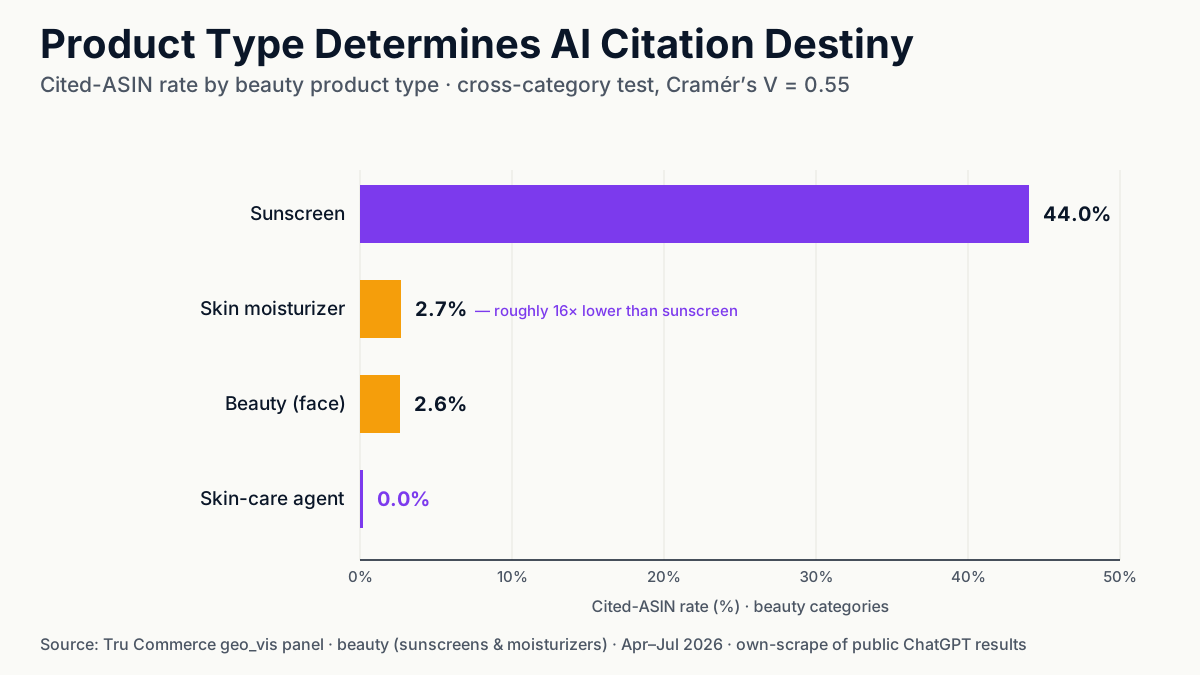
Two products can have equally clean listings, equal review counts, and equal price discipline, and still land in completely different visibility regimes — because the category they sit in decides most of the ceiling before the listing is even read. In our beauty panel, sunscreen ASINs get cited by ChatGPT at roughly 16 times the rate of moisturizers. The association between product type and citation is strong enough to plan around. This piece is about treating category selection as a lever, not a given.
A category lead at a beauty brand asked us recently which of their lines to point an AI-visibility program at first — "we have the budget for one, where does it move fastest?" The instinct in the room was to name the biggest revenue line. The data says that is often the wrong question. The right one is which category the model is structurally willing to cite at all, because that number varies more across a catalogue than almost anything you can change inside a single listing.
This is the tenth piece in our Winning in AI Visibility with Amazon series, and it runs on the beauty half of our measurement spine: a locked panel built from the sunscreen and moisturizer categories, re-run across seven dated pulls between April 13 and July 10, 2026, and stored in our geo_vis schema — 5,182 sunscreen cards and 2,087 moisturizer cards, 45,773 and 10,173 citations respectively.
The 15x gap is real, and it is not noise
We ran a cross-category test asking a blunt question: does the rate at which an ASIN gets cited depend on what kind of product it is? It does, at a strength worth taking seriously. The association between product type and citation came in at Cramér's V = 0.55 — a strong effect, not a rounding artefact — and it held when we re-ran it on a larger sample rather than collapsing, which is the usual fate of a first-pass finding.
Here is the shape of it, as cited-ASIN rate by product type across beauty:
| Product type | Cited-ASIN rate | Relative to sunscreen |
|---|---|---|
| Sunscreen | 44.0% | 1.0x |
| Skin moisturizer | 2.7% | ~16x lower |
| Beauty (face) | 2.6% | ~17x lower |
| Skin-care agent (actives) | 0.0% | not cited |
A sunscreen ASIN is cited nearly one time in two. A moisturizer ASIN is cited fewer than three times in a hundred. That is roughly a 16x gap between two categories a shopper would file under the same shelf in a physical store — and the actives sub-type, in this window, did not clear the bar at all. The point is not the exact multiple; it is that the multiple is enormous and it tracks the category, not the effort.
The gap compounds in live volume
A cited-ASIN rate is one view. The live citation graph is another, and it tells the same story with bigger numbers. Over the same April–July window, the two categories drew very different volumes of attention from the model:
| Metric (Apr–Jul 2026) | Sunscreen | Moisturizer | Ratio |
|---|---|---|---|
| Citations in graph | 45,773 | 10,173 | ~4.5x |
| Shopping cards rendered | 5,182 | 2,087 | ~2.5x |
| Amazon citation share of voice | 1.47% | 3.06% | — |
Sunscreen is simply a more AI-visible category: about four and a half times the citation volume and two and a half times the shelf. The one number that inverts is worth flagging honestly — the marketplace's own citation share is actually higher in moisturizers (3.06%) than in sunscreens (1.47%), because a bigger, more crowded citation graph gives the marketplace's own pages a smaller slice even as the category as a whole draws far more references. That is the two-layer model at work: placement and citation are different games, and a category can be loud overall while any single player's citation share stays thin.
Why some categories are structurally citable
The mechanism is not mysterious, and stating it plainly predicts which categories will behave which way.
Citability follows the way a category is researched. Sunscreen is a concern-led, experiential purchase: people ask by skin type, by finish, by whether it leaves a white cast, by what held up on a beach day. That question shape generates comparative, review-dense, third-party text — the buying guides, the threads, the "I tried twelve" posts — which is exactly the material the model retrieves as evidence. A moisturizer, for most shoppers, is a lower-research, more habitual buy; it generates far less of that comparative text, so there is less for the model to cite.
This connects directly to two findings earlier in the series. First, reviews are the eligibility gate: cited ASINs in our data carry a median of roughly 25,000 reviews against about 250 for uncited ones, and high-research categories accumulate that review depth naturally. Second, most of what the model recommends comes from its cited sources — the evidence layer, not the product page — so a category that generates rich third-party evidence starts with a structural head start. Product type, in other words, is upstream of the review-depth lever and the evidence lever at once. It is not a separate factor so much as the thing that sets the level of both.
Two qualifications keep this honest. First, "structural" does not mean "fixed for a given brand" — you cannot change what category a product is, but you can choose which category to invest in first, and you can seed the comparative evidence a low-visibility category lacks rather than waiting for it to appear. Second, a single window is a snapshot: the actives sub-type reading 0.0% here means "not cleared in this pull," not "permanently uncitable" — emerging categories move, as the beauty shelf's own repair over these months shows.
What this means for marketplaces and for D2C brands
For a marketplace or a large multi-category seller, the implication is a sequencing decision. You have finite content and PR capacity; spend it where the ceiling is highest first. Leading an AEO program with a structurally citable category — sunscreen over moisturizer, in beauty — means you build the playbook, prove the citation-rank and share-of-voice movement, and generate internal belief in a category where the model is already listening. Then you carry that playbook into the harder categories with evidence in hand, instead of burning your first quarter proving the concept in the least responsive part of the catalogue.
For a D2C brand the read is sharper, because you usually cannot pick your category — you are the sunscreen brand or you are the moisturizer brand. If you are in a high-citability category, the opportunity is time-sensitive: the evidence layer is active and being written now, and presence in it is cheap while few competitors compete for it deliberately. If you are in a low-citability category, the honest plan is a patient one — you are partly in the business of creating the comparative evidence your category does not generate on its own: honest owner reports, real comparisons, the six-months-later post. You are seeding the shape of query the model wants, in a category that does not hand it to you.
Either way, the mistake is assuming the category-level ceiling is a brand-level failure. A moisturizer team hitting a low citation rate is not necessarily executing worse than a sunscreen team hitting a high one; they are playing a structurally harder game, and their targets should say so.
What not to do
Do not benchmark every category against your best one and call the laggards broken. A flat cited-ASIN target across a catalogue quietly punishes teams in low-citability categories for a structural fact, and rewards teams in easy ones for showing up. Set category-relative targets.
And do not read low citation as a reason to abandon a category. Low-visibility categories are longer plays, not lost ones — the beauty shelf in our data went from 97.9% broken buy-links to 2.7% in three months, which is a reminder that emerging AI-shopping surfaces move fast and that today's floor is not permanent. The right response to a hard category is a patient, evidence-seeding plan and a realistic timeline, not a withdrawal.
The measurement habit
The discipline is the same as everywhere in this series, with one addition: measure per category, and compare each category to itself over time rather than to the loudest category in the catalogue. Run a locked prompt set per category on a schedule, track cited-ASIN rate and citation share by category and by product sub-type, and watch the trend within each. One number tells you where the structural ceiling sits; the trend tells you whether a low-ceiling category is nonetheless opening. Pick where to lead by the ceiling, and judge each team by its own curve.
Product type determines destiny — but destiny here means the starting terrain, not the outcome. The lever is choosing where to plant first, and being honest about how steep the ground is everywhere else.
If you want to see your own categories ranked by structural citability before you commit a quarter to one, book a demo.
Next in the series: The Broken Carousel — how Amazon Beauty's AI shelf went from 97.9% broken buy-links to nearly fixed in three months, and why that repair was the opening.
FAQ
Yes, and measurably. In our cross-category test the association between product type and whether an ASIN gets cited was Cramér's V = 0.55 — a strong effect that held when we re-ran it on a larger sample. Sunscreen ASINs were cited at 44.0% versus 2.7% for skin moisturizers, roughly a 16x difference driven by category structure, not listing quality alone.
The most citable categories are the ones people research comparatively and experientially — sunscreen gets discussed by skin type, concern, and 'what actually worked' far more than a moisturizer does. That generates the comparative, review-dense, third-party text the model retrieves as evidence, which is exactly what makes a category citable. Low-research, commodity-feeling categories generate little such text and sit near the floor.
Not by revenue alone. Because citability is uneven, the same effort buys very different ceilings in different categories. Lead your AEO program with a structurally citable category so you build the playbook where the model is already listening, then treat low-visibility categories as longer, more patient plays rather than expecting the same curve.
Sources
Continue reading
October 12, 2026
How a Claude shopping agent picks products
Anthropic ships no ranking layer. A Claude for Commerce shopping agent reads compact catalog rows of 70 to 120 characters that the merchant's own search returns, adds only server-issued ids to the cart, and never sees the checkout URL. Claude in Chrome reads the page and asks before buying. What is documented, what is not, and who filled the gap.
October 12, 2026
Claude commerce agents: what a merchant has to build
Anthropic's blueprint of 2 September 2026 hands a merchant's engineers a shopping agent, a merchant agent and an 11-method backend contract, and leaves payments, authorization, ranking and fraud to the deployment. The three runtime paths, where MCP enters, Shopify's UCP implementation, and what to build first.
October 12, 2026
Claude for Commerce explained: what Anthropic shipped
Anthropic published its commerce agents blueprint on 2 September 2026: a shopping agent and a merchant agent as open-source reference code, payment left to the merchant. What shipped, who is named, what the 35% figure describes, and what is still missing.