
From recommended to transacted: agentic commerce
Getting recommended is the on-ramp; being transactable is the destination. Adobe has AI-referred retail visits converting 60% higher than other traffic in July 2026, yet most brands still make an agent find them and then dead-end it at a checkout it cannot complete. The series finale: why discovery without transactability leaks the value, what ACP, UCP and AP2 do, and how a recommendation becomes a purchase inside the chat.
Viren Inaniyan · September 19, 2026 · Checkout & Protocols
The agentic commerce value chain at a glance
Use this seven-layer map to place discovery, payments and checkout in context. Open the text version below for every layer and company shown.
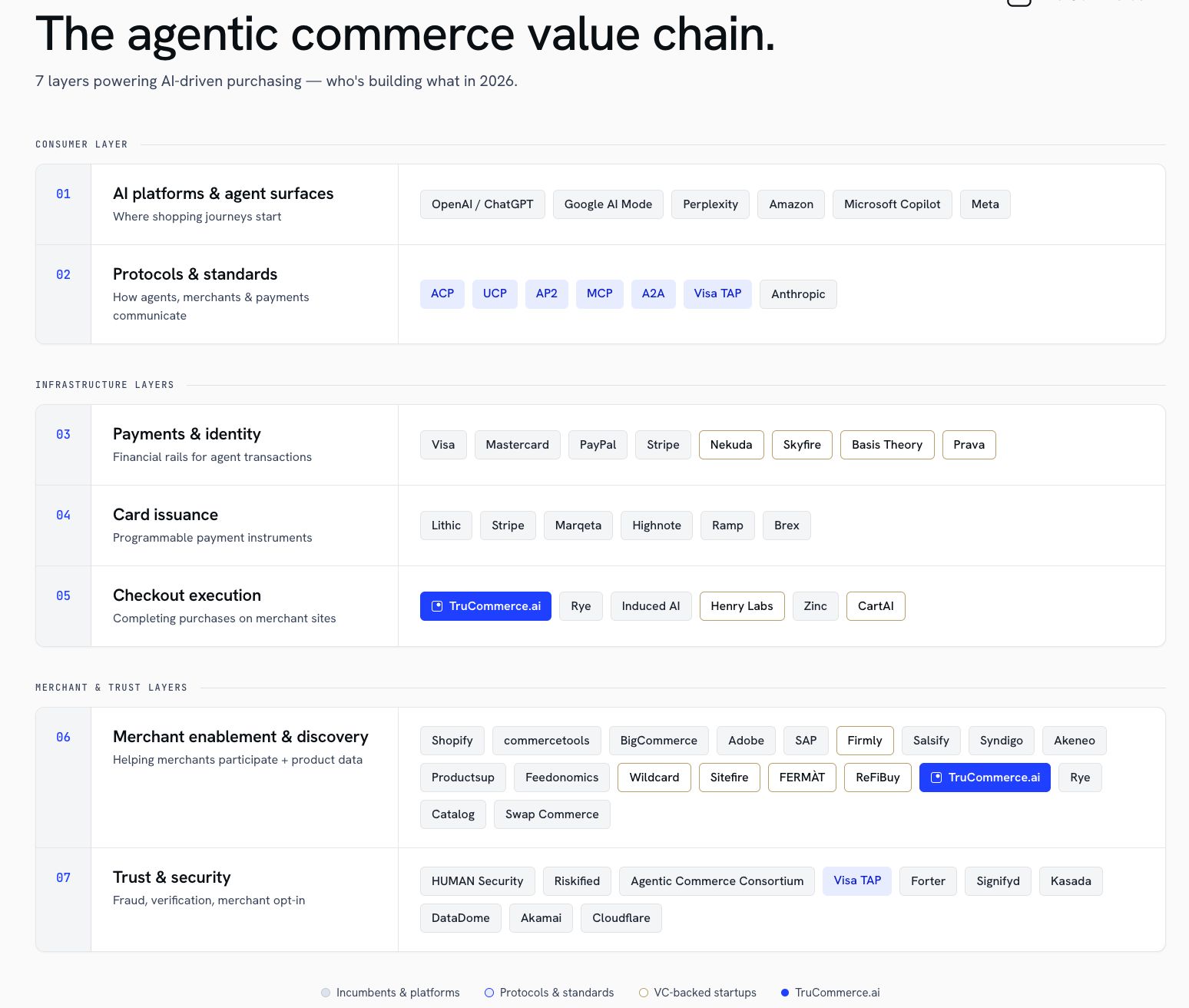
Read all seven layers and company names
The agentic commerce value chain. 7 layers powering AI-driven purchasing — who's building what in 2026. Text version of the diagram:
Consumer layer · 01
AI platforms & agent surfaces
Where shopping journeys start.
OpenAI / ChatGPT · Google AI Mode · Perplexity · Amazon · Microsoft Copilot · Meta
Consumer layer · 02
Protocols & standards
How agents, merchants & payments communicate.
ACP · UCP · AP2 · MCP · A2A · Visa TAP · Anthropic
Infrastructure layers · 03
Payments & identity
Financial rails for agent transactions.
Visa · Mastercard · PayPal · Stripe · Nekuda · Skyfire · Basis Theory · Prava
Infrastructure layers · 04
Card issuance
Programmable payment instruments.
Lithic · Stripe · Marqeta · Highnote · Ramp · Brex
Infrastructure layers · 05
Checkout execution
Completing purchases on merchant sites.
TruCommerce.ai · Rye · Induced AI · Henry Labs · Zinc · CartAI
Merchant & trust layers · 06
Merchant enablement & discovery
Helping merchants participate + product data.
Shopify · commercetools · BigCommerce · Adobe · SAP · Firmly · Salsify · Syndigo · Akeneo · Productsup · Feedonomics · Wildcard · Sitefire · FERMÀT · ReFiBuy · TruCommerce.ai · Rye · Catalog · Swap Commerce
Merchant & trust layers · 07
Trust & security
Fraud, verification, merchant opt-in.
HUMAN Security · Riskified · Agentic Commerce Consortium · Visa TAP · Forter · Signifyd · Kasada · DataDome · Akamai · Cloudflare
Diagram legend: incumbents & platforms; protocols & standards; VC-backed startups; TruCommerce.ai.
Getting recommended is the on-ramp; being transactable is the destination. Adobe has AI-referred visits to US retail sites converting 60% higher than other traffic in July 2026, yet most brands still make an agent find them and then dead-end it at a checkout it cannot complete. The series finale: why discovery without transactability leaks the value, what ACP, UCP and AP2 do, and how a recommendation becomes a purchase inside the chat.
Agentic commerce conversion has two layers: an agent must recommend you, and then it must be able to buy from you. Adobe reports AI-referred retail visits converting 60% higher than non-AI visits in July 2026 (Digital Commerce 360, 19 August 2026); that premium is collected only where the purchase completes near the recommendation.
Last updated: 13 October 2026.
The number that reframes the series
Adobe Analytics measures how AI-referred visits to US retail sites convert compared with visits from every other source. The arc is the story.
| Period | AI-referred conversion vs non-AI visits | Source and date |
|---|---|---|
| January 2025 | 49% less likely to convert | Adobe, August 2025 |
| July 2025 | 23% less likely | Adobe, August 2025 |
| October 2025 | 16% more likely | Digital Commerce 360, November 2025 |
| March 2026 | 42% more likely; 37% higher revenue per visit | Adobe Digital Insights, April 2026 |
| July 2026 | 60% higher; 53% more revenue per visit | Digital Commerce 360, 19 August 2026 |
The premium is new, AI traffic converted worse than other traffic until September 2025 and July 2026 was only the eleventh month ahead (Digital Commerce 360, 19 August 2026), and it is relative. For an absolute anchor, 180 Marketing's GA4 pull across 94 ecommerce stores in 2025 has ChatGPT referrals converting at 1.81% against 1.39% for non-branded organic, a 31% lift on a 14.3% lower average order value (180 Marketing, 23 February 2026). Tens of percent, not multiples.
The mechanism is familiar from this series: the assistant does the interpreting, the query fan-out, the comparison and the shortlisting before the shopper sees anything (teardown of ChatGPT's shopping surface). The shopper arrives later in the funnel than a search click delivers them. The trap: the premium is collected only if the purchase can happen at or near the moment of recommendation. Hand the shopper a link to a site the agent cannot navigate and the leaky click funnel is back in the one channel that had removed it.
Recommended is the on-ramp, and the on-ramp leaks
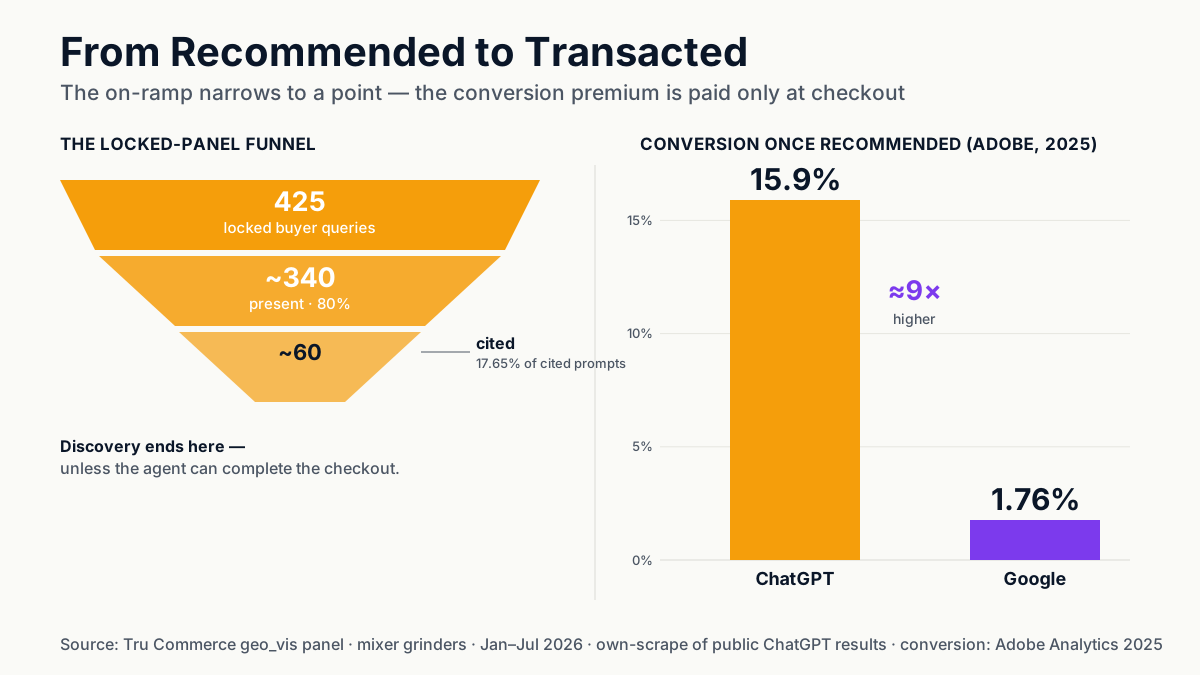
In the locked panel, Amazon's presence, the share of the 425 prompts where it appeared at any rank, was 80.00% in January 2026, 96.26% in May and 62.35% in July (Tru Commerce geo_vis panel, 2026; timeline in the citation collapse and reversal). A strong on-ramp, and the point where every rank-tracking tool stops.
Being present is not being the cited evidence behind the pick, the point of the two-layer model: presence and own-citation moved in opposite directions twice in eight months on the same prompts. A citation is not a sale. The funnel narrows, present, cited, chosen, then hits the wall: can the agent complete the transaction? For most brands today, no: the shopper is bounced to a mobile web checkout the assistant cannot follow. That is where the premium Adobe measures leaks back out.
The destination is transactability, and the plumbing already exists
The protocols. ACP, the Agentic Commerce Protocol, was released by Stripe and OpenAI alongside Instant Checkout in ChatGPT on 29 September 2025 (Stripe, 2025). UCP, the Universal Commerce Protocol, was announced by Google on 11 January 2026 for its Search and Gemini surfaces (Google, 2026). AP2, the Agent Payments Protocol, carries the payment mandate under either. The shape is the same: a machine-readable catalog, an agent-drivable cart and a payment step the agent executes with the shopper's authorisation. Rails and credentials are in how AI agent payments work.
The proof. Nykaa announced a multi-year OpenAI partnership in June 2026 that lists its Nykaa Beauty and Nykaa Fashion storefronts as connected apps inside ChatGPT, built on the Agentic Commerce Protocol (Medianama, 17 June 2026).
The movers. Swiggy opened ordering for Food, Instamart and Dineout inside ChatGPT and Claude over MCP on 27 January 2026 (Swiggy, 2026), and Zepto publishes a public MCP server with search, cart and order placement (zeptonow/mcp on GitHub, read October 2026). Their inventory is agent-callable; most brands' is not.
The incumbents. Amazon unified Rufus, its answer-box assistant, with Alexa as Alexa for Shopping on 13 May 2026 (GeekWire, 13 May 2026), a move from answering shopping questions to acting on them. The personal agents that already buy for shoppers are compared, with dates and rails, in AI shopping agents.
What this means for marketplaces and for D2C brands
Marketplaces and large retailers: your placement advantage is real but rented; the Amazon shelf reversal showed how quickly that surface re-sorts. The defensible position is being the merchant of record the protocols route to first, won on ACP, UCP and AP2 readiness rather than product-page optimisation.
D2C brands: the more urgent case and the bigger opportunity. You control your own catalog and checkout, so you can become transactable without waiting for a marketplace to carry you, as merchant of record and with the attribution. The brand that is agent-buyable where competitors are only agent-findable collects the premium alone. One caution from the price piece: the agent compares every offer before rendering one, and a stale price or stock status can get you routed around entirely.
Two qualifications keep this honest
First, Adobe's figures are relative and US retail; the absolute rates are small and close. ChatGPT referrals converted at 1.81% against 1.39% for non-branded organic across 94 stores in 2025 (180 Marketing, 2026), and across 973 ecommerce sites organic LLM traffic converted "above paid social but below all other traditional channels" in its first year (Kaiser and Schulze, Marketing Science, 2026). Treat the premium as tens of percent and growing, not a multiple, and expect your category to differ.
Second, transactability is necessary, not sufficient. Being buyable does nothing if the agent never recommends you, which is why the previous fifteen pieces exist. Build the destination; keep feeding the on-ramp.
The measurement habit
The series ran from visibility to eligibility (crossing the gates that decide whether you can be cited) to the levers that move position, and finally to transactability. Keep the locked prompt set, re-run on a schedule, track presence and citation as separate scoreboards, and add a third column: can an agent complete the purchase, and does the attribution land with you? GA4 will not fill that column on its own: for MyMuse, GA4 reported ₹11.5K/mo of AI revenue against ₹81.2K/mo measured over a 12-month attribution (Tru Commerce case study, 2026); the mechanics are in dark agentic commerce traffic.
We began this series asking why ChatGPT recommends someone else. We end with a harder question: when it finally recommends you, can it buy from you? Recommended was always the on-ramp. Transactable is the destination, and the road is open.
Where Tru Commerce fits
We have run this on Gray Porter and a group of US DTC brands: we made the product pages and checkout readable and finishable by an agent, then placed a real Muse order on the store. Agentic checkout is the product that work runs on, with the merchant as merchant of record; the same catalog is exposed to agents over MCP. On measurement, MyMuse is the reference: GA4 showed ₹11.5K/mo of AI revenue, the real figure was ₹81.2K/mo, 7× hidden, and the Year 1 net surfaced was +₹29.34L. To see whether an agent can buy from your store today, book a demo.
FAQ
An AI assistant completing the purchase for the shopper rather than only recommending: searching, comparing, adding to cart and checking out inside the conversation. It needs a catalog an agent can call and a checkout an agent can drive, which is what ACP, UCP and AP2 standardise.
In Adobe's US retail data, yes since September 2025: 60% higher than non-AI visits in July 2026 (Digital Commerce 360, 2026). In absolute terms, 1.81% for ChatGPT referrals against 1.39% for non-branded organic across 94 stores in 2025 (180 Marketing, 2026).
Two layers. Expose the catalog so an agent can query it, through an MCP server or an agent-ready feed. Then expose a checkout an agent can complete under ACP, UCP or AP2, with your brand as merchant of record and attribution landing back with you.
Sources
- 1.Adobe AI referral traffic data, July 2026 - Digital Commerce 360, 2026
- 2.Generative AI shopping traffic and conversion at US retail sites, July 2025 data - Adobe Business Blog, 2025
- 3.October ecommerce sales and generative AI traffic, 2025 - Digital Commerce 360, 2025
- 4.Quarterly AI Traffic Report, Q2 2026: AI-sourced traffic insights (PDF) - Adobe Digital Insights, 2026
- 5.ChatGPT vs. Organic Search Conversion Rates: Data from 94 eCommerce Stores - 180 Marketing (Visibility Labs), 2026
- 6.ChatGPT Referrals to E-Commerce Websites: How Do LLMs Compare Against Traditional Channels? - Marketing Science (INFORMS), 2026
- 7.Stripe powers Instant Checkout in ChatGPT and releases Agentic Commerce Protocol co-developed with OpenAI - Stripe Newsroom, 2025
- 8.New agentic commerce tools and an open protocol for retailers and platforms - Google, 2026
- 9.Swiggy now lets you order food, Dineout and shop on Instamart directly inside ChatGPT and Claude - Swiggy, 2026
- 10.zeptonow/mcp: Zepto MCP server - Zepto (GitHub), 2026
- 11.Nykaa partners with OpenAI for ChatGPT shopping - Medianama, 2026
- 12.Amazon unifies Alexa and Rufus as AI rivals move into online shopping - GeekWire, 2026
Continue reading
September 17, 2026
Returns, Refunds and Chargebacks on Agent-Placed Orders
The question every ops team asks second, right after "can an agent buy from us". Here is how returns, refunds and disputes actually work on agent-placed orders.
September 17, 2026
Who Is Liable When an AI Agent Makes a Fraudulent Purchase
Three parties could plausibly carry an unauthorised agent purchase. Today, in most cases, it is the merchant. Here is why, and what reduces the exposure.
September 17, 2026
PayPal in Agentic Commerce: The Wallet Advantage
Most agentic payments coverage is merchant-side. PayPal's position is different, and the difference matters when there is no human present to enter a card.