
The 86% Rule - In AI Shopping, Eligibility Beats Ranking
When a retailer product page gets cited in a ChatGPT shopping answer, it wins the top recommendation slot 86.03% of the time - the highest hit rate of any content type in an 18,942-citation dataset. But retailer pages are only 8.28% of what ChatGPT cites. That inversion rewrites the whole playbook: the scarce, high-conversion battle in AI shopping is getting cited at all, not ranking once cited. Here are the three gates that decide citation eligibility - reviews, product-type fit, sub-intent presence - and the two beloved PDP levers that tested statistically dead.
Viren Inaniyan · August 7, 2026 · Citation Rank & Share of Voice
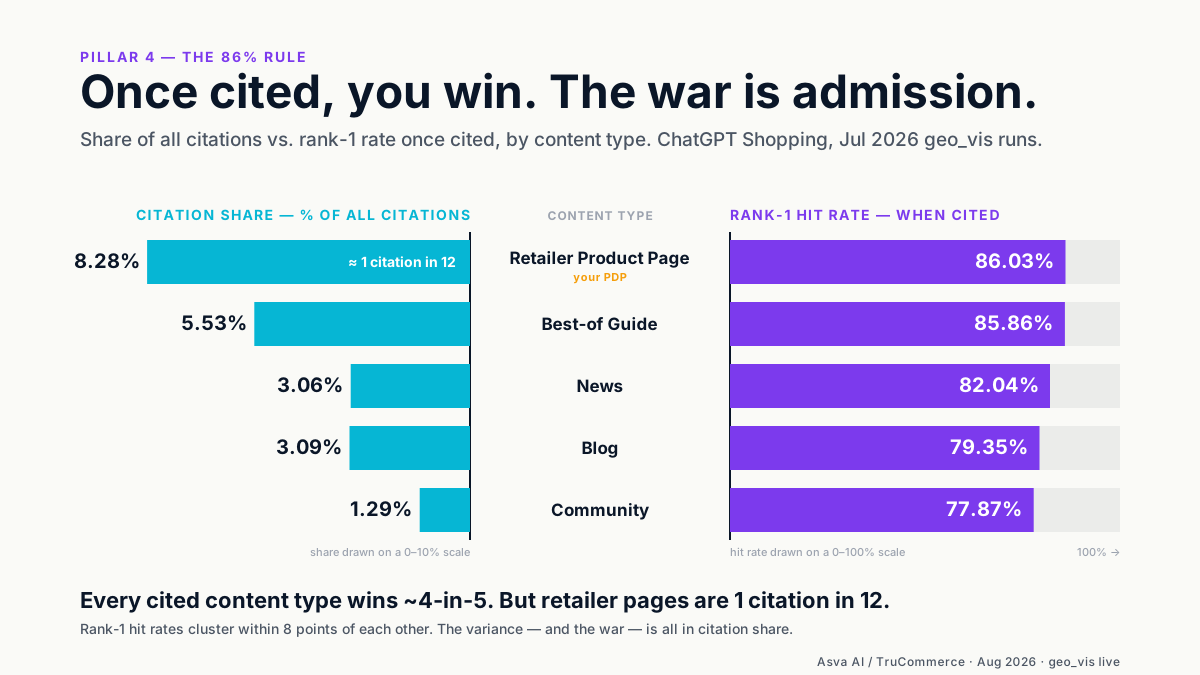
Every AI-visibility engagement starts with the same question: "How do we rank higher in ChatGPT?" It is the wrong question, and 18,942 classified citations prove it. When a retailer product page gets cited in a ChatGPT shopping answer, it takes the top recommendation slot 86.03% of the time - the best hit rate of any content type we measured. But retailer pages are only 8.28% of what ChatGPT cites. Ranking is a fight that is mostly decided before it is contested. The scarce battle is getting cited at all.
Two questions from real client conversations frame this piece. An FMCG major asked us, mid-audit: "Which marketplace should we prioritize for listing changes?" A retail-intelligence platform asked, more bluntly: "Do marketplace citations really decide AI answers?" Both questions assume the game is optimization - tweak the listing, climb the ranking. The data from our Amazon measurement program says the game is admission. There is a gate in front of the ranking, almost everything that matters happens at the gate, and most product pages never get through it.
This is the third piece in our Winning in AI Visibility with Amazon series, built on the same reverse-engineered dataset as the first two: the locked 425-prompt mixer-grinder panel plus the beauty-category expansion, pulled live from our geo_vis measurement schema.
The table that inverts the playbook
We classified 18,942 citations from ChatGPT shopping answers in a single high-competition category (mixer grinders, India) by content type, then measured each type's rank-1 hit rate - how often the product associated with that citation lands in the top recommendation slot.
| Content type | Share of citations | Rank-1 hit rate when cited |
|---|---|---|
| Retailer Product Page (/dp/, /product/) | 8.28% | 86.03% |
| Best-of / Buying Guide (/best/, /review/, /guide/, /vs/) | 5.53% | 85.86% |
| News / Editorial | 3.06% | 82.04% |
| Blog | 3.09% | 79.35% |
| Community / UGC (Reddit) | 1.29% | 77.87% |
| Other (unclassified URLs) | 78.76% | 82.17% |
Read the two columns against each other. The hit-rate column is compressed: the spread between the best classified content type (retailer PDP, 86.03%) and the worst (community, 77.87%) is barely eight points. Every content type that makes it into a ChatGPT answer converts to the top slot at roughly four-in-five or better.
The share column is not compressed at all. Retailer product pages - the single highest-converting citation type - are one citation in twelve. The battle for the hit-rate column is nearly a coin flip between content types. The battle for the share column is the whole war.
That is the 86% rule: once a product page is cited, it wins. The binding constraint is that it almost never gets cited.
Why eligibility is the whole game
Three findings from the wider dataset stack into the argument.
First: the shelf is assembled from the reading list. 84.6% of the products ChatGPT recommends come from its cited sources. The model does not recommend a product and then go looking for evidence; the evidence set largely determines the candidate set. If your product does not exist in the pages ChatGPT reads, it functionally does not exist at recommendation time.
Second: the reading list is overwhelmingly external. More than 95% of citations point to sources the brand does not own - editorial, affiliate guides, community threads, marketplaces. Across the full 114,705-citation dataset, retailer citations of any kind are just 2.43%, and Amazon - the most-linked marketplace on Earth - is 0.78% of all citations. Yet amazon.in appears as a buy-link on 61.48% of recommended products (24,467 of 39,796 shopping cards). Amazon is the purchase infrastructure on six of ten cards while being one in 128 citations. That asymmetry is the citation gate made visible at scale - and it answers the retail-intelligence platform's question directly: yes, citations decide the answer, and the marketplace's own PDP is almost never the citation doing the deciding.
Third: once you're in, position barely moves. Amazon's average buy-link position holds at ~1.87 across every run and category we measured - through a citation collapse, through a shelf reversal, through a full citation-graph rewire. Rank, once present, is basically invariant. Nobody is winning or losing on position. They are winning or losing on presence.
Put together: the funnel is eligibility → citation → recommendation → rank, and all of the variance lives in the first two stages. Optimizing rank is polishing the one variable the system has already fixed.
The three gates that actually decide eligibility
So what decides whether a product page is eligible to be cited? We falsified this the hard way - a cross-category hypothesis program (beauty plus kitchen, N=50 pilot re-run at N=158) that tested the standard PDP-optimization playbook claim by claim. Three gates survived. They are measurable, and none of them is "write better copy."
Gate 1 - The review-count gate
The single strongest supported hypothesis in the program: more reviews → more likely cited, r=0.49, confidence interval [0.43, 0.55]. The magnitude is what stops people: cited Amazon ASINs carry a median of roughly 25,000 reviews; uncited ones sit near 250. That is a 100× gap between the products ChatGPT vouches for and the ones it ignores - in the same categories, at the same price points.
The July 23 mixer-grinder card data shows the same gate operating at the card level:
| Card group (July 2026, mixer) | Cards | Avg reviews | Avg rating | % with any review data |
|---|---|---|---|---|
| With Amazon buy-link | 883 | 343 | 4.38 | 33% |
| Without Amazon buy-link | 1,041 | 191 | 4.40 | 15% |
Cards carrying an Amazon buy-link have 1.8× the average review count and are 2.2× more likely to carry any review data at all - while the ratings are statistically identical (4.38 vs 4.40). ChatGPT is not selecting better products. It is selecting richer ones: pages dense enough in verifiable social proof to be safely quoted. Reviews are not a ranking factor here; they are an admission ticket.
Gate 2 - The product-type gate
Citation eligibility is not evenly distributed across categories, and the differences are not small. In the beauty falsification set, product type predicted citation with a Cramér's V of 0.55 - a strong association. Sunscreen ASINs were cited at 44.0%. Skin moisturizers: 2.7%. Generic beauty: 2.6%. A sunscreen is 15-20× more likely to be cited than a moisturizer sitting in the same storefront, with the same seller, often the same brand.
The cross-category ASIN data makes the gate concrete. For every Amazon ASIN appearing as a buy-link, what fraction also appears as a citation?
| Topic | Buy-link ASINs | Cited ASINs | Cite rate |
|---|---|---|---|
| Sunscreens & Sun Protection | 202 | 40 | 19.8% |
| Mixers - Regional | 83 | 8 | 9.6% |
| Mixers - Appliances | 63 | 6 | 9.5% |
| Mixers - Use Cases | 104 | 6 | 5.8% |
| Mixers - Brands | 41 | 2 | 4.9% |
| Mixers - Specifications | 64 | 3 | 4.7% |
| Mixers - Price | 62 | 2 | 3.2% |
Beauty PDPs get cited at 2-6× the rate of kitchen-appliance PDPs, even when the appliance ASIN is already the buy-link on the card. Some product types are born citation-eligible - ingredient-driven, spec-attestable, claim-heavy categories where the PDP itself is the evidence. Others will need their evidence built off-page no matter how good the listing is. Knowing which side of that line your catalog sits on is worth more than any amount of title optimization.
Gate 3 - The sub-intent gate
Even within one category, ChatGPT does not read retailer pages uniformly across query types. Spec-oriented sub-topics pull retailer product pages at 13.98% of citations; regional long-tail queries pull them at 7.65%, use-case queries at 6.23%. When a buyer asks a specification-shaped question - wattage, jar capacity, warranty - the model reaches for PDPs, because PDPs are where specs live. When the question is "best mixie for dhokla batter," it reaches for guides and community threads instead.
The tactical read: your PDP's citation surface is concentrated in spec-shaped queries. If the specs are buried in an image, a PDF, or below the fold, you are invisible precisely where retailer pages get read the most.
The levers that tested dead
Falsification cuts both ways, and two of the most widely-invoiced PDP levers did not survive it.
Category breadcrumbs: odds ratio exactly 1.0. The hypothesis that a wrong category/breadcrumb suppresses citation returned an odds ratio of 1.0 with a Fisher p-value of 1.0 - as null as a result can be. This directly contradicted our own earlier working assumption that category fixes were the #1 lever. They are hygiene. Do them for catalog sanity, not for AI visibility, and do not pay anyone who promises citations from them.
Variant consolidation: inverse. The hypothesis that consolidating variants helps citation came back not just unsupported but backwards - ρ between −0.44 and −0.48. Fragmented variant families were, if anything, more visible. The defensible reframe is "promote one canonical variant," not "merge everything." An agency proposing a consolidation project as an AI-visibility play is selling a lever that measures negative.
Half the standard listing-optimization playbook, in other words, does not survive contact with data. The half that survives - reviews, product-type fit, sub-intent presence - is unglamorous and slow. That is usually the sign it is real.
What to do on Monday
- Re-score your catalog for eligibility, not rank. Bucket every hero SKU: cited / buy-link-only / absent. Your growth is in the buy-link-only bucket - products ChatGPT already sells but will not vouch for. Migrating that bucket is the program; rank tracking is a byproduct.
- Treat 1,000 reviews as the floor, not the target. The cited-vs-uncited median gap is 25,000 vs ~250. Concentrate review velocity on the handful of ASINs you need cited rather than spreading it across the catalog.
- Pick fights your product type can win. If you sell in a high-cite-rate category (sunscreens at 19.8%), invest in the PDP itself. If you sell in a low-cite-rate one (price-intent appliances at 3.2%), your citation budget belongs off-page - best-of guides convert at 85.86%, nearly matching PDPs, and are far easier to place.
- Put specs above the fold, in text. Spec-shaped queries are where retailer pages get read (13.98% of citations vs 7.65% on regional queries). A structured, crawlable spec table is the cheapest eligibility move on the board.
- Stop buying dead levers. Breadcrumb remediation (OR=1.0) and variant consolidation (inverse) are off the visibility roadmap. Redirect that budget to reviews and external citation surface.
- Track citation and placement separately. Amazon's own numbers - 0.78% of citations, 61.48% of buy-links - only make sense as two metrics. A blended score would have hidden the entire story.
The same measurement-first loop drove our Amazon India engagement, where Top-5 presence rose +2.4% in 6 weeks - see the Amazon case study. The usual first step is Share of Voice.
FAQ
It is the finding that when a retailer product page is cited in a ChatGPT shopping answer, the associated product wins the top recommendation slot 86.03% of the time - the highest rank-1 hit rate of any content type in an 18,942-citation dataset. Because retailer pages are only 8.28% of all citations, the practical implication is that eligibility (getting cited at all) matters far more than ranking (position once cited).
Three levers are statistically supported: build review volume (cited ASINs carry a median ~25,000 reviews vs ~250 for uncited, r=0.49), sell or lead in product types with high citation propensity (sunscreen ASINs cite at 19.8% vs 3.2-9.6% for appliances), and expose structured specs above the fold, because spec-shaped queries pull retailer pages at nearly twice the rate of other query types.
Yes - it is the strongest supported hypothesis in our cross-category falsification program (r=0.49, CI [0.43, 0.55]). Notably, ratings do not differentiate: cards with and without Amazon buy-links rate 4.38 vs 4.40. It is review *volume and richness* that gates citation, not review sentiment.
No. The category/breadcrumb hypothesis returned an odds ratio of exactly 1.0 (Fisher p=1.0) - no measurable effect on citation. Variant consolidation tested worse: inversely correlated with visibility (ρ=−0.44 to −0.48). Both belong in catalog hygiene, not in an AI-visibility budget.
84.6% of recommended products come from ChatGPT's cited sources, and over 95% of those citations are external to the brand: affiliate best-of guides, editorial, community threads, and comparison sites. Retailer product pages are just 8.28% of citations - scarce, but the highest-converting citation type when they appear.
Amazon is 0.78% of all citations in the 114,705-citation dataset, yet amazon.in is a buy-link on 61.48% of recommended products. ChatGPT uses external sources as evidence and Amazon as fulfillment. That is exactly why the eligibility fight matters: a cited Amazon PDP converts to the #1 slot ~86% of the time, so every PDP that clears the citation gate compounds an already-dominant buy-link position.
Continue reading
August 7, 2026
Query Fan-Out: One Question Becomes 5-7 Searches (And ChatGPT Rewrites All of Them)
A user typed 'ALTRR Portable Spice Mill (200W)' into ChatGPT. The shopping backend searched 'portable spice grinder travel' - brand stripped, spec dropped, intent added. That rewrite is stamped into every card's payload as generated_product_query, and it is only one branch of a fan-out that turns a single buyer question into 5-7 sub-queries across 8 distinct axes. Classical SEO optimizes one keyword per page. AI shopping ranks you across the whole fan-out - which is exactly why Amazon holds 63-79% presence on every sub-intent type we measure.
August 7, 2026
AI Visibility Has Two Layers: The Placement vs Citation Dashboard That Actually Works
AI shopping answers have two independent layers - the products the model recommends (placement) and the sources it attributes the answer to (citation) - and every brand's AI-visibility dashboard is quietly blending them into one number that lies. On Amazon's India mixer-grinder data, one layer is 61.48% and the other is 0.78% - a 79× gap. On sunscreens the same structural pattern holds at 25×. And both layers moved in opposite directions twice in eight months. Here is the four-KPI-group model that fixes it.
August 7, 2026
The Amazon Shelf Story: What Really Happened to Amazon in ChatGPT Shopping Between May and July 2026
Everyone screenshotted the May chart: Amazon's ChatGPT presence rose to 96% while its citation rate collapsed to 1.91%. Two months later, on the exact same 425 buyer prompts, both metrics reversed - and the popular narrative got the story completely wrong. The 96% was on a half-empty shelf (56% zero-card responses). The July shelf is about three times healthier. And Amazon still wins the top-2 slot plus cheapest price on 210 of those 425 prompts. Here is the reverse-engineered version of what actually moved.