
ChatGPT Ads Examples: 1,193 Real Ads, Measured
A public ChatGPT ad library exists, and we crawled it in full: 1,193 unique creatives from 336 advertisers, each with the conversational prompt that fired it. The headline finding is that the format limit is 50 characters and the median ad uses 26. Real examples, the conquesting pattern behind comparison prompts, and five templates for your own category.
Viren Inaniyan · August 29, 2026 · AI Search Visibility
Every ad in ChatGPT is the same small unit: a 50-character title, a 100-character description, and a set of written context hints doing the targeting work keywords used to do. That makes ad construction unusually learnable — the same patterns repeat across categories. Below: a real ad from our own advertiser account, the named brands on record, and five template builds, archetype by archetype.
What a real ChatGPT ad looks like
This is a real one — the generated ad preview from our own OpenAI Ads Manager account, rendered exactly as ChatGPT shows it to a Free or Go user:
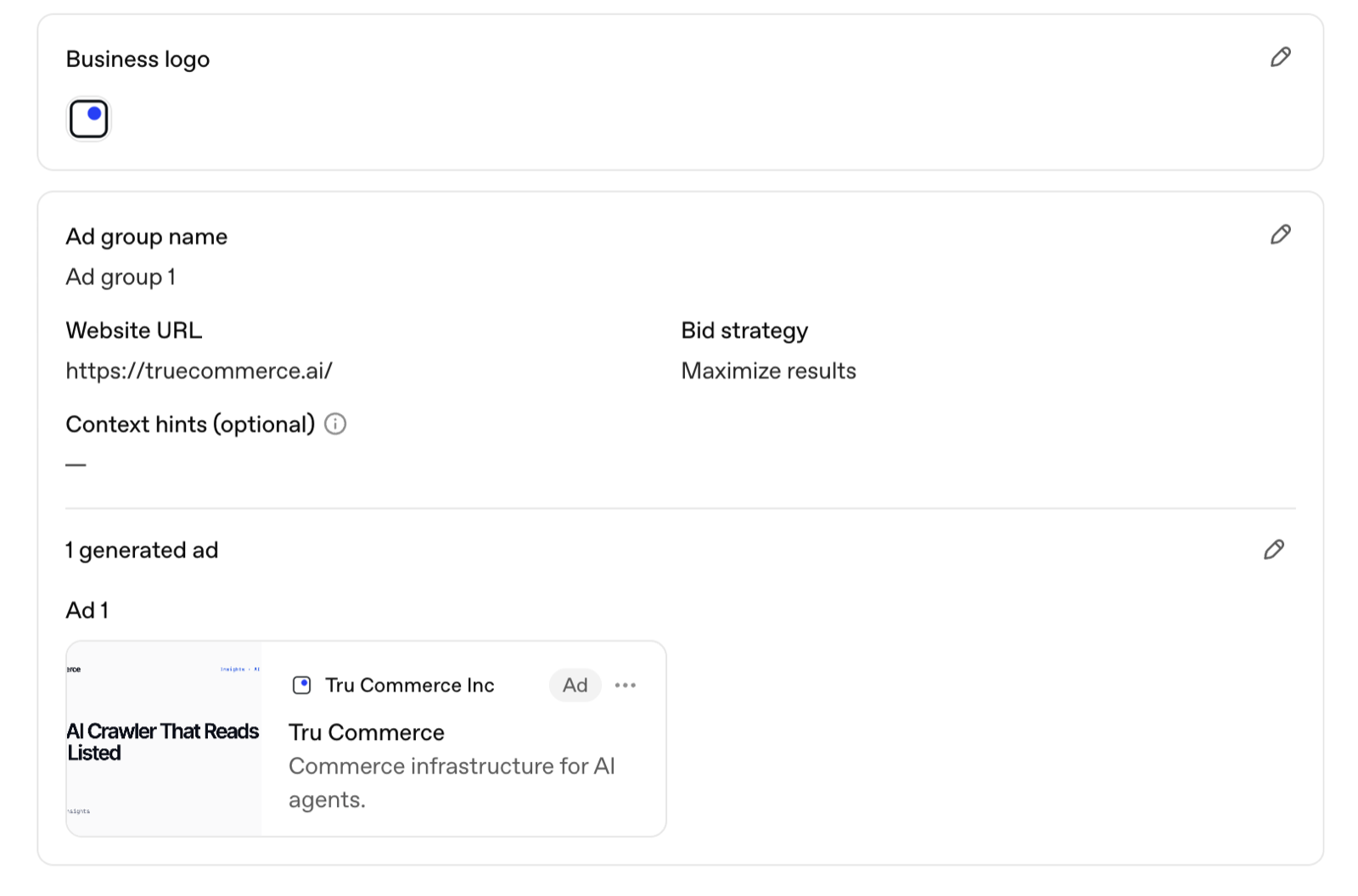
The format is fixed: since the US test began on February 9, 2026, every ad has been a single labeled sponsored box below the answer, with the advertiser's name, a logo, a title of up to 50 characters, a description of up to 100 characters, a square image of at least 256×256 pixels, and a destination link (OpenAI, 2026). One advertiser per matched conversation. Bids start around $3–5 CPC in most categories and $8–18 in software and finance (WebFX; OpenAI docs, 2026). The full mechanics — auction, budgets, verification — are in our Ads Manager guide.
The brands running real ChatGPT ads
A public ad library now exists, and we have measured it — see the section below. Trade reporting has separately named the confirmed advertisers from the US pilot (Floodlight; Marketing4eCommerce, February 2026): Target through its Roundel retail-media arm, Williams-Sonoma, Albertsons, HelloFresh, The Knot Worldwide, Audible, Adobe (Acrobat and Firefly, via WPP), Ford and Mazda (via WPP), and Audemars Piguet. In India, 50+ brands went live in the launch week starting August 27, 2026, with WPP and Omnicom as the first agency partners (The Hindu BusinessLine). The full roster, and what the category pattern means for your brand, is in who is advertising on ChatGPT; what self-serve advertisers report spending is in our Reddit roundup.
1,193 real ChatGPT ads, measured
In September 2026 we crawled the public ChatGPT Ad Library (chatgptadlibrary.com) in full — 4,276 pages — and decoded the structured ad objects behind its vertical leaderboards. That gives us 1,193 unique creatives from 336 advertisers, each with its title, body copy, destination URL, appearance count, and the conversational prompts that fired it. Last-seen dates run 1 July to 3 August 2026.
Read the sample honestly. Each vertical page exposes only its top two or three ads, so this is a top-of-leaderboard slice biased toward high-frequency advertisers — roughly 7% of the ads that library reported holding as of August 2026. Everything below is "in this sample", not a market rate.
The format limit is 50 characters. Almost nobody uses 30 of them.
OpenAI allows a title up to 50 characters and a description up to 100. Here is what advertisers actually ship:
| Spec limit | Median in this sample | Share using >50 chars | |
|---|---|---|---|
| Title | 50 chars | 26 chars (4 words) | 0.3% (3 of 1,193) |
| Description | 100 chars | 57 chars | 0.5% over 100 |
That is the single most useful number on this page. The limit is not the target. The ads that run most often are roughly half the permitted length — because the card sits under a finished answer, and a reader who already has their answer will not work through a dense one.
Real ads, and the conversations that fired them
Verbatim from the corpus. The prompt column is a conversation the library recorded as triggering that creative.
| Advertiser | Title | Description | A prompt that fired it |
|---|---|---|---|
| TouchBistro | Need a new POS? (15) | Manage your whole restaurant on one platform. | "is Toast worth it for a fine dining restaurant with 12 tables" |
| Drata | SOC 2 Compliance (16) | Automate and accelerate SOC 2 compliance | "AuditBoard vs Diligent vs Galvanize for board level GRC reporting" |
| Angi | EV Charger Install Pros (23) | Get quotes in minutes from affordable EV charger pros. | "best home level 2 ev charger under $600 in 2026" |
| Resume.io | Resume Done Right (17) | Turn ChatGPT content into a real resume. | "is online cpr certification actually accepted by employers" |
| VistaPrint | Birthday soon? (14) | Vinyl banners for every birthday party | "is it worth paying more for a premium birthday character company" |
| HiBob | HiBob: All-in-One HR System (27) | One HR platform. Global team. Zero chaos >> Learn more | "best software for international HR audits and payroll documentation" |
| Monday.com | If Dashboards Are A Must (24) | See how teams track KPIs and progress with AI dashboards. | "how do I unify siloed data across schedules costs and field reports in construction" |
| Capterra | Top Survey & Form Tools (23) | Find top-rated feedback & data collection apps. | "which tools help mobile app founders stay updated on customer feedback?" |
Three things jump out of that table.
The prompt is a sentence, not a keyword. Median trigger length across the sample is 14 words. "is Toast worth it for a fine dining restaurant with 12 tables" is how people actually talk to an assistant, and it carries the budget, the segment and the objection in one line. Nobody types that into Google.
The brand in the prompt is often not the brand in the ad. A shopper asks about Toast and gets TouchBistro. A shopper compares AuditBoard, Diligent and Galvanize and gets Drata — a fourth company entirely. 25% of triggers in this sample are comparison prompts (vs, compare, alternative), and conquesting is the norm rather than the exception. If your category has a category leader, people are asking about them by name and your competitors are buying that moment.
The creative almost never picks the fight. Under 1% of creatives contain "vs" at all, and only 14% put the advertiser's name in the title. The comparison happens in the prompt; the card just answers "which one".
Who actually runs these
By appearance count in this sample, the heaviest advertisers are BestMoney (1,460), ZoomInfo (799), Capterra (423), Mastercard (282), Angi (219), HiBob (207) and Cloudflare (203). That is comparison sites, B2B data and home services — direct-response categories, not brand advertising. If you are a consumer brand, the auction you are entering is emptier than the headline advertiser counts suggest.
Five templates for your own category
The corpus above shows what is running. It does not show your category — no library covers every vertical, and OpenAI keeps conversations private from advertisers, so nobody can hand you a competitor's exact live creative on demand. The five builds below are templates written to the measured reality above: short titles, one-line bodies, and hints written as buyer moments. Treat them as starting points, not as evidence of what any specific brand is running.
Example 1: DTC skincare
The buyer moment. Someone describes their skin to ChatGPT — "oily, breaks out around my chin, sensitive to fragrance" — and asks what routine to follow. That specificity is the targeting.
Title (43 chars): Clearer skin in 8 weeks, or your money back
Description (86 chars): Clinically tested niacinamide serum for oily, acne-prone skin. Free shipping over $30.
Context hints (a sample of the 5–15):
- "The user is describing oily or acne-prone skin and asking for a routine or product recommendations."
- "The user is comparing niacinamide, salicylic acid, or retinol products for breakouts."
- "The user asks what serum to use for hormonal acne or clogged pores."
Why it works. The title sells the outcome and removes the risk in one line — no brand name wasted (the advertiser name already renders above the title). The description carries the proof point ("clinically tested") and the friction-remover ("free shipping"). The hints mirror how people actually describe skin in conversation, not how the brand describes its ingredients. For catalog-scale skincare brands, product feed ads — launched June 2026 with a 100-SKU minimum — can generate these per-product automatically.
Example 2: B2B SaaS
The buyer moment. A finance lead asks ChatGPT how to shorten the monthly close, or what tools integrate with NetSuite. Software and finance are the expensive end of the auction — $8–18 CPCs (WebFX, 2026) — so precision in the hints matters most here.
Title (39 chars): Close your books in 3 days, not 3 weeks
Description (98 chars): Accounting automation for 50–500 person companies. Connects to QuickBooks and NetSuite in minutes.
Context hints:
- "The user is asking how to speed up the monthly or quarterly close process."
- "The user is comparing accounting automation or close-management software for a mid-size company."
- "The user mentions reconciliation taking too long or asks what integrates with NetSuite or QuickBooks."
Why it works. The title is a before/after in nine words. The description qualifies the buyer by company size — at these CPCs, disqualifying the wrong clicker is worth more than attracting an extra one. Note what is absent: no "AI-driven platform" language, because the person is already talking to an AI and the ad sits under a better answer than any adjective.
Example 3: Food delivery
The buyer moment. "What should I make for dinner with what's in my fridge?" or "best late-night food near me." High intent, short window, decided in minutes.
Title (33 chars): Dinner at your door in 30 minutes
Description (75 chars): Order from 2,000+ local restaurants. First delivery free for new customers.
Context hints:
- "The user is deciding what to eat tonight and seems short on time or ingredients."
- "The user asks about takeout, delivery, or late-night food options in their city."
Why it works. Speed is the only outcome that matters in this moment, so the title is a clock. Geography does the rest: ChatGPT ads target by country, region, DMA, and postal code (OpenAI, 2026), so a delivery service bids only where it operates. The new-customer offer belongs in the description because this archetype lives or dies on first-order acquisition.
Example 4: Consumer electronics
The buyer moment. Research mode: "OLED vs QLED for a bright living room," "best TV under $1,500 for gaming." These are the comparison conversations where ChatGPT already assembles a shortlist organically — the ad rides alongside it.
Title (44 chars): The 65-inch OLED reviewers keep shortlisting
Description (72 chars): Compare specs, read the 4K gaming test results, and check today's price.
Context hints:
- "The user is comparing TV technologies or asking which TV to buy for gaming or movies."
- "The user has a budget in mind for a large-screen TV and is weighing two or three models."
Why it works. Research-mode buyers do not want to be sold; they want their comparison finished. The title borrows third-party validation, and the description invites more research rather than demanding a purchase. This is also the archetype where the organic layer matters most — whether ChatGPT's own answer names your product is decided by your catalog data and citations, not your bid. Our ChatGPT shopping teardown covers how that earned shortlist is assembled.
Example 5: Online education
The buyer moment. Career-change conversations: "how do I get into data analytics without a degree," "is a bootcamp worth it in 2026." Long consideration cycles, so the conversion-optimized CPC bid model — where OpenAI optimizes delivery toward your conversion event but still charges per click (OpenAI Help Center, 2026) — fits this archetype well.
Title (43 chars): Learn data analytics in 12 weeks, part-time
Description (74 chars): Live online cohort with job placement support. Next start date: October 6.
Context hints:
- "The user is asking how to switch careers into data, analytics, or tech roles."
- "The user is comparing bootcamps, certificates, or online courses and asking about job outcomes."
- "The user mentions studying part-time or learning alongside a full-time job."
Why it works. "12 weeks, part-time" answers the two objections — time and feasibility — before the click. A dated start creates a real deadline without fake urgency. The hints capture the doubt stage ("is it worth it"), not just the purchase stage, because education buyers spend most of the funnel there.
The pattern underneath all five
Titles sell outcomes, not products. Clearer skin, faster close, dinner in 30 minutes. Fifty characters is not enough room for features, and the advertiser name already renders above the title.
Descriptions carry one proof point and one friction-remover. Clinically tested + free shipping. Named integrations + company-size fit. Nothing else fits in 100 characters, and nothing else needs to.
Context hints are buyer moments, not keyword lists. The unit of targeting is a sentence describing a situation. Writing "niacinamide serum acne treatment" is porting a Google habit into a system that has no keywords; writing "the user is describing oily, breakout-prone skin and asking for a routine" is using the system as designed.
Expectations stay modest. Chatbot ad CTR benchmarks sit around 0.9% versus roughly 6.4% for Google search (eMarketer, 2026), and delivery ramps slowly during beta by design (OpenAI onboarding). Our own US campaigns have averaged around 1.3% CTR since July 2026 (our campaign data). Where the next dollar should go depends on your category — we work through that math in ChatGPT ads vs Google Ads, and the full format reference lives on our ChatGPT Ads hub.
Related: the surface with no ads at all
Meta's Muse agent, the number one US app in September 2026, carries no sponsored placement; Zuckerberg said Meta expects "over time" to take "a small fee from transactions" instead (Connect, 23 September 2026). What is documented about how it picks products, and what is only guessed, is in How Meta Muse shops.
Related: six weeks of ChatGPT Ads in India, on the record
ChatGPT Ads switched on in India on 27 August 2026 and, by 1 September, OpenAI was reporting a $1 billion annualised run rate (exchange4media, 1 September 2026). What the Indian business press asked us in those six weeks, every answer verbatim with the data behind it, is in ChatGPT Ads in India: six weeks in, on the record.
Where Tru Commerce fits
Every example above buys one thing: a labeled box under the answer, shown only to Free and Go users. The answer itself is a separate layer — and brands cannot buy influence over ChatGPT's answers (OpenAI, 2026). Plus and Pro users, who never see ads at all, only ever see the earned recommendation. That earned layer converts remarkably well: AI-referred visits to US retail sites convert 60% better than non-AI traffic (Adobe Analytics via Digital Commerce 360, July 2026 data).
So before you write your first title, find out what the answer already says about you. Our free Citation Rank scan shows where your brand ranks in AI answers across ChatGPT, Gemini, Perplexity, and more — results in 24 hours, no login, no credit card. If the organic layer needs work, start with your product catalog; it feeds both the answers and, since June 2026, the ads.
FAQ
Yes. A public ChatGPT ad library exists, and in September 2026 we crawled it in full and decoded 1,193 unique creatives from 336 advertisers, with last-seen dates from 1 July to 3 August 2026. Real examples include TouchBistro's “Need a new POS?” firing on the prompt “is Toast worth it for a fine dining restaurant with 12 tables”, and Drata's “SOC 2 Compliance” firing on “AuditBoard vs Diligent vs Galvanize”. Note the sample is a top-of-leaderboard slice, roughly 7% of that library's holdings.
The limit is 50 characters, but the limit is not the target. Across 1,193 measured creatives the median title is 26 characters — about four words — and only 0.3% use more than 50. Median description length is 57 characters against a 100-character limit. Short wins because the card sits below an answer the reader already has.
Often, yes. In our sample 25% of the conversational prompts that fired an ad were comparison prompts using “vs”, “compare” or “alternative”, and the brand named in the prompt is frequently not the brand in the card — a question about Toast returned a TouchBistro ad. Conquesting is the norm in this format, not the exception.
A single labeled sponsored box below the answer: advertiser name, logo, a title up to 50 characters, a description up to 100 characters, a square image, and a destination link. Only one advertiser appears per matched conversation (OpenAI, 2026).
Confirmed US-pilot advertisers include Target (via Roundel), Williams-Sonoma, Albertsons, HelloFresh, The Knot Worldwide, Audible, Adobe, Ford, Mazda, and Audemars Piguet (Floodlight; Marketing4eCommerce, Feb 2026). In India, 50+ brands went live in launch week starting August 27, 2026 (The Hindu BusinessLine).
Lead the title with the outcome the buyer asked about, use the description for one proof point plus one friction-remover, and write 5–15 context hints describing the buyer moments you want to match (OpenAI Ads Manager guidance).
No. There are no keywords or exact-match rules. Matching is conversational — based on the current topic, past chats, and past ad interactions — steered by the context hints you write per ad group (OpenAI, 2026).
OpenAI recommends 5–15 discrete context hints per ad group, each a 1–2 sentence description of a buyer moment. Hints guide matching; they are not exact-match rules (OpenAI Ads Manager docs).
Only logged-in adults on the Free and Go tiers. Plus, Pro, Business, Enterprise, and Education users never see ads, and ads never influence ChatGPT's answers (OpenAI, 2026).
Sources
- 1.Ads in ChatGPT: The Basics - OpenAI Help Center, 2026
- 2.Create campaigns for ChatGPT - OpenAI Help Center, 2026
- 3.Ads Manager Beta: account setup - OpenAI Help Center, 2026
- 4.Adobe: AI referral traffic to retail sites converts 60% higher, July 2026 data - Digital Commerce 360, 2026
Continue reading
October 10, 2026
ChatGPT Ads in India: six weeks in, on the record
ChatGPT Ads switched on in India on 27 August 2026. Six weeks on, eight articles in five outlets quoted us and TechTimes cited our benchmarks. Every question the press asked, every answer verbatim and linked, and the numbers behind each one.
September 4, 2026
Criteo Prompt Smart Ads: 2,000 Brands on ChatGPT and a 4x Spend Lift
Criteo was the first ad-tech partner inside OpenAI's ChatGPT ads pilot. Its Prompt Smart Ads product auto-generates creatives and context hints matched to how people actually prompt - here is what it is, the numbers behind it, and what its creative reports teach every advertiser.
September 2, 2026
ChatGPT Ads Conversion Strategies: What the Query-Mix Data Says to Do
Only ~1 in 10 ChatGPT conversations carries commercial intent, 76.4% of shopping answers already show an ad, and market leaders buy almost none of them. Four strategies built on that data - not on search-ads instinct.