
How to Optimize Your Product Catalog for AI
AI assistants now read your catalog before shoppers do - and most product pages are unreadable to them. Here's how to fix the data, the feed, and the crawl access so agents recommend you.
Viren Inaniyan · July 14, 2026 · AI Search Visibility
title: "How to Optimize Your Product Catalog for AI" slug: "optimize-product-catalog-for-ai" author: "Tru Commerce" publishedAt: "2026-08-08" updatedAt: "2026-08-08"
metaTitle: "How to Optimize Your Product Catalog for AI (2026)" metaDescription: "The practical playbook for making your product catalog readable - and recommended - by ChatGPT, Perplexity, Gemini, and Google AI Overviews." primaryKeyword: "how to optimize product catalog for AI" schemaType: "BlogPosting" canonicalUrl: "https://trucommerce.ai/insights/optimize-product-catalog-for-ai" ctaUrl: "https://trucommerce.ai/free-tools/citation-rank"
pillar: "Catalog Optimizer" cluster: "aeo" tags:
- "AEO"
- "product catalog"
- "structured data"
- "AI shopping"
- "Shopify"
excerpt: "AI assistants now read your catalog before shoppers do - and most product pages are unreadable to them. Here's how to fix the data, the feed, and the crawl access so agents recommend you."
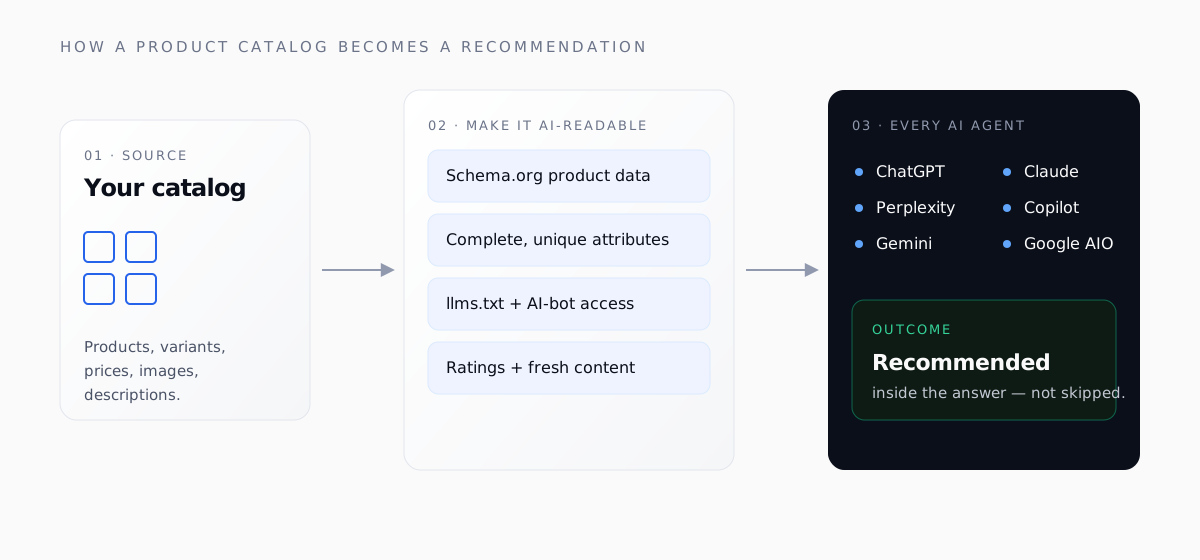
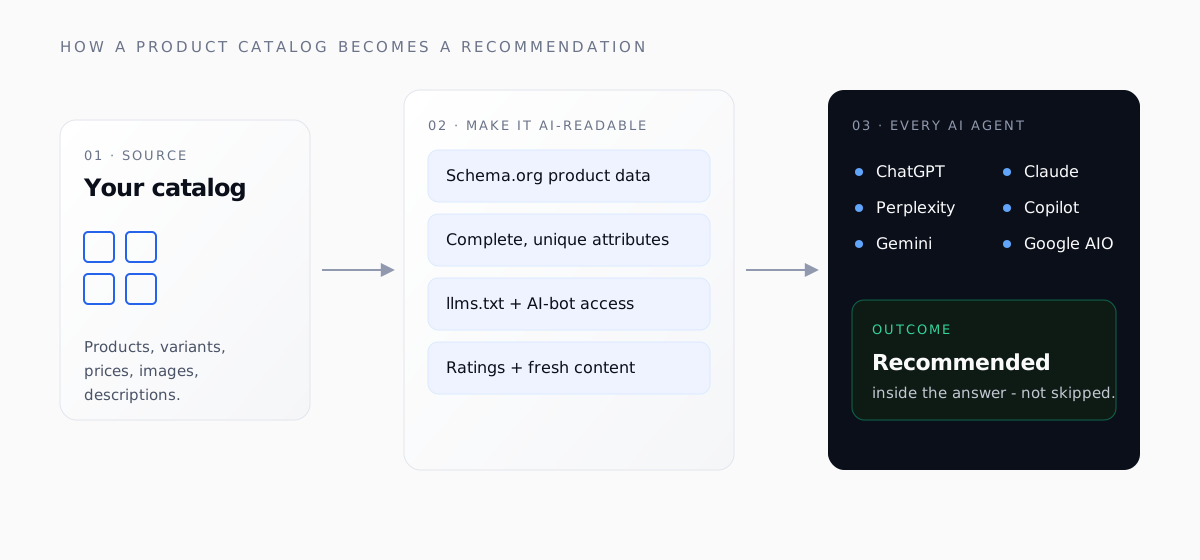
image_alt: "Flow diagram: a product catalog becomes an AI recommendation through structured data, complete attributes, llms.txt, and AI-bot access, surfacing across ChatGPT, Perplexity, Gemini, Claude, Copilot, and Google AI Overviews." image_path: "/blog-images/optimize-product-catalog-for-ai/catalog-to-ai-flow.svg"
status: "draft" hidden: false
How to Optimize Your Product Catalog for AI
AI assistants now read your catalog before a shopper ever does. Optimizing it for AI means shipping product data an agent can read - structured, server-rendered, and crawlable - so ChatGPT, Perplexity, Gemini, and Google AI Overviews recommend your products instead of skipping them.

What "optimizing your catalog for AI" actually means
It means making every product machine-readable so an AI agent can extract your price, stock, and attributes and quote them in an answer. This is a different job from ranking a page. Traditional SEO earns a blue link; AI optimization earns a sentence inside the response - often with no click at all.
The urgency is measurable. AI-referred traffic to U.S. retail sites grew 393% year over year in Q1 2026 (Adobe Analytics, reported by Digital Commerce 360, June 2026), and that traffic converts 42% better than non-AI traffic with 37% higher revenue per visit (Adobe Analytics, April 2026). Yet retail product detail pages score the lowest AI-readability of the retail page types Adobe measured - 66%, versus 74% for category pages and 75% for homepages (Adobe AI Content Visibility Checker, 2026), because they're the most numerous and least hand-optimized pages on a store. The demand is arriving faster than catalogs are ready for it.
Ship product data an agent can read without JavaScript
This is the single biggest technical mistake, so fix it first: major AI crawlers fetch raw HTML and do not execute JavaScript. Analyses of GPTBot's behavior (Vercel / MERJ, 2025) found no evidence it runs JS. So any price, spec, review, or variant that only appears after a client-side render is invisible to the agent - even on a page that ranks #1 on Google, which does render JavaScript.
The fix is server-side rendering or prerendering: the critical product facts must be present in the initial HTML the crawler receives. If your PDP loads a skeleton and then hydrates the price and reviews in the browser, ChatGPT and Claude see the skeleton. Test it the way an agent sees it - view the raw page source (not the rendered DOM) and confirm the price, availability, and description are actually there.
Structured data: the Product fields that decide whether you show up
Add Product JSON-LD, server-rendered, to every PDP - it's how a machine reliably reads your catalog. The fields that matter most:
name,description,brand- the minimum an agent needs to identify the product and attribute it to you.offers→price,priceCurrency,availability- price and in-stock status are what AI systems treat as authoritative for whether to surface you at all.gtin/mpn/sku- unique IDs let agents match your item across feeds and dedupe it; missing GTINs are a top feed-disqualification reason.aggregateRating+review- ratings are heavily weighted in "best X" queries. Adding review schema alone drove an estimated ~20% organic-traffic uplift in a controlled SEO A/B test (SearchPilot, 2025).image, plus retail fields likeshippingDetailsandhasMerchantReturnPolicy- the exact data agents need to answer "does it ship free / can I return it" without leaving the conversation.
Validate everything in Google's Rich Results Test, and make sure the schema reflects what's visible on the page - markup describing content a reader can't see is a weaker signal, and AI crawlers discount it.
Your product feed is the front door
For AI shopping, the Google Merchant Center feed is often what agents read first - not the page. Roughly 83% of products shown in ChatGPT shopping carousels matched Google's top-40 organic Shopping results (Athos Commerce / Search Engine Land, 2025). A complete, error-free feed - valid GTINs, populated google_product_category, live price and stock, zero disapprovals - is now foundational to AI visibility, not just a paid-Shopping concern.
This is why "we don't run Shopping ads" is no longer a reason to neglect the feed. The feed is upstream of whether an agent can recommend you organically.
Write for extraction, not for vibes
Agents extract facts, not adjectives. Manufacturer boilerplate duplicated across every reseller gives an agent no reason to pick you; unique, attribute-rich copy - materials, dimensions, compatibility, and explicit "best for" use-cases - is what matches long-tail shopping queries. The same product can be invisible or quotable depending entirely on how its data is written and structured.
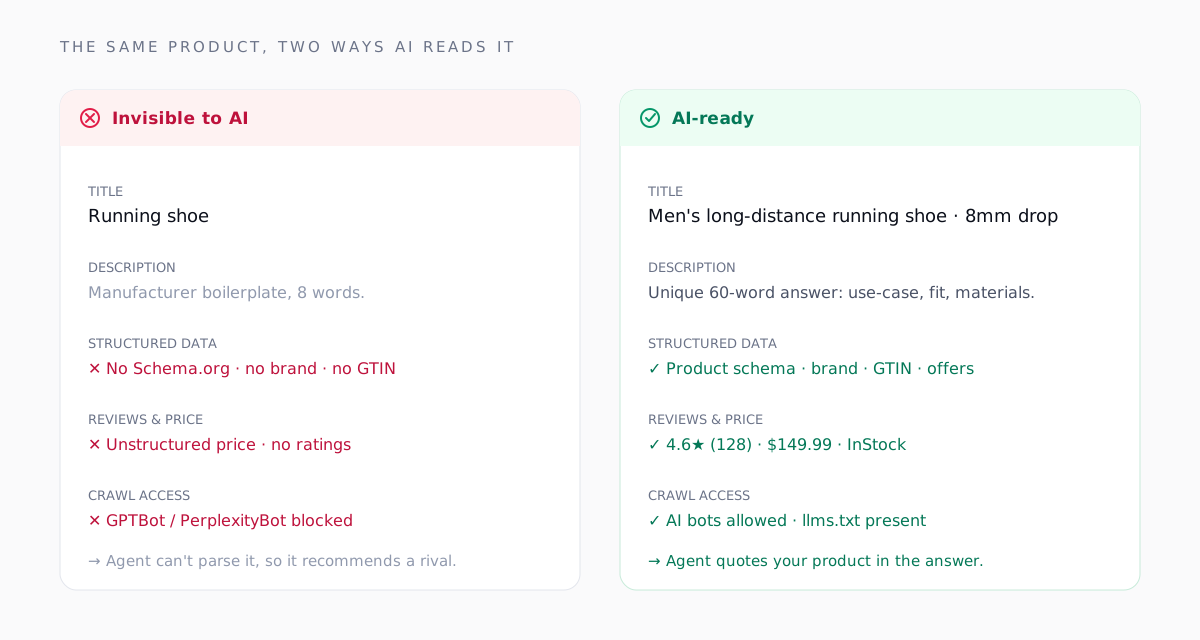

Write descriptions as facts an agent can lift: specific attributes, plain-language use-cases, and bulleted specs beat hero prose. Then consolidate variant and parameter URLs with canonical tags so your reviews and signals aren't split across duplicates.
Let the right crawlers in
If you block the crawlers, you can't be cited. Check robots.txt and explicitly allow the agents you want: OpenAI's GPTBot and OAI-SearchBot, Anthropic's ClaudeBot, and Perplexity's PerplexityBot.
One nuance trips up a lot of stores: Google-Extended controls Gemini training only - it does not control Google AI Overviews. AI Overviews are generated from the normal Googlebot index, so if you block Googlebot to "keep AI out," you remove yourself from AIO entirely. Don't over-block. Then add an llms.txt at your root pointing agents to your authoritative catalog, shipping, and returns pages - it's low-cost upside while adoption is still emerging, not a substitute for structured data.
Reviews and freshness close the sale
Two signals punch above their weight at the moment of purchase intent. Reviews: volume and recency feed both your aggregateRating schema and an agent's confidence when ranking "best" and "top" queries. Freshness: for commercial queries, stale price or stock doesn't just look bad - it gets you excluded or surfaced wrong exactly when a shopper is ready to buy. Keep the feed and PDP price/availability live and accurate, and treat review generation as an AI-visibility lever, not just a social-proof one.
The stakes are high because the click is disappearing. When a Google search shows an AI summary, users click a traditional result on just 8% of visits, versus 15% when no summary appears - and click a link inside the summary itself on only 1% of visits (Pew Research Center, July 2025). Being the recommended product increasingly matters more than earning the visit.
The 10-point AI catalog readiness checklist
- Server-render (SSR/SSG) every PDP so price, specs, and reviews live in the raw HTML.
- Add valid
ProductJSON-LD: name, description, brand,offers(price/currency/availability), image. - Include unique product IDs - GTIN and/or MPN - on every item.
- Add
aggregateRating+reviewschema; grow review volume and recency. - Write unique, attribute-rich descriptions - kill manufacturer boilerplate.
- Keep a complete, error-free Google Merchant Center feed with live price and stock.
- Allow AI crawlers in
robots.txt(GPTBot, OAI-SearchBot, ClaudeBot, PerplexityBot); never block Googlebot. - Set canonical tags to consolidate variant and parameter URLs.
- Add descriptive alt text and clean, canonical product images.
- Publish
llms.txt, then validate every schema type in Google's Rich Results Test.
Where this fits in your AI visibility work
Everything above makes your catalog readable. The harder question is whether the work is translating into actual recommendations across the surfaces your buyers use - and that's a measurement problem, not a content one. A free Citation Rank scan shows where AI agents surface you versus competitors today, so you know which fixes moved the needle.
If you're on Shopify, most of this checklist - schema, AI-bot access, feed-quality signals - can be applied without touching code through the Tru Commerce Shopify integration, and connected to every agent surface via the MCP App Builder. See the case studies for what moving these signals did to brands' AI share of voice.
Shoppers are already asking AI what to buy - 55% of AI-using U.S. shoppers research products with it weekly and 43% have discovered a new brand through it (Semrush, March 2026). The brands that get recommended are the ones whose catalogs an agent can actually read.
We used this exact playbook with House of Zelena, taking them from 22% to 56% ChatGPT mention share in 6 months - read the House of Zelena case study.
From a readable catalog to a working assistant
A readable catalog is the starting point. The onsite assistant deployment checklist covers the implementation questions that follow. For stock and variant accuracy, work through our guide to preventing out-of-stock and wrong-variant recommendations before launch.
FAQ
Serve complete Product structured data - name, description, brand, price, availability, GTIN, and ratings - in server-rendered HTML, keep a clean Google Merchant Center feed, and allow the major AI crawlers in robots.txt. The goal is that an agent can read your price, stock, and attributes without executing JavaScript.
Generally no. Crawlers like GPTBot, ClaudeBot, and PerplexityBot fetch raw HTML and don't execute JavaScript, so anything rendered client-side - price, reviews, variants - is invisible to them. Use server-side rendering or prerendering so critical product data is in the initial HTML.
Product schema with offers (price, currency, availability), a unique description, brand, gtin/mpn, image, and aggregateRating/review. These are the fields AI systems treat as authoritative when deciding whether and how to recommend your product.
Yes. AI surfaces like ChatGPT pull heavily from Merchant Center data - roughly 83% of ChatGPT carousel products matched Google's top-40 Shopping results. A complete, accurate feed with valid GTINs and live price and stock is now foundational to AI visibility, not just paid Shopping.
Allow OpenAI's GPTBot and OAI-SearchBot, Anthropic's ClaudeBot, and Perplexity's PerplexityBot, and keep Googlebot fully allowed since it powers Google AI Overviews. Blocking these crawlers means AI assistants can't cite or recommend your products.
SEO earns a ranking and a click; AI optimization earns a citation inside the answer, frequently with no click. It leans harder on server-rendered structured data, a clean product feed, and unambiguous entities (brand, GTIN, attributes) rather than keyword density.
Sources
- 1.AI-referred traffic to retail sites doubles in a year (up 393% YoY, Q1 2026) - Adobe Analytics via Digital Commerce 360, 2026
- 2.AI-driven traffic converts 42% better than non-AI traffic - Adobe Analytics via Digital Commerce 360, 2026
- 3.Retail product pages score lowest on machine readability (66%, AI Content Visibility Checker) - Adobe, 2026
- 4.Google users are less likely to click when an AI summary appears - Pew Research Center, 2025
- 5.ChatGPT receives 84M+ shopping questions from U.S. consumers weekly - Stackline, 2025
- 6.AI tools & the modern buyer journey study - Semrush, 2026
- 7.SEO split test: adding review schema to product pages (~20% uplift) - SearchPilot, 2025
- 8.AI shopping and the product feed (~83% carousel overlap) - Athos Commerce / Search Engine Land, 2025
Continue reading
October 12, 2026
How a Claude shopping agent picks products
Anthropic ships no ranking layer. A Claude for Commerce shopping agent reads compact catalog rows of 70 to 120 characters that the merchant's own search returns, adds only server-issued ids to the cart, and never sees the checkout URL. Claude in Chrome reads the page and asks before buying. What is documented, what is not, and who filled the gap.
October 12, 2026
Claude commerce agents: what a merchant has to build
Anthropic's blueprint of 2 September 2026 hands a merchant's engineers a shopping agent, a merchant agent and an 11-method backend contract, and leaves payments, authorization, ranking and fraud to the deployment. The three runtime paths, where MCP enters, Shopify's UCP implementation, and what to build first.
October 12, 2026
Claude for Commerce explained: what Anthropic shipped
Anthropic published its commerce agents blueprint on 2 September 2026: a shopping agent and a merchant agent as open-source reference code, payment left to the merchant. What shipped, who is named, what the 35% figure describes, and what is still missing.