
What Do ChatGPT Ads Look Like? Format, Placement, and Anatomy
A ChatGPT ad is a single labeled sponsored box below the answer — advertiser name, 32×32 logo, title up to 50 characters, description up to 100, a square image and a link. But we measured 1,193 real creatives, and the median ad uses just 26 title characters. Here is the anatomy, element by element, and what advertisers actually ship.
Viren Inaniyan · August 29, 2026 · ChatGPT Ads
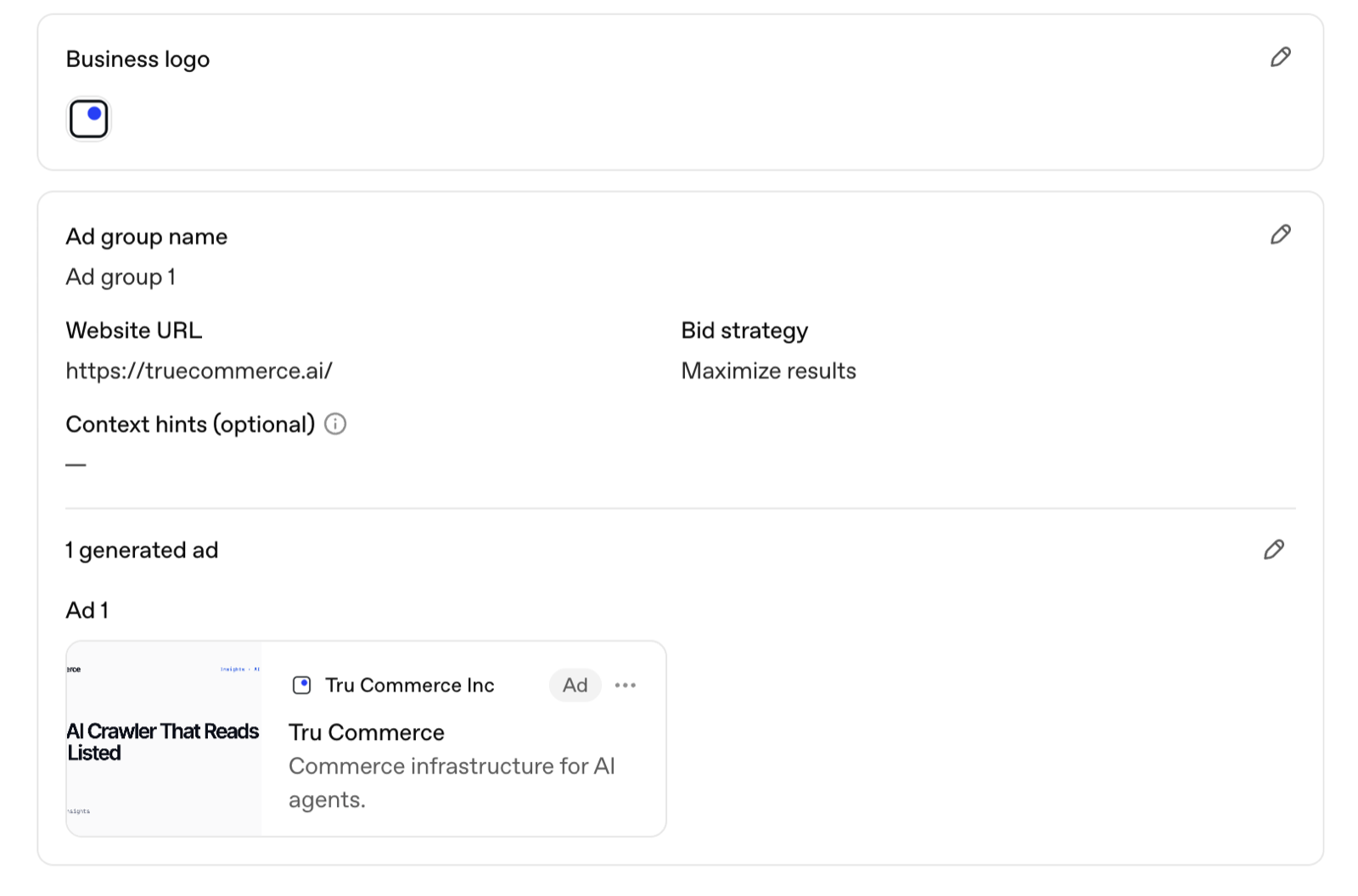
A ChatGPT ad is one small, clearly labeled sponsored card that renders below the assistant's answer - advertiser name, logo, a 50-character title, a 100-character description, one square image, one link. It never sits inside the answer, and it never changes what the answer says. That second fact matters more than the format.
The short answer: one box, below the answer
If you have never seen a ChatGPT ad, the honest reason may be that you pay for ChatGPT. Ads appear only to logged-in adults on the Free and Go tiers; Plus, Pro, Business, Enterprise, and Education users never see them (OpenAI, 2026). And they only began appearing at all recently - US testing started February 9, 2026, with the UK, Canada, Australia, New Zealand, Japan, Korea, and India following through the year. We track the full country-by-country picture in our rollout tracker.
When an ad does appear, it looks like this: you ask a question, ChatGPT writes its answer in full, and below that answer sits one compact card in a clearly labeled sponsored container. That is the entire ad experience. No pre-roll, no interstitial, no shaded "sponsored results" block sitting above the real content the way paid listings do on a search results page.
The placement choice is deliberate. The answer stays untouched; the ad is an addendum. OpenAI has stated repeatedly since February 2026 that ads never influence ChatGPT's responses and that conversations are kept private from advertisers.
Anatomy of the unit, element by element
We can do better than the spec sheet. In September 2026 we crawled the public ChatGPT ad library (chatgptadlibrary.com) in full and decoded 1,193 real creatives from 336 advertisers, last seen between 1 July and 3 August 2026. So below is each element as the OpenAI Ads Manager defines it — and what advertisers actually ship. There are six.
Advertiser name. Your business name, displayed plainly on the card. Combined with the sponsored label, it makes the commercial nature of the unit unambiguous - a user always knows who paid and that someone paid.
Logo, rendered at 32×32. A favicon-sized mark. At 32 pixels square, wordmarks and detailed logos collapse into noise; a simple, high-contrast icon survives. This is the smallest canvas your brand will render on anywhere, so test it at actual size before uploading.
Title, up to 50 characters. Roughly six to eight words. That is shorter than a Google responsive search ad headline pairing, so there is no room for a value proposition plus a qualifier plus a call to action. Pick one job for the title and do it.
Description, up to 100 characters. One sentence. The discipline the format imposes is real: 150 total characters of text is less than half a tweet. Copy that survives is specific - a concrete product, a concrete outcome, a concrete price.
Square image, at least 256×256. One image, square aspect ratio. For product campaigns this typically comes straight from your catalog: since June 2026, product feed ads let you upload a Google Shopping-format feed and ChatGPT auto-generates the product ads from it, with a 100 SKU minimum and support up to 1M SKUs (OpenAI Ads Manager docs; Digiday, June 2026). If your feed images are cluttered lifestyle shots, they will render badly at card size - the same catalog quality work that helps you organically helps here too.
Destination link. One click-through to the URL you set. Clicks carry the __oppref click-id that OpenAI's pixel uses for conversion measurement - covered properly in our setup guide.
What real ads actually look like, measured
The spec above is the ceiling. This is the floor advertisers actually build on, across 1,193 measured creatives:
| Spec limit | Median in the wild | Over the limit | |
|---|---|---|---|
| Title | 50 characters | 26 characters (about 4 words) | 0.3% exceed 50 |
| Description | 100 characters | 57 characters | 0.5% exceed 100 |
| Image | ≥256×256 square | present on 95% of creatives | — |
Advertisers use roughly half the space they are given. That is the most practical thing on this page. The card renders below an answer the reader already has, so a dense unit is a unit that gets scrolled past. Short, plain and concrete is what survives.
A few verbatim, so you can see the register:
- VistaPrint — "Birthday soon?" (14 characters) / "Vinyl banners for every birthday party"
- TouchBistro — "Need a new POS?" (15) / "Manage your whole restaurant on one platform."
- Drata — "SOC 2 Compliance" (16) / "Automate and accelerate SOC 2 compliance"
- Resume.io — "Resume Done Right" (17) / "Turn ChatGPT content into a real resume."
- Angi — "EV Charger Install Pros" (23) / "Get quotes in minutes from affordable EV charger pros."
Two structural details the spec sheet will not tell you. Only 14% of creatives put the advertiser's name in the title — the name already renders above it, so spending title characters on it is waste. And under 1% contain the word "vs", even though 25% of the conversations that fire these ads are comparison prompts. The comparison happens in the question; the card simply answers which one.
Sample caveat: each vertical page in that library exposes only its top two or three ads, so this is a top-of-leaderboard slice — roughly 7% of what the library reported holding as of August 2026, biased toward high-frequency advertisers. Treat it as "in this sample", not as a market rate. The full teardown, including the trigger-prompt patterns, is in ChatGPT ads examples.
One advertiser per conversation
This is the structural fact that makes the format unlike anything in search. When a conversation matches, exactly one advertiser gets the slot. There is no ad stack, no positions two through four, no bidding your way from the bottom of the page to the top.
Two consequences follow. First, winning the slot is binary - the relevance-weighted second-price auction picks one winner, and relevance is weighted heavily, so a tightly matched small advertiser can beat a loosely matched big one. Second, there are no keywords to buy. Matching is conversational: the current conversation topic, past chats, and past ad interactions. Advertisers steer it with context hints - OpenAI recommends 5-15 discrete one-to-two-sentence descriptions of buyer moments per ad group, and hints guide matching rather than acting as exact-match rules (OpenAI Ads Manager; help docs). What that costs and how the auction behaves is the subject of our ecommerce cost breakdown.
What the ad never does
It never alters the answer. The organic recommendation - which brands ChatGPT names, in what order, with what caveats - is generated independently of the ad auction. OpenAI has held this line publicly since the February 2026 launch.
It never appears for paying users. Plus, Pro, Business, Enterprise, and Education tiers see zero ads. If your buyers skew professional, a meaningful share of them can never be reached by this format at any budget.
It never interrupts. The card renders after the answer completes, below it. Users read the answer first, every time.
It never exposes the conversation to you. Advertisers do not see what the user asked; conversations are kept private and user data is not sold (OpenAI, 2026).
Why the format is built this way
The modesty of the unit is the strategy. ChatGPT's value is trust in the answer; a format that let advertisers crowd or color the answer would spend that trust. So OpenAI shipped the most conservative unit it could: one box, hard character limits, below the fold of the response, clearly labeled.
Early performance data reflects a format users notice but do not resent: chatbot ad CTR runs around 0.9% versus roughly 6.4% for Google search ads (eMarketer, 2026). In our own US campaigns running since July 2026, CTR has averaged around 1.3% (our campaign data). Modest clicks, but from a high-intent surface - AI-referred visits to US retail sites convert 60% better than non-AI traffic (Adobe Analytics via Digital Commerce 360, July 2026 data).
Related: what Meta Muse shows instead of an ad
Meta's Muse agent shows product cards it assembled by browsing merchant sites and Shopify Catalog, and Meta says "your conversations are not shared with Meta's ad systems" (ai.meta.com, September 2026). The explainer, with every download estimate named, is Meta Muse explained.
Related: six weeks of ChatGPT Ads in India, on the record
ChatGPT Ads switched on in India on 27 August 2026 and, by 1 September, OpenAI was reporting a $1 billion annualised run rate (exchange4media, 1 September 2026). What the Indian business press asked us in those six weeks, every answer verbatim with the data behind it, is in ChatGPT Ads in India: six weeks in, on the record.
Where Tru Commerce fits
Look at the geometry of the page one more time. The answer sits on top. The ad sits below it. Brands now compete on two layers of that page: the organic recommendation, which is earned, and the sponsored placement, which is bought and labelled - and premium users only ever see the earned layer. As our founder told The Hindu BusinessLine in August 2026: "Brands cannot buy influence over ChatGPT's answers."
The ad rents the bottom of the conversation. The recommendation above it is won with catalog structure, third-party presence, and the mechanics we unpack in our ChatGPT shopping teardown. Before you budget for the rented layer - and our ChatGPT Ads hub will help you do that well - find out where you stand on the earned one.
Run the free Citation Rank scan. Work email and brand URL, and within 24 hours you will know whether ChatGPT already recommends you in the answer - the slot no advertiser can buy.
FAQ
Smaller than the limits allow. Across 1,193 creatives we measured from the public ChatGPT ad library in September 2026, the median title is 26 characters — about four words — against a 50-character limit, and the median description is 57 characters against a 100-character limit. Only 0.3% of titles exceed 50 characters. An image is present on 95% of creatives. Real examples include VistaPrint's 14-character “Birthday soon?” and TouchBistro's “Need a new POS?”.
In one labeled sponsored box below the assistant's answer, inside the conversation. There are no sidebar ads, no banners, and no ads inside the answer text itself. Only one advertiser appears per matched conversation (OpenAI, 2026).
Yes. Every ad renders in a clearly labeled sponsored container, visually separated from the answer. OpenAI has stated repeatedly since February 2026 that ads never influence what ChatGPT actually says.
No. Ads show only to logged-in adults on the Free and Go tiers. Plus, Pro, Business, Enterprise, and Education users never see ads (OpenAI, 2026).
One compact card: advertiser name, a logo rendered at 32×32, a title up to 50 characters, a description up to 100 characters, one square image of at least 256×256, and a destination link (OpenAI Ads Manager docs, 2026).
No. The ad slot is separate from the answer. As our founder put it in The Hindu BusinessLine (Aug 2026): "Brands cannot buy influence over ChatGPT's answers." The organic recommendation has to be earned.
Sources
- 1.Ads in ChatGPT: The Basics - OpenAI Help Center, 2026
- 2.ChatGPT ads will soon reach more users — proven results still missing - eMarketer, 2026
- 3.Adobe: AI referral traffic to retail sites converts 60% higher, July 2026 data - Digital Commerce 360, 2026
Continue reading
October 10, 2026
ChatGPT Ads in India: six weeks in, on the record
ChatGPT Ads switched on in India on 27 August 2026. Six weeks on, eight articles in five outlets quoted us and TechTimes cited our benchmarks. Every question the press asked, every answer verbatim and linked, and the numbers behind each one.
September 4, 2026
Criteo Prompt Smart Ads: 2,000 Brands on ChatGPT and a 4x Spend Lift
Criteo was the first ad-tech partner inside OpenAI's ChatGPT ads pilot. Its Prompt Smart Ads product auto-generates creatives and context hints matched to how people actually prompt - here is what it is, the numbers behind it, and what its creative reports teach every advertiser.
September 2, 2026
ChatGPT Ads Conversion Strategies: What the Query-Mix Data Says to Do
Only ~1 in 10 ChatGPT conversations carries commercial intent, 76.4% of shopping answers already show an ad, and market leaders buy almost none of them. Four strategies built on that data - not on search-ads instinct.