
How to Advertise on ChatGPT (2026): Setup Guide and Ads Manager Walkthrough
As of May 2026, running ads on ChatGPT no longer requires an agency relationship or a six-figure minimum. Here's the actual sign-up path, what to prepare, and what a $25/day first campaign buys.
Viren Inaniyan · July 14, 2026 · AI Search Visibility
As of May 2026, running ads on ChatGPT no longer requires an agency relationship or a six-figure minimum. Here's the actual sign-up path, what you'll need to prepare, and what to expect in your first campaign.
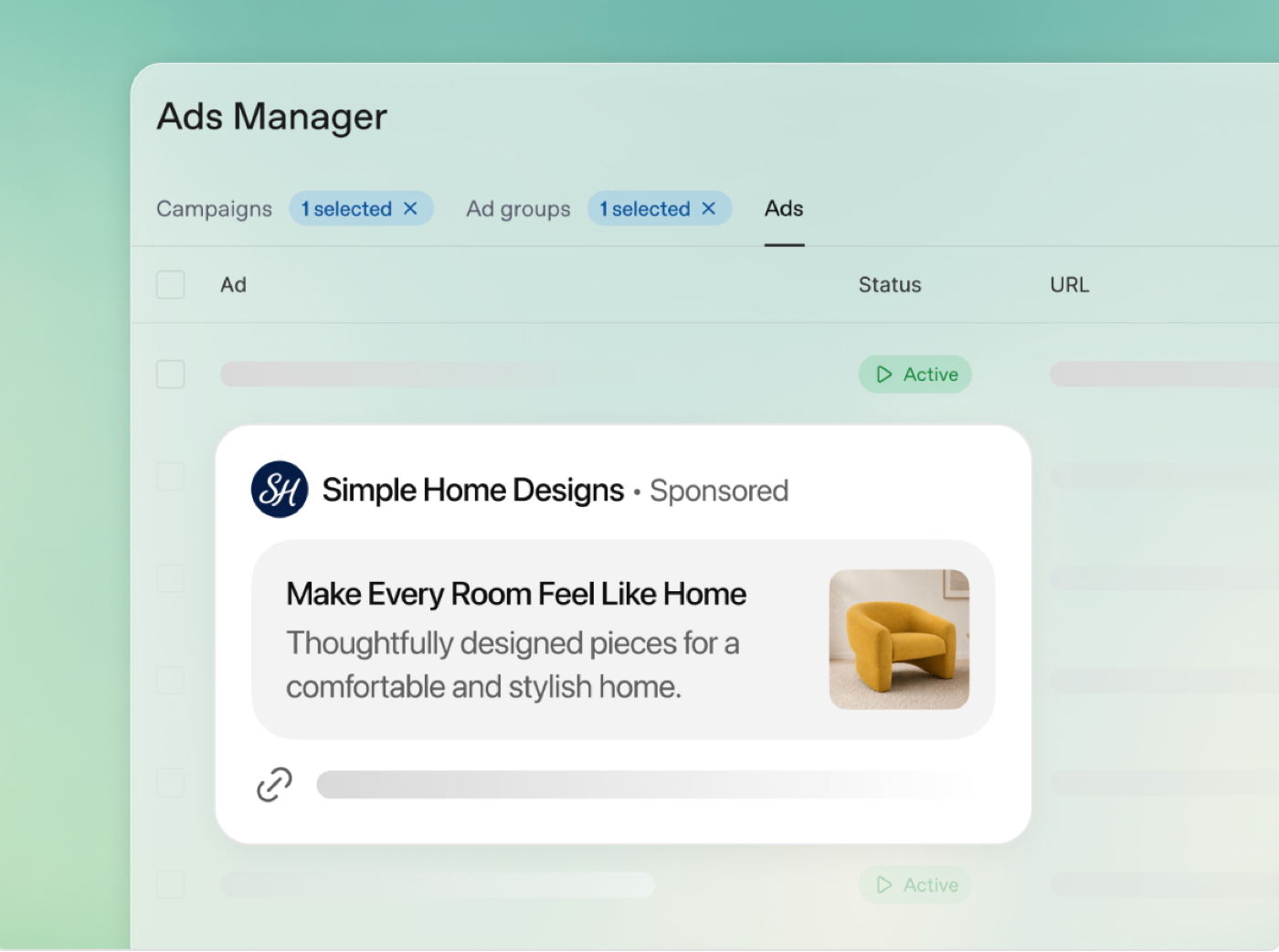
A live ChatGPT ad inside OpenAI's Ads Manager. The "Sponsored" label, brand name, headline, one-line description, and a single product image are the entire unit - there's no carousel and no feed.
Who sees ChatGPT ads — and who should advertise
ChatGPT ads appear only to logged-in adults on the Free and Go tiers. Plus, Pro, Business, Enterprise, and Education subscribers never see an ad at all (OpenAI). That shapes the buy: the audience you can pay to reach is the free-tier audience, and paying subscribers only ever encounter your brand through the organic recommendation layer.
The format also favors some businesses over others. It rewards considered purchases, the categories shoppers genuinely research in conversation before buying: software, home goods, apparel, personal care, anything where "which one should I get?" is a real question. If your product is bought on habit or price alone, there is less of a conversational moment to show up in. Restricted and regulated categories face additional limits on where and whether ads serve, so check OpenAI's current policies for your specific category before you invest in creative.
What a ChatGPT ad looks like
One unit, clearly labeled. A ChatGPT ad is a single sponsored box below the answer, carrying the advertiser name and logo, a title of up to 50 characters, a description of up to 100 characters, a square image, and a destination link (OpenAI Ads Manager docs). Only one advertiser matches any given conversation, so your placement never sits in a stack of competing ads. We break down the full unit, with screenshots, in the deeper anatomy post.
Step 1: Confirm you're eligible to advertise
ChatGPT ads only appear to logged-in adult users on the Free and ChatGPT Go tiers - Plus, Pro, Business, Enterprise, and Education users don't see them at all. Before building a campaign, size your actual addressable audience: if your buyers skew toward paid ChatGPT tiers, your reach through ads is smaller than total ChatGPT usage would suggest.
OpenAI also restricts categories at launch: no ads are shown near health, mental health, or political conversations, and no ads target accounts OpenAI predicts belong to users under 18. If your product sits in a regulated or sensitive category, check current eligibility before you invest in creative.
Step 2: Sign up
Two paths exist, depending on how you want to buy:
Self-serve (most ecommerce brands): Go to ads.openai.com and sign up for the self-serve Ads Manager beta directly. This is the path OpenAI opened to all US businesses starting May 2026, with no minimum spend requirement.
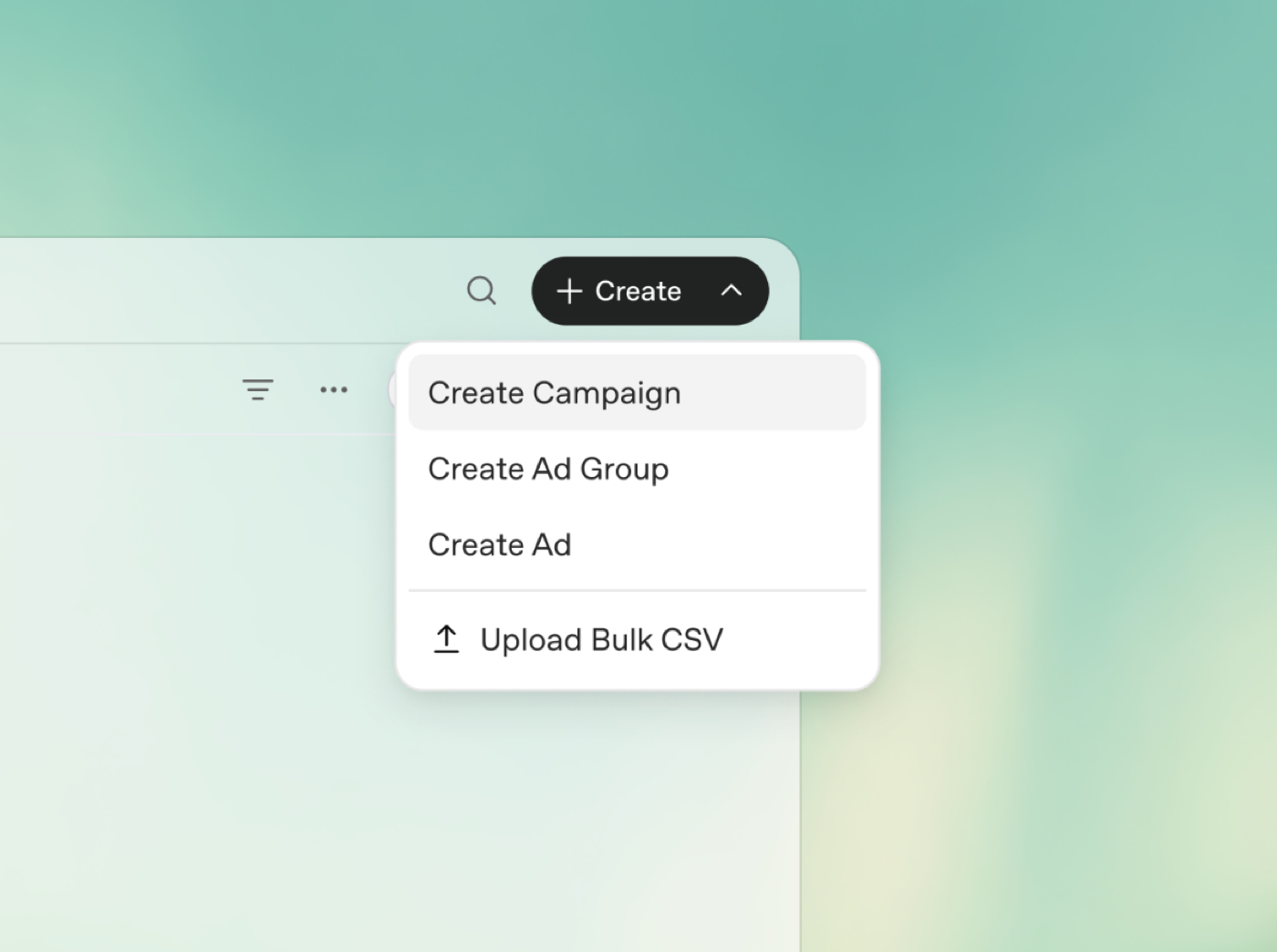
Once you're in, everything starts from the Create menu. Note the Upload Bulk CSV option - that's how you launch many ads at once from a spreadsheet instead of building each one by hand.
Through an agency or ad-tech partner: OpenAI has formal partnerships with agencies including Dentsu, Omnicom, Publicis, and WPP, and technology partners including Adobe, for teams that want to manage ChatGPT ads through tools and workflows they already use. If your team already runs paid media through one of these partners, ask your existing rep about ChatGPT ads access before setting up a separate self-serve account.
For general updates before you're ready to commit either way, openai.com/advertisers is OpenAI's own sign-up point for advertiser news.
Step 3: Prepare your creative
Requirements are deliberately lean compared to Google or Meta:
- Merchant description: 40-80 words. This is doing more work than it looks like - since targeting is contextual rather than keyword-based, this description is effectively how OpenAI's system understands what your product is and when it's relevant.
- Square hero image: one image, no carousel or multi-format requirement at this stage.
- Category mapping: tagging your product/service into OpenAI's category taxonomy so it can be matched to relevant conversations.
There's no video format and no dynamic product feed integration yet, which is a real constraint if you're used to Google Shopping-style automated feeds - everything here is closer to a single static unit than a catalog-driven campaign, at least in this phase of the rollout.
Step 4: Choose a bidding model
Three options exist as of mid-2026, added in roughly this order:
- CPM - available since launch, priced as high as ~$60 at the invite-only February 2026 start, reported as low as ~$25 in some pilot categories by mid-2026.
- CPC - added with the self-serve launch, starting around $3-5 per click.
- CPA - activated June 5, 2026, turning ChatGPT Ads into a performance channel where you can bid toward a completed action rather than a click or impression.
For a first test, CPC is the lowest-commitment starting point: you're not paying for impressions that don't lead anywhere, and the per-click cost is transparent enough to set a real test budget against.
Step 5: Set expectations for measurement
OpenAI has shipped a Conversions API and pixel-based measurement so you can tie post-click events back to the impression that drove them - standard infrastructure, but worth confirming your analytics stack can actually ingest it before launch, especially if your attribution setup already struggles with AI-referred traffic showing up as "Direct" in GA4. (If that sounds familiar, it's the same underlying problem we cover in Dark Agentic Commerce Traffic - AI surfaces in general are hard for legacy analytics to see correctly, and ad-driven traffic is not automatically exempt from that blind spot.)
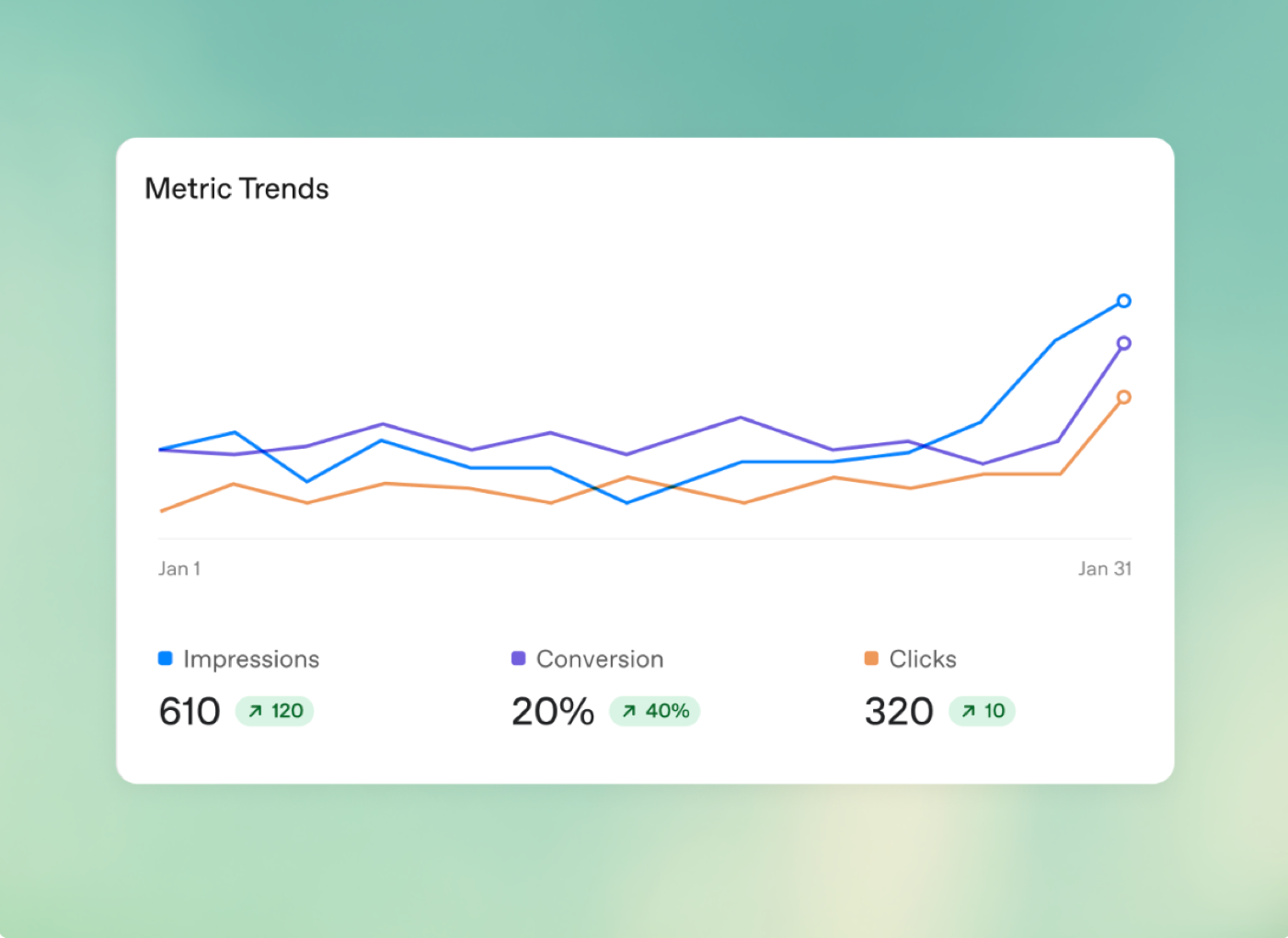
Ads Manager reports the numbers you'd expect - impressions, conversion, clicks - so measurement is real. What you never get is the conversation content behind each impression.
Advertisers only receive aggregate performance data - impressions, clicks, spend - never the underlying conversation content. Build your measurement expectations around that constraint rather than assuming ChatGPT-level conversation insight the way you might get from a search-query report in Google Ads.
What a reasonable first campaign looks like
- Budget: Small and time-boxed. No minimum spend means you can test with a few hundred dollars over a couple of weeks rather than committing to a quarter-long contract.
- Bidding: CPC to start, since it's the most directly comparable to what most teams already know from search advertising.
- Creative: One well-written 40-80 word merchant description per core product line, not per SKU - the format doesn't reward granularity the way a Shopping feed does.
- Category: Pick your single most evaluation-heavy product line first - the one where customers genuinely compare options - since that's the conversational moment ChatGPT ads are built to reach.
- Timeline: Treat the first 60-90 days as a learning phase. The platform itself is still evolving - CPA bidding only shipped in June 2026, and OpenAI's own updates describe this as an active pilot, not a mature, fully-documented ad system.
Is advertising on ChatGPT worth it?
Click rates are modest, but the slot is exclusive. eMarketer puts chatbot ad CTR around 0.9% (2026), and in our own US campaigns running since July 2026, CTR has averaged roughly 1.3% (our campaign data). Because there is a single ad slot and one advertiser per matched conversation, that click arrives without a competing ad above or beside it.
What happens after the click is the stronger argument. AI-referred visits to US retail sites convert 60% better than non-AI traffic (Adobe Analytics via Digital Commerce 360, July 2026 data). Fewer clicks, but each one is worth substantially more. We run the full math, including the cases where the honest answer is "not yet", in the full worth-it analysis.
If you'd rather not manage this yourself
Setting up and optimizing a new ad channel from scratch takes real time, and ChatGPT Ads is genuinely new enough that best practices are still forming in real time as OpenAI ships features. If you'd rather have someone who's already tracking the rollout run this for you, AI-Sponsored Placements is a service we offer specifically for this - we set up and manage paid placement across AI surfaces including ChatGPT, alongside the organic-visibility work most brands are already doing with us. Book a demo and we'll tell you honestly whether your category is ready for a ChatGPT ads test yet.
Update: running ChatGPT ads from India
ChatGPT ads went live in India on August 27, 2026 for Free and Go users, and from September 4, 2026 the self-serve Ads Manager is open to any Indian business - same flow as above, with a minimum daily budget of ₹725 (The Hindu BusinessLine; Storyboard18, Aug 2026). WPP and Omnicom ran the launch wave, but no agency is required for self-serve. The full India walkthrough, including account and billing specifics, is in how to run ChatGPT ads in India, and the market context lives on our India launch page.
Where Tru Commerce fits
Ads rent the conversation; the organic recommendation is earned. Every brand on ChatGPT now competes on two layers: the sponsored placement you buy, which only Free and Go users see, and the organic answer, which every user sees, including the paid tiers ads never reach. Before you spend on the rented layer, find out where you stand on the earned one. Run the free Citation Rank scan to see how AI surfaces cite your brand today, and browse our ChatGPT Ads hub for the rest of this series.
We ran this at marketplace scale with Amazon India, lifting AI Share of Voice +0.98% across 6 categories in 6 weeks - read the Amazon case study.
FAQ
No. As of the self-serve Ads Manager launch in May 2026, there's no minimum spend requirement - a change from the $200,000 minimum required at the invite-only February 2026 launch.
Self-serve access is at ads.openai.com. For general advertiser updates before committing, OpenAI's sign-up page is at openai.com/advertisers. Agencies including Dentsu, Omnicom, Publicis, and WPP also support ChatGPT ad buys.
A merchant description of 40-80 words, one square hero image, and category mapping. There's no video or carousel format, and no dynamic product feed integration yet.
CPM (available since launch), CPC (added with self-serve access, starting around $3-5), and CPA (activated June 5, 2026).
Check current eligibility carefully. OpenAI does not show ads near health, mental health, or political conversations, and restricts ads from accounts predicted to belong to users under 18.
Treat the first 60-90 days as a learning phase. The platform is actively evolving - bidding options and market availability have both changed multiple times since the February 2026 launch - so early performance data should be read as directional, not final.
Go to ads.openai.com and create an account. You'll need business details, a tax ID, a billing method, identity verification through Persona, and an account logo before your ads can serve (OpenAI Ads Manager, 2026).
The minimum daily budget is $25 with no minimum lifetime spend. Recommended starting bids are $3-5 CPC, rising to $8-18 in software and finance; CPM options run roughly $25-60 (WebFX; OpenAI docs, 2026).
No. The self-serve Ads Manager Beta opened in May 2026 to any business. In India, agencies ran the first campaigns, but self-serve opens to all merchants on September 4, 2026 at a ₹725 minimum daily budget (Storyboard18, 2026).
No. There are no keywords. Matching is conversational - based on the current conversation, past chats, and past ad interactions. You steer it with 5-15 context hints per ad group describing the buyer moments you want (OpenAI Ads Manager, 2026).
Sources
- 1.Ads in ChatGPT: The Basics - OpenAI Help Center, 2026
- 2.Create campaigns for ChatGPT - OpenAI Help Center, 2026
- 3.Ads Manager Beta: account setup - OpenAI Help Center, 2026
- 4.Adobe: AI referral traffic to retail sites converts 60% higher, July 2026 data - Digital Commerce 360, 2026
Continue reading
October 10, 2026
ChatGPT Ads in India: six weeks in, on the record
ChatGPT Ads switched on in India on 27 August 2026. Six weeks on, eight articles in five outlets quoted us and TechTimes cited our benchmarks. Every question the press asked, every answer verbatim and linked, and the numbers behind each one.
September 4, 2026
Criteo Prompt Smart Ads: 2,000 Brands on ChatGPT and a 4x Spend Lift
Criteo was the first ad-tech partner inside OpenAI's ChatGPT ads pilot. Its Prompt Smart Ads product auto-generates creatives and context hints matched to how people actually prompt - here is what it is, the numbers behind it, and what its creative reports teach every advertiser.
September 2, 2026
ChatGPT Ads Conversion Strategies: What the Query-Mix Data Says to Do
Only ~1 in 10 ChatGPT conversations carries commercial intent, 76.4% of shopping answers already show an ad, and market leaders buy almost none of them. Four strategies built on that data - not on search-ads instinct.