
ChatGPT Shopping Ads vs Standard Ads: Which Format Fits Your Brand
ChatGPT now sells two ad formats: standard ads you write by hand and product feed ads auto-generated from a catalog of 100+ SKUs. Here is how to pick - and why neither buys the recommendation itself.
Viren Inaniyan · August 29, 2026 · ChatGPT Ads
ChatGPT now sells two distinct ad formats: standard ads you build by hand and shopping ads generated automatically from your product feed. They share an auction, a sponsored box, and a price floor - but they fit very different brands. And neither one buys what most advertisers actually want: the recommendation inside the answer.
The two paid formats, side by side
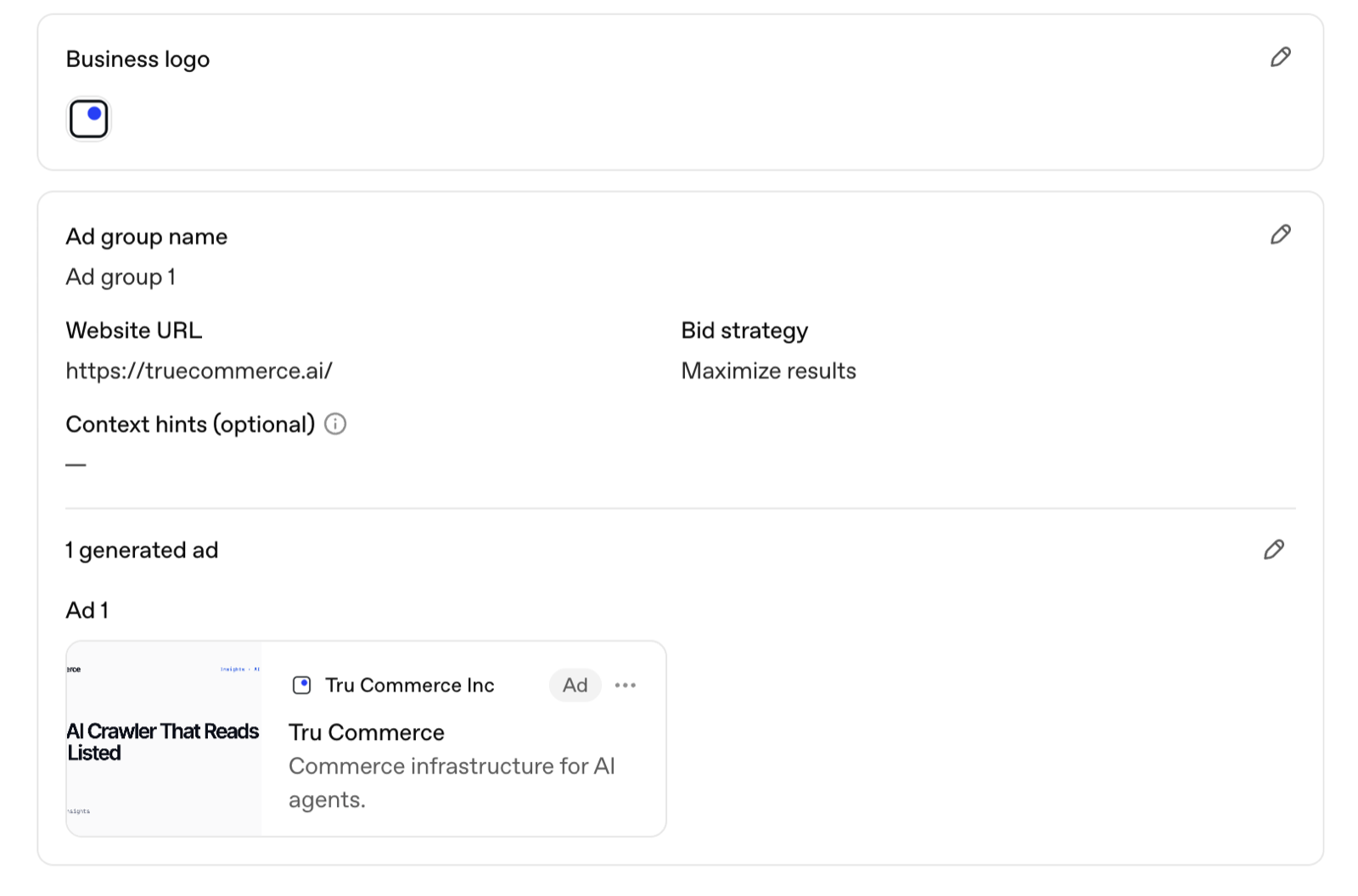
Since the self-serve Ads Manager Beta opened in May 2026, any advertiser can run ads in ChatGPT without an agency or a minimum lifetime spend (OpenAI, May 2026). What you buy comes in two shapes.
Standard ads are the original unit. You supply the creative yourself - advertiser name, logo, a title of up to 50 characters, a description of up to 100 characters, a square image of at least 256×256 pixels, and a destination link. There are no keywords; you steer matching with context hints, which OpenAI recommends writing as 5-15 discrete one-to-two-sentence descriptions of buyer moments per ad group (OpenAI Ads Manager docs).
Product feed ads - the format most people mean by "ChatGPT shopping ads" - launched in June 2026. You upload a catalog in Google Shopping format and ChatGPT auto-generates a product ad for each SKU, choosing which product to show based on the conversation. The minimum is 100 SKUs; feeds scale to 1 million SKUs (OpenAI Ads Manager docs; Digiday, June 2026).
Both formats render identically to the shopper: a single labeled sponsored box below the answer, one advertiser per matched conversation. Both run through the same relevance-weighted second-price auction, with Maximize results or Manual Max CPC bidding and a $25 minimum daily budget. Both are visible only to logged-in adults on Free and Go tiers - Plus, Pro, Business, Enterprise, and Education users never see either one (OpenAI).
Standard ads: you write the ad, hints steer the match
A standard ad is closer to a search ad than anything else in the OpenAI stack - except there is no keyword to bid on. Matching is conversational: ChatGPT weighs the current conversation topic, past chats, and past ad interactions, and your context hints tell the system which buyer moments you want (OpenAI Ads Manager; help docs). Hints guide matching but are not exact-match rules, so the craft is describing the situation - "a founder comparing checkout providers for a Shopify store" - rather than stuffing query strings. We covered how to write them in our context hints guide.
The format's strength is control. One offer, one message, one landing page. You decide exactly what 150 characters of text represent your brand in the conversation.
Its limit is scale. Every ad is hand-built. If you sell 4,000 SKUs, you cannot write 4,000 standard ads - and a generic "shop our store" ad wastes the one slot the conversation gives you.
Product feed ads: the catalog is the campaign
Feed ads invert the work. Instead of writing creative, you maintain a catalog, and ChatGPT assembles the ad - title, image, price, link - from the SKU it judges most relevant to the conversation. A shopper asking about trail runners for wide feet can be shown your wide-fit trail shoe, not your brand's hero ad.
Three practical consequences:
- Your feed quality is your ad quality. The same attributes that decide whether ChatGPT can recommend your products organically - titles, structured specs, availability, price accuracy - now also decide what your paid placement looks like. Our guide to optimizing your product catalog for AI applies to both layers.
- The 100 SKU minimum is a real gate. Single-product DTC brands and most B2B software companies simply do not qualify. That is by design: the format exists for catalogs, not offers.
- Reuse what you have. The feed is Google Shopping format, so a retailer already running Google Merchant Center can onboard with the catalog it maintains today. The full spec is in our product feed guide.
Which format fits your brand
Run standard ads if you sell a considered purchase. B2B software, financial products, services, courses, high-ticket single-hero-product brands. The buyer needs a pitch, not a product tile, and your "catalog" is one to ten offers. Note the auction reflects this: CPCs run $8-18 in software and finance categories versus $3-5 recommended starting bids overall (WebFX; OpenAI docs; practitioner reports, 2026).
Run product feed ads if you are a retailer with a deep catalog. Above 100 SKUs, when the right product depends on what the shopper is describing, the feed will pick better than any hand-built ad group. Apparel, beauty, home goods, electronics, grocery - anywhere the query is "which one" rather than "why you."
Run both if you have a catalog and a story. A retailer can use feed ads for in-market product conversations and a standard campaign for brand-level moments the feed cannot express - a sale event, a sustainability claim, a bundle. Budget from $25 a day per campaign; the setup walkthrough covers the mechanics, and our ecommerce cost breakdown covers what to expect on price.
Whichever format you pick, keep expectations honest. Chatbot ad CTR benchmarks around 0.9%, versus roughly 6.4% for Google search (eMarketer, 2026), delivery ramps slowly during beta by design (OpenAI onboarding), and agencies still report measurement gaps and unproven outcomes (eMarketer/Digiday, 2026). Our own US campaigns, running since July 2026, average around 1.3% CTR - better than benchmark, still an experiment we size accordingly.
Neither format is the shopping layer
Here is the distinction that should shape your budget: both ad formats appear below the answer, in a labeled sponsored box. Neither appears inside it. Ads never influence ChatGPT's answers, and conversations stay private from advertisers (OpenAI, stated repeatedly since February 2026).
The product carousels and recommendations inside the answer are the organic shopping layer - earned through catalog data, structured feeds, and the sources ChatGPT cites, not bought. We took that system apart in our ChatGPT shopping teardown. As our founder put it in The Hindu BusinessLine (August 28, 2026): "Brands cannot buy influence over ChatGPT's answers."
That earned layer is also where the economics live. AI-referred visits to US retail sites convert 60% better than non-AI traffic (Adobe Analytics via Digital Commerce 360, July 2026 data). And because paying subscribers never see ads, the organic recommendation is the only placement that reaches Plus and Pro users at all. ChatGPT ads reaching $100M in annualized revenue (eMarketer, 2026) tells you the sponsored layer is real - it does not make it a substitute for the layer that closes.
Where Tru Commerce fits
Both ad formats rent space in the conversation. The recommendation inside the answer is earned - and it is the layer we build for. Tru Commerce connects your catalog to every agent surface, measures where you show up with Citation Rank and Share of Voice, and fixes the catalog and citation gaps that keep you out of the answer.
Before you decide between standard ads and feed ads, find out what the earned layer already says about you. Run the free Citation Rank scan - see your rank in 24 hours, no login, no credit card. Then, if paid still makes sense, our ChatGPT Ads hub has every format, cost, and setup guide in one place.
Before writing the channel off, measure it - MyMuse's real AI revenue turned out to be 7× what GA4 reported - see the MyMuse case study. If you want to see where you stand before committing, start with ChatGPT Ads for ecommerce brands.
FAQ
ChatGPT shopping ads are product feed ads: you upload a Google Shopping-format catalog to OpenAI's Ads Manager and ChatGPT auto-generates a product ad per SKU. They launched in June 2026 with a 100 SKU minimum and support catalogs up to 1M SKUs (OpenAI; Digiday, June 2026).
Standard ads are hand-built: you write the title, description, and image, then steer matching with 5-15 context hints. Product feed ads are generated automatically from your catalog, one ad per SKU. Standard ads suit single offers; feed ads suit large retail catalogs.
100 SKUs minimum, per OpenAI's Ads Manager documentation (June 2026). Feeds scale up to 1 million SKUs and use the Google Shopping catalog format, so most retailers can reuse the feed they already maintain for Google Merchant Center.
No. Ads never influence ChatGPT's answers (OpenAI, stated since February 2026). Both ad formats appear in a labeled sponsored box below the answer. The organic recommendation inside the answer is earned through catalog data and citations - and it is the only layer Plus and Pro users see.
Recommended starting bids are $3-5 CPC, rising to $8-18 in software and finance; CPM options run roughly $25-60 (WebFX; OpenAI docs, 2026). Minimum daily budget is $25, billing is postpay, and there is no minimum lifetime spend since the May 2026 self-serve beta.
Sources
- 1.Ads in ChatGPT: The Basics - OpenAI Help Center, 2026
- 2.OpenAI makes it easier to run shopping ads in ChatGPT - Digiday, 2026
- 3.Create campaigns for ChatGPT - OpenAI Help Center, 2026
- 4.ChatGPT ads will soon reach more users — proven results still missing - eMarketer, 2026
- 5.AI-driven traffic converts 42% better than non-AI traffic - Adobe Analytics via Digital Commerce 360, 2026
- 6.Adobe: AI referral traffic to retail sites converts 60% higher, July 2026 data - Digital Commerce 360, 2026
Continue reading
October 10, 2026
ChatGPT Ads in India: six weeks in, on the record
ChatGPT Ads switched on in India on 27 August 2026. Six weeks on, eight articles in five outlets quoted us and TechTimes cited our benchmarks. Every question the press asked, every answer verbatim and linked, and the numbers behind each one.
September 4, 2026
Criteo Prompt Smart Ads: 2,000 Brands on ChatGPT and a 4x Spend Lift
Criteo was the first ad-tech partner inside OpenAI's ChatGPT ads pilot. Its Prompt Smart Ads product auto-generates creatives and context hints matched to how people actually prompt - here is what it is, the numbers behind it, and what its creative reports teach every advertiser.
September 2, 2026
ChatGPT Ads Conversion Strategies: What the Query-Mix Data Says to Do
Only ~1 in 10 ChatGPT conversations carries commercial intent, 76.4% of shopping answers already show an ad, and market leaders buy almost none of them. Four strategies built on that data - not on search-ads instinct.