
ChatGPT Ads Targeting Options: What You Can and Cannot Control
ChatGPT ads have exactly three targeting levers - geography, custom audiences, and 5-15 context hints per ad group. There are no keywords, no demographic profiles, and no third-party audiences. Here is the full inventory.
Viren Inaniyan · August 29, 2026 · ChatGPT Ads
ChatGPT ads give you exactly three targeting levers: where the user is, which audience list they belong to, and 5-15 sentences describing the buyer moment you want. Everything else - keywords, demographics, third-party audiences - does not exist, and OpenAI says it never will in the form performance marketers expect. Here is the complete inventory of what you control and what you don't.
The short version: less control than you're used to
If you run Google Ads, you manage keywords, match types, negatives, demographics, in-market audiences, and lookalikes. ChatGPT ads strip nearly all of that away. OpenAI's system decides which conversation gets which ad, and your job is to describe - in plain sentences - the moments where your product belongs.
That is not a beta limitation waiting to be fixed. It follows directly from OpenAI's two hard commitments: ads never influence ChatGPT's answers, and conversations are kept private from advertisers (OpenAI, stated repeatedly since February 2026). A keyword-auction model would require exposing query-level data to advertisers. The conversational-matching model keeps that data inside OpenAI's walls and hands you influence, not control.
So the honest framing for a media plan: you control geography precisely, audiences roughly, and conversation matching only by suggestion.
Lever 1: geography - the one hard filter
Geo is the only targeting layer that works like a strict gate. In OpenAI Ads Manager you can target by:
- Country - required, and constrained by the rollout map. The US opened February 9, 2026; the UK on June 6, 2026 (OpenAI's first European market); Canada, Australia, New Zealand, Japan, and Korea are live; India switched on August 27, 2026 (OpenAI expansion posts, 2026; The Hindu BusinessLine, Aug 28, 2026). Our rollout tracker keeps the current list.
- Region - state or province level.
- DMA - the Nielsen media-market unit US TV and radio buyers already know, useful for retail footprints and regional DTC brands.
- Postal code - the finest grain available, which matters for local services, store-led retail, and delivery-zone businesses.
What geo cannot do: radius targeting around a point, and location-based bid adjustments. If you want to bid up in strong markets, you build separate campaigns per geo rather than layering multipliers - the multipliers live on audiences, not locations.
Lever 2: custom audiences with bid multipliers
Custom audiences are the second lever: you bring a list, and you attach a bid multiplier to it, so your Manual Max CPC (or your Maximize results budget) works harder when a matched conversation involves someone on that list (OpenAI Ads Manager docs).
What this is good for. Bidding up your existing customers for a repeat-purchase push, bidding up site visitors captured through the OpenAI pixel, or bidding down segments you already reach cheaply elsewhere. If you have the conversion tracking stack in place - the pixel plus the server-side Conversions API - your audience data compounds with your measurement data.
What this is not. There are no third-party audiences to buy, no in-market segments, no lookalike expansion. OpenAI does not sell user data to advertisers, so there is no data marketplace layered on top of the auction. Your audiences are your own first-party lists, full stop.
Lever 3: context hints - the lever that actually matters
Since there are no keywords, context hints are where a ChatGPT ads practitioner earns their fee. A context hint is a 1-2-sentence description of a buyer moment - the situation, not the search string. OpenAI recommends 5-15 discrete hints per ad group, and is explicit that hints guide matching rather than gate it (OpenAI Ads Manager; help docs).
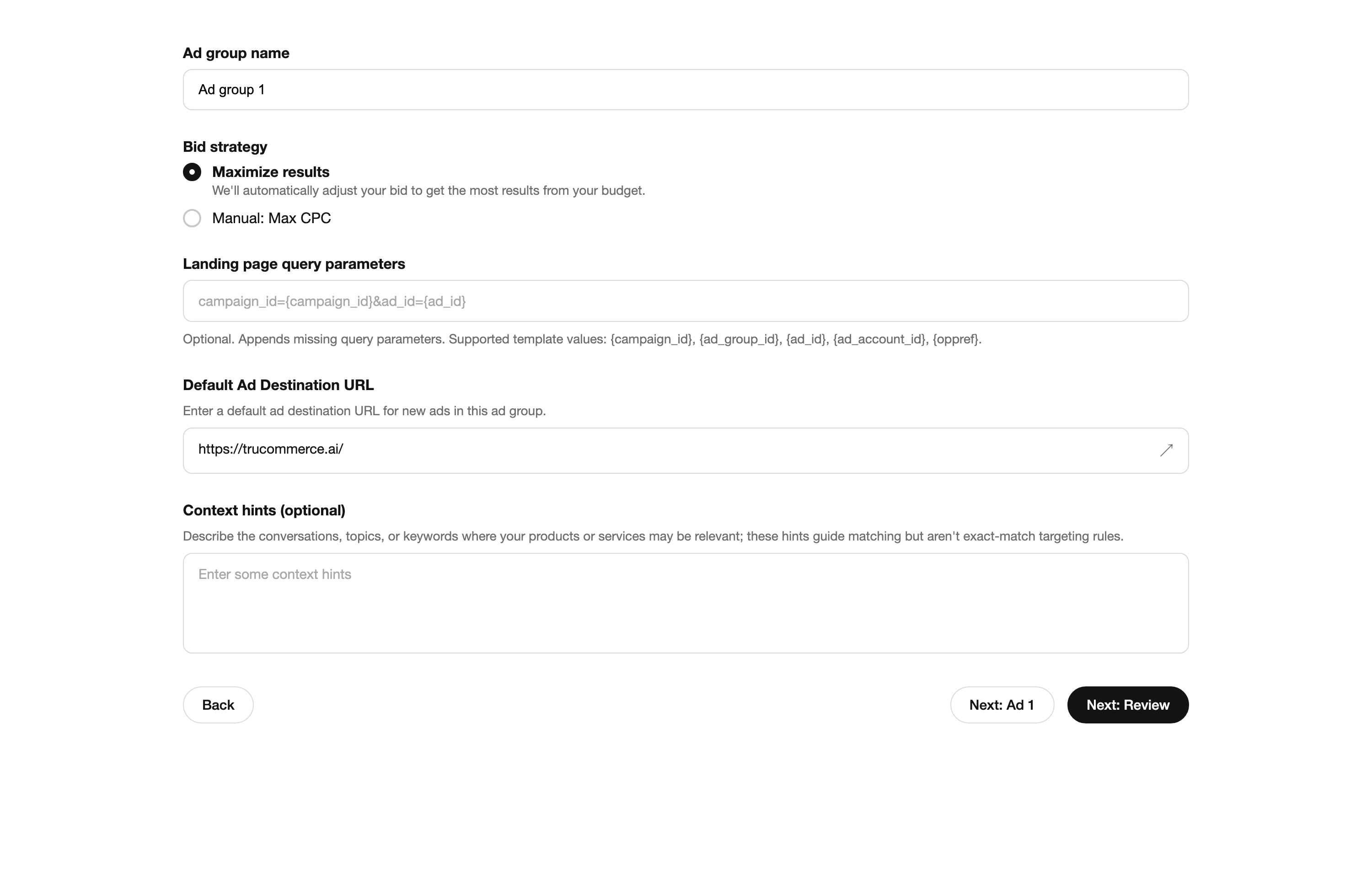
The whole targeting surface fits on one form (recreated view): bid strategy, tracking parameters, destination, and the context hints box.
The matching system reads the current conversation topic, the user's past chats, and their past ad interactions, then runs a relevance-weighted second-price auction to pick one advertiser for the conversation - a single labeled sponsored box below the answer. Your hints tell that system what "relevant" means for you.
Write moments, not keywords. "Someone planning meals for a toddler who refuses vegetables" beats "toddler food." The system matches conversations, and conversations have context - a situation, a constraint, an intent.
Cover distinct moments, not synonyms. Fifteen rephrasings of one moment waste the budget of hints. Five genuinely different buyer situations - gifting, replenishment, comparison, problem-solving, occasion - teach the matcher more than fifteen near-duplicates.
Expect drift, and read the logs. Because hints are not exact-match rules, your ad will surface in conversations you did not describe. There are no negative keywords to fence with; your correction mechanism is rewriting hints and watching what changes. Our full context hints playbook covers hint-writing patterns in depth, and the setup guide shows where hints sit in campaign structure.
What does not exist - the complete list
Worth stating plainly, because every media plan we review assumes at least one of these:
- Keyword targeting. None. No match types, no negatives, no search-term reports in the Google sense.
- Demographic targeting. No age bands, gender, income, or parental status. The only demographic fact in the system is the built-in floor: ads serve only to logged-in adults on Free and Go tiers (OpenAI).
- Third-party audiences. No data partners, no purchasable segments. User data is not sold to advertisers (OpenAI).
- Device, placement, or time-of-day controls. The ad unit is fixed - one sponsored box, one advertiser per matched conversation.
- Tier targeting. You cannot choose which subscription tiers see your ads, and the highest-intent power users on Plus and Pro never will. As our founder Viren put it in The Hindu BusinessLine (Aug 28, 2026): "Brands cannot buy influence over ChatGPT's answers." Premium users see only the earned layer.
For budget context around these constraints - bids, CPCs, and what the auction actually charges - see our ecommerce cost breakdown and the ChatGPT ads vs Google Ads comparison. The short version: $3-5 recommended starting CPCs, rising to $8-18 in software and finance (WebFX; OpenAI docs; practitioner reports, 2026), against a chatbot-ad CTR benchmark of roughly 0.9% (eMarketer, 2026). Our own US campaigns running since July 2026 average about 1.3% CTR (our campaign data) - better than benchmark, still a low-click channel.
The privacy stance behind the design
The targeting inventory only makes sense once you take OpenAI's privacy position at face value, because it explains every gap:
- Conversations are private from advertisers. You never see the chats your ad appeared in - you see campaign metrics.
- User data is not sold. No profile marketplace means no demographic or interest targeting to buy.
- Ads never influence answers. The organic recommendation and the sponsored box are separate systems. Paying more buys a better shot at the labeled slot below the answer - never a word of the answer itself.
For advertisers trained on two decades of data-rich auctions, this feels like flying blind. But it is also the reason ChatGPT's recommendation layer retains trust - and trust is why AI-referred visits to US retail sites convert 60% better than non-AI traffic (Adobe Analytics via Digital Commerce 360, July 2026 data). The targeting constraints and the conversion premium are the same design decision viewed from two sides.
Where Tru Commerce fits
Every targeting lever above rents space in a conversation. None of them touches the answer itself - the product ChatGPT actually recommends when a shopper asks what to buy. Brands now compete on two layers: the organic recommendation, which is earned, and the sponsored placement, which is bought and labeled. Premium users - the highest-spending segment - see only the earned layer.
That earned layer is where precision genuinely lives. You cannot keyword-target your way into ChatGPT's answers, but you can measure whether your products appear in them, for which buyer questions, against which competitors - and then fix the catalog and content gaps that keep you out. That is what we do, across ChatGPT, Gemini, Perplexity, Rufus, Copilot, and Claude.
Before you spend a rupee or a dollar on the rented layer, find out where you stand on the earned one. Run a free Citation Rank scan - work email and brand URL, results in 24 hours - and browse our ChatGPT Ads hub for the rest of this series.
Before writing the channel off, measure it - MyMuse's real AI revenue turned out to be 7× what GA4 reported - see the MyMuse case study. The usual first step is ChatGPT Ads for ecommerce brands.
FAQ
No. There is no keyword targeting in ChatGPT ads. Matching is conversational - based on the current conversation topic, past chats, and past ad interactions. You steer it with context hints: 5-15 short buyer-moment descriptions per ad group (OpenAI Ads Manager docs).
Yes. You can target by country, region, DMA, and postal code. Geography is the one hard targeting filter in the system - everything else (context hints, custom audiences) influences matching rather than strictly gating it.
No. OpenAI does not sell demographic profiles and does not sell user data to advertisers. Ads only serve to logged-in adults on the Free and Go tiers, but you cannot narrow further by demographics.
Context hints are 1-2 sentence descriptions of buyer moments you want your ad matched to. OpenAI recommends 5-15 per ad group. They guide the conversational matching system but are not exact-match rules like keywords (OpenAI help docs).
No. Conversations are kept private from advertisers, and ads never influence ChatGPT's answers - OpenAI has stated both repeatedly since the February 2026 launch. Advertisers see campaign performance data, not chats.
Sources
- 1.Ads in ChatGPT: The Basics - OpenAI Help Center, 2026
- 2.Create campaigns for ChatGPT - OpenAI Help Center, 2026
- 3.Ads Manager Beta: account setup - OpenAI Help Center, 2026
- 4.Adobe: AI referral traffic to retail sites converts 60% higher, July 2026 data - Digital Commerce 360, 2026
Continue reading
October 10, 2026
ChatGPT Ads in India: six weeks in, on the record
ChatGPT Ads switched on in India on 27 August 2026. Six weeks on, eight articles in five outlets quoted us and TechTimes cited our benchmarks. Every question the press asked, every answer verbatim and linked, and the numbers behind each one.
September 4, 2026
Criteo Prompt Smart Ads: 2,000 Brands on ChatGPT and a 4x Spend Lift
Criteo was the first ad-tech partner inside OpenAI's ChatGPT ads pilot. Its Prompt Smart Ads product auto-generates creatives and context hints matched to how people actually prompt - here is what it is, the numbers behind it, and what its creative reports teach every advertiser.
September 2, 2026
ChatGPT Ads Conversion Strategies: What the Query-Mix Data Says to Do
Only ~1 in 10 ChatGPT conversations carries commercial intent, 76.4% of shopping answers already show an ad, and market leaders buy almost none of them. Four strategies built on that data - not on search-ads instinct.