
How to Run ChatGPT Ads in India: Setup From September 4
ChatGPT self-serve ads open to every Indian business on September 4, 2026, with a ₹725 minimum daily budget and no agency required. Here is the full setup: account verification, campaign build, context hints, and the conversion tracking you must install before your first rupee of spend.
Viren Inaniyan · August 29, 2026 · ChatGPT Ads
ChatGPT ads switched on in India on August 27, 2026 - but through agencies. September 4 is the date that actually matters for most merchants: self-serve opens to any Indian business, minimum ₹725 a day, no agency required. Here is the exact setup, in order, including the tracking step most first-time advertisers skip and regret.
What opened August 27 - and what opens September 4
Two different doors opened a week apart, and it is worth being precise about which one you are walking through.
On August 27, 2026, OpenAI switched ads on for Indian users on the Free and Go tiers. More than 50 brands were live in the first week, with WPP and Omnicom as the first agency partners (The Hindu BusinessLine, Aug 28, 2026; Storyboard18, Aug 2026). That launch was agency-led - if you were not working with one of the partner networks, you could see the ads but not buy them.
September 4, 2026 is the self-serve date. From that day, ChatGPT Ads Manager at ads.openai.com is available to any Indian business, with a minimum daily budget of ₹725 (Storyboard18, Aug 2026). No agency. No minimum lifetime spend - OpenAI dropped spend minimums when the self-serve beta opened globally in May 2026.
One scoping fact before you build anything: ads appear only to logged-in adults on Free and Go. Plus, Pro, Business, Enterprise, and Education users never see them (OpenAI). And ads never influence ChatGPT's answers - the sponsored box is a separate, labeled unit below the response, and conversations are kept private from advertisers (OpenAI, stated repeatedly since Feb 2026). We track the full country-by-country rollout in our rollout tracker.
Step 1: set up and verify your account
Go to ads.openai.com and create an advertiser account. Nothing serves until five things are in place:
- Business details. Legal business name and address, matching your registration.
- Tax details. Your tax ID is required at account setup - have it ready before you start.
- Billing method. Billing is postpay: you add a payment method and are charged after delivery, not upfront. The ₹725/day minimum is a budget floor, not a deposit.
- Persona verification. OpenAI verifies advertiser identity through Persona. Budget a day or two of buffer for this rather than assuming instant approval.
- Account logo. Your logo renders as a 32×32 favicon on every ad, so upload something legible at that size - a wordmark that works at billboard scale often turns to mush at 32 pixels.
Do this the week before you plan to launch. Verification is the step you cannot compress on launch day.
Step 2: build the campaign - Clicks objective
Ads Manager offers two campaign objectives: Clicks or Reach. For almost every merchant starting on September 4, pick Clicks - you want measurable traffic you can tie to conversions, not impressions.
- Objective: Clicks.
- Geography: country-level India to start. Targeting supports country, region, DMA, and postal code, so you can tighten later once you see where conversions come from.
- Budget: the ₹725/day minimum is a sane starting point. Delivery ramps slowly during the beta by design (OpenAI onboarding), so a large day-one budget mostly buys you unspent budget.
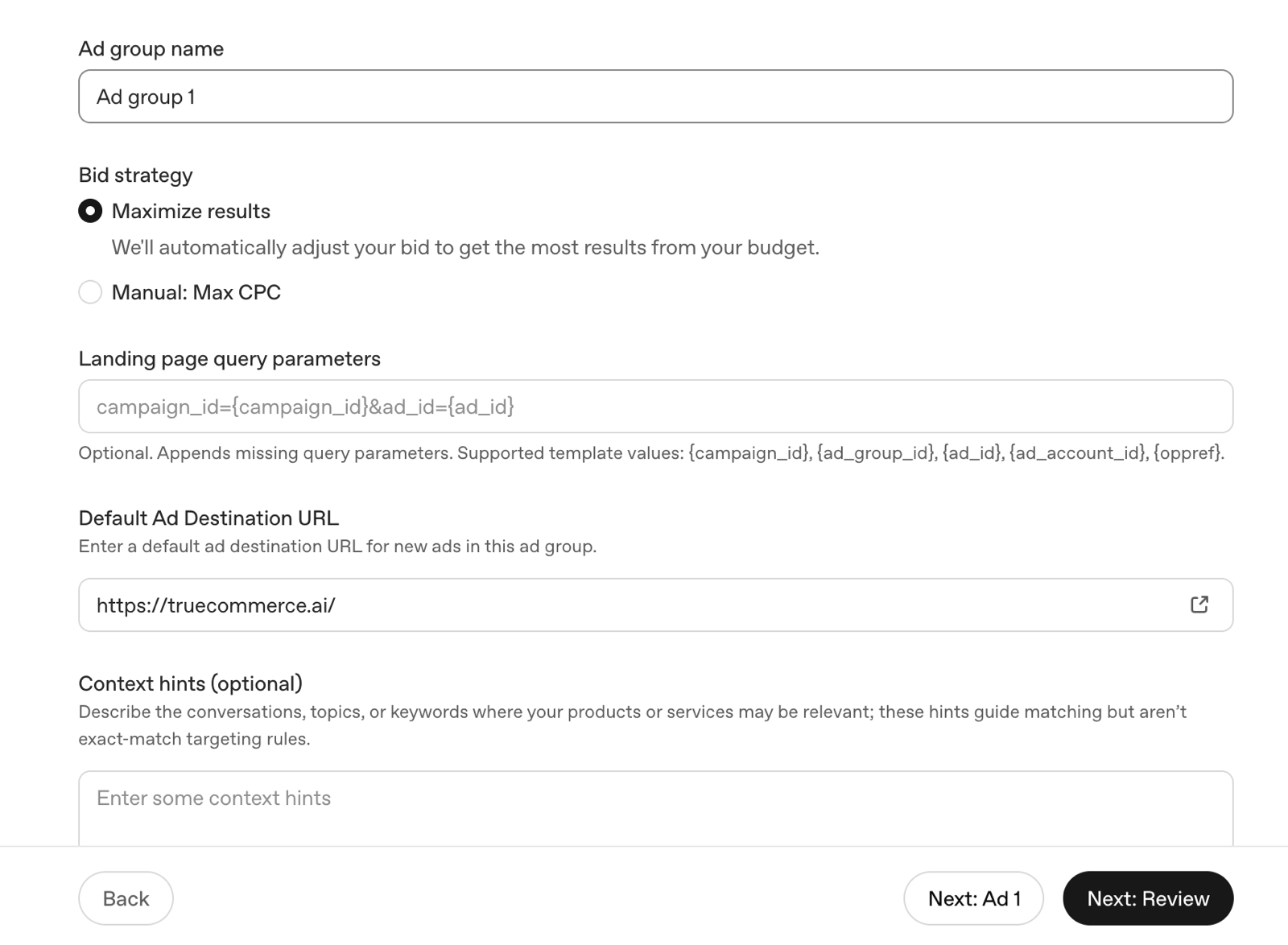
- Bidding: Maximize results (automatic) or Manual Max CPC, cleared through a relevance-weighted second-price auction. Start on Maximize results; switch to manual only after you have enough click data to know what a click is worth to you.
The ad unit itself is a single labeled sponsored box below the answer: advertiser name, logo, a title up to 50 characters, a description up to 100, a square image of at least 256×256, and a destination link. One advertiser per matched conversation - you are not stacked against three rivals on the same answer.
Step 3: write 5-15 context hints per ad group
This is the part that has no Google Ads equivalent. There are no keywords. Matching is conversational - ChatGPT weighs the current conversation topic, past chats, and past ad interactions. You steer it with context hints: OpenAI recommends 5-15 discrete, 1-2-sentence descriptions of buyer moments per ad group (OpenAI Ads Manager; help docs).
A hint is not a keyword list. "Running shoes India" is a bad hint. "Someone asking which running shoes handle monsoon-season road running and want delivery within a week" is a good one - it describes a moment, with intent and constraint. Write each of your 5-15 hints as a distinct buyer situation, not fifteen paraphrases of the same one. Hints guide matching; they are not exact-match rules, so precision beats volume.
We wrote a full playbook on this in our guide to context hints and targeting, and the broader mechanics - auction, pricing, formats - are in our ChatGPT ads for ecommerce explainer.
Step 4: install conversion tracking before you spend
Do not launch untracked. This is the most common first-week mistake, and it is expensive in the one currency you cannot get back: learning.
Measurement runs on two rails. The OpenAI pixel (oaiq.min.js) sets a __oppref click-id cookie on your site; the server-side Conversions API posts events to bzr.openai.com/v1/events. Events sent on both rails deduplicate on a shared event_id, and the default conversion window is 30 days. Even on a Clicks campaign, conversion-optimized CPC bidding steers delivery toward your selected conversion event while still charging per click (OpenAI Help Center, article 20001210) - so the tracking is not just reporting, it feeds delivery.
The full install, event by event, is in our conversion tracking setup guide. If you sell through a US or UK entity too, the same account structure carries over - the general walkthrough is in our global setup guide.
Do you need an agency? No.
Worth saying plainly, because the August 27 coverage was dominated by agency names: from September 4, agencies are not required. WPP and Omnicom were first through the door because the pre-self-serve window was agency-only. Self-serve is open to all merchants (Storyboard18, Aug 2026), and at ₹725 a day the sensible first month is one you run yourself - the account is small enough to learn hands-on, and the context-hint craft transfers directly into how you think about organic AI visibility.
Set expectations honestly. Chatbot ad CTR runs around 0.9% industry-wide, against roughly 6.4% for Google search benchmarks (eMarketer, 2026). In our own US campaigns running since July 2026, CTR has averaged ~1.3% (our campaign data). Agencies globally still report measurement gaps and unproven outcomes (eMarketer/Digiday, 2026). This channel is early. Treat month one as paid research, not a revenue line.
Where Tru Commerce fits
Our founder put the frame on record when the India launch landed: "Brands cannot buy influence over ChatGPT's answers" (The Hindu BusinessLine, Aug 28, 2026). From September 4, Indian brands compete on two layers. The sponsored placement is bought, labeled, and shown only to Free and Go users. The organic recommendation is earned - and it is the only layer Plus and Pro users ever see. AI-referred visits to US retail sites convert 60% better than non-AI traffic (Adobe Analytics via Digital Commerce 360, July 2026 data), and that conversion power belongs to the answer itself, not the ad box under it.
So sequence it correctly: before you fund the rented layer, measure the earned one. Run the free Citation Rank scan to see whether ChatGPT already recommends you, and to whom it recommends your competitors instead. Then use our ChatGPT Ads hub as the ongoing reference while you build. Ads rent the conversation. The recommendation is the asset.
Worth checking what this channel already drives for you: for MyMuse, GA4 reported ₹11.5K/mo of AI revenue when the real number was ₹81.2K/mo - read the MyMuse case study. If you want to see where you stand before committing, start with ChatGPT Ads for ecommerce brands.
FAQ
From September 4, 2026, create an account at ads.openai.com, add business details, tax ID, a billing method, and complete Persona verification. Then build a Clicks campaign with 5-15 context hints per ad group. Minimum daily budget is ₹725 (Storyboard18, Aug 2026).
No. Agencies ran the first campaigns after the August 27 launch - WPP and Omnicom were the first partners - but from September 4 self-serve is open to any Indian business at ads.openai.com. No agency, no minimum lifetime spend.
₹725 per day per campaign (Storyboard18, Aug 2026). Billing is postpay - you are charged after delivery, not upfront. There is no minimum lifetime spend commitment.
Only logged-in adults on the Free and Go tiers. Plus, Pro, Business, Enterprise, and Education users never see ads. Ads appear as a single labeled sponsored box below the answer and never influence what ChatGPT actually recommends (OpenAI).
Ads switched on for Indian Free and Go users on August 27, 2026, with 50+ brands live in the first week (The Hindu BusinessLine, Aug 28, 2026). Self-serve access for all businesses opens September 4, 2026.
Sources
- 1.Ads in ChatGPT: The Basics - OpenAI Help Center, 2026
- 2.ChatGPT Ads set to rewrite the rules of digital advertising in India - The Hindu BusinessLine, 2026
- 3.Create campaigns for ChatGPT - OpenAI Help Center, 2026
- 4.Adobe: AI referral traffic to retail sites converts 60% higher, July 2026 data - Digital Commerce 360, 2026
Continue reading
October 10, 2026
ChatGPT Ads in India: six weeks in, on the record
ChatGPT Ads switched on in India on 27 August 2026. Six weeks on, eight articles in five outlets quoted us and TechTimes cited our benchmarks. Every question the press asked, every answer verbatim and linked, and the numbers behind each one.
September 4, 2026
Criteo Prompt Smart Ads: 2,000 Brands on ChatGPT and a 4x Spend Lift
Criteo was the first ad-tech partner inside OpenAI's ChatGPT ads pilot. Its Prompt Smart Ads product auto-generates creatives and context hints matched to how people actually prompt - here is what it is, the numbers behind it, and what its creative reports teach every advertiser.
September 2, 2026
ChatGPT Ads Conversion Strategies: What the Query-Mix Data Says to Do
Only ~1 in 10 ChatGPT conversations carries commercial intent, 76.4% of shopping answers already show an ad, and market leaders buy almost none of them. Four strategies built on that data - not on search-ads instinct.