
ChatGPT Product Feed vs Google Shopping Feed: Same File, Different Game
ChatGPT product feed ads accept your Google Shopping-format catalog as-is - 100 SKU minimum, up to 1M SKUs. The file carries over. The keyword auction, placements, and measurement stack do not.
Viren Inaniyan · August 29, 2026 · ChatGPT Ads
Your Google Shopping feed already speaks ChatGPT's language - OpenAI adopted the same catalog format on purpose. What changed is everything around the file: no keywords, no placement grid, no familiar measurement stack. The upload takes an afternoon. Understanding the new matching model is the real work.
The same file, on purpose
When OpenAI launched product feed ads in June 2026, one decision saved every ecommerce team weeks of work: the catalog upload uses the Google Shopping format. Titles, descriptions, GTINs, prices, availability, images - the file you maintain for Merchant Center goes into ChatGPT Ads Manager without reformatting (OpenAI Ads Manager docs; Digiday, June 2026).
The constraints are simple. You need at least 100 SKUs, and the system supports up to 1M. Once uploaded, ChatGPT auto-generates the product ads - you do not build creative per SKU. The ad itself is a single labeled sponsored box below the answer: name, logo, a 50-character title, a 100-character description, a square image, and a link. One advertiser per matched conversation (OpenAI Ads Manager docs).
So the file transfer is trivial. The mental model is not.
What carries over
The feed file itself. Same format, same attributes, same update pipeline. If you sync your feed from Shopify or a PIM today, point the same output at ChatGPT Ads Manager.
Feed hygiene, with interest. Every hour spent on accurate titles, complete GTINs, correct availability, and honest pricing pays out again. Because ChatGPT generates the ad from the feed, a vague title becomes a vague ad with no keyword targeting to rescue it. We covered the discipline in how to optimize your product catalog for AI.
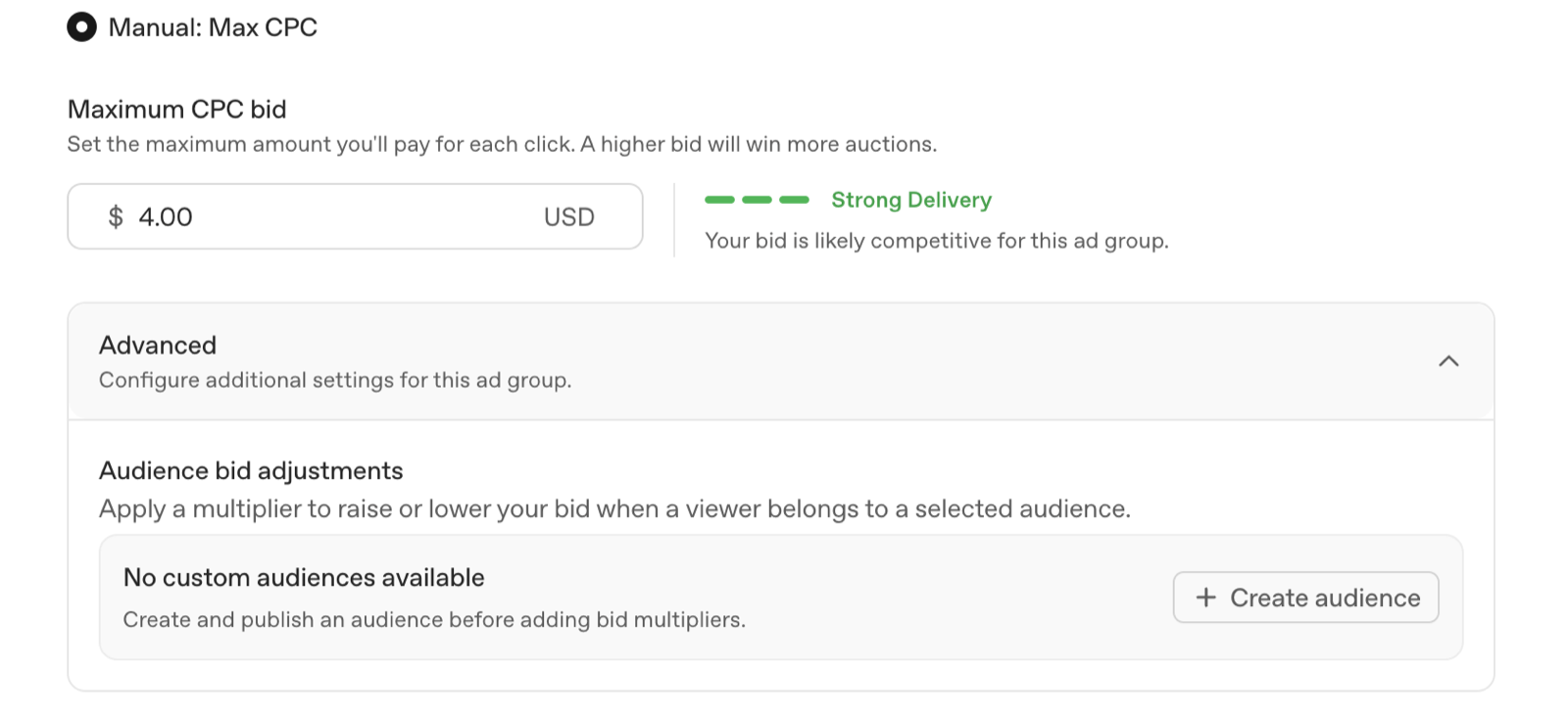
Campaign fundamentals. Budgets, geographic targeting (country, region, DMA, postal code), and bid strategy choices all exist in familiar shapes. Objectives are Clicks or Reach; bidding is Maximize results or Manual Max CPC; the minimum daily budget is $25 (OpenAI Ads Manager docs).
The economics conversation. CPCs sit in a familiar range: $3-5 recommended starting bids, $8-18 in software and finance, CPMs from roughly $25-60 (WebFX; OpenAI docs, 2026). This is not the $60 CPM, $200,000-minimum product of the February launch - both have since been dropped.
What does not carry over
Keyword bidding. There are no keywords in ChatGPT ads. None to bid on, none to negate. Matching is conversational: the current conversation topic, the user's past chats, and their past ad interactions decide which advertiser's box appears. Your steering wheel is context hints - OpenAI recommends 5-15 discrete, 1-2-sentence buyer-moment descriptions per ad group; hints guide matching but are not exact-match rules (OpenAI Ads Manager docs). A decade of query-level Shopping craft - priority tiers, brand splits, search term mining - has no equivalent here. What replaces it is writing precise descriptions of the moments when your product is the right answer.
Placements. Google Shopping gives you a grid of surfaces - search, Shopping tab, Display, YouTube - with per-placement reporting. ChatGPT gives you one placement: the sponsored box below an answer, shown only to logged-in adults on the Free and Go tiers. Plus, Pro, Business, Enterprise, and Education users never see ads (OpenAI). There is no placement strategy because there is nothing to allocate across.
Your measurement stack. Google conversions, years of Merchant Center history, smart bidding seasoned on your data - none of it transfers. ChatGPT measurement means installing OpenAI's pixel (oaiq.min.js, which sets a click-id cookie) and the server-side Conversions API, with events deduplicated on a shared event_id and a 30-day default conversion window (OpenAI Help Center, 2026). You start cold, and delivery ramps slowly during beta by design (OpenAI onboarding). Agencies report measurement gaps and unproven outcomes as the category's weak point (eMarketer/Digiday, 2026). And once clicks land, many arrive in GA4 looking like Direct - the dark agentic commerce traffic problem applies to paid clicks too.
CTR expectations. Chatbot ads average around 0.9% CTR against a roughly 6.4% Google search benchmark (eMarketer, 2026). Our own US campaigns, running since July 2026, have averaged about 1.3% (our campaign data) - better, still nothing like search. The compensating fact is organic: AI-referred visits to US retail sites convert 60% better than non-AI traffic (Adobe Analytics via Digital Commerce 360, July 2026 data).
The afternoon migration, step by step
If your Google feed is clean, here is the realistic scope of work:
- Export or re-point your existing Google Shopping feed. No reformatting. Confirm you clear the 100 SKU minimum.
- Set up the Ads Manager account. Business details, tax ID, billing method, Persona verification, and an account logo are required before serving; billing is postpay (OpenAI docs). This step may add a day of waiting, not working.
- Write context hints instead of keyword lists. Draft 5-15 buyer-moment descriptions per ad group: "a shopper asking for a gift for a runner who hates bulky watches," not "running watch + gift."
- Install measurement. Pixel plus Conversions API, deduplicated on event_id. Do this before spending, not after.
- Start with recommended bids. $3-5 CPC, $25/day minimum, and patience - beta delivery ramps slowly.
The full account walkthrough is in our ChatGPT ads setup guide, and the cost mechanics are in how ChatGPT ads work for ecommerce and what they cost. If you are still deciding whether the budget belongs here at all, we argued both sides in ChatGPT ads vs Google Ads.
This is no longer a US-only question, either. India switched ads on August 27, 2026, and self-serve opens to any Indian business on September 4 with a minimum daily budget of ₹725 (The Hindu BusinessLine, Aug 28, 2026; Storyboard18, Aug 2026). The same Google-format feed works everywhere the product is live.
If your feed is not clean, fix that first
The migration estimate collapses when the feed is the problem. Missing GTINs, stale availability, titles written for internal SKU logic rather than shoppers - Google partially forgives these because keywords and smart bidding paper over weak attributes. ChatGPT does not. The feed is the creative, and the conversation is the targeting.
There is a second reason to fix it: the same catalog attributes feed ChatGPT's organic shopping answers - the recommendations shown to every user, including the Plus and Pro subscribers who never see ads. We walked through how that surface selects products in our ChatGPT shopping teardown. A clean feed is one asset serving two channels.
Where Tru Commerce fits
Brands now compete on two layers in ChatGPT: the organic recommendation, which is earned, and the sponsored placement, which is bought and labeled. As our founder put it in The Hindu BusinessLine (Aug 28, 2026), "Brands cannot buy influence over ChatGPT's answers." Your migrated feed rents the sponsored box for Free and Go users. It does nothing for the earned layer - the only layer premium users ever see.
Before you spend the afternoon on the ad migration, spend two minutes finding out where you stand organically. Run the free Citation Rank scan to see whether ChatGPT already recommends your products when shoppers ask - and visit our ChatGPT Ads hub for everything on the paid side. The feed is the same file. The game is winning both layers with it.
The upside here is measurable: House of Zelena went from 22% to 56% ChatGPT mention share in 6 months with us - see the House of Zelena case study. If you want to see where you stand before committing, start with ChatGPT Ads for ecommerce brands.
FAQ
Yes. ChatGPT product feed ads, launched June 2026, accept a Google Shopping-format catalog directly - no reformatting. The minimum is 100 SKUs and the ceiling is 1M SKUs (OpenAI Ads Manager docs; Digiday, June 2026).
No. There are no keywords and no keyword bidding. Matching is conversational - based on the current conversation topic, past chats, and past ad interactions. Advertisers steer with 5-15 context hints per ad group instead (OpenAI Ads Manager docs).
At least 100 SKUs in your uploaded catalog; the format supports up to 1M SKUs. ChatGPT auto-generates the product ads from the feed once it is uploaded (OpenAI Ads Manager docs; Digiday, June 2026).
Recommended starting bids are $3-5 CPC, rising to $8-18 in software and finance; CPM options run roughly $25-60 (WebFX; OpenAI docs, 2026). Minimum daily budget is $25. Billing is postpay.
Yes, on average. Chatbot ad CTR runs around 0.9% versus a roughly 6.4% Google search benchmark (eMarketer, 2026). Our own US campaigns have averaged about 1.3% CTR since July 2026 - better, but still a different game than search.
Sources
- 1.Ads in ChatGPT: The Basics - OpenAI Help Center, 2026
- 2.OpenAI makes it easier to run shopping ads in ChatGPT - Digiday, 2026
- 3.Create campaigns for ChatGPT - OpenAI Help Center, 2026
- 4.ChatGPT ads will soon reach more users — proven results still missing - eMarketer, 2026
- 5.AI-driven traffic converts 42% better than non-AI traffic - Adobe Analytics via Digital Commerce 360, 2026
- 6.Adobe: AI referral traffic to retail sites converts 60% higher, July 2026 data - Digital Commerce 360, 2026
Continue reading
October 10, 2026
ChatGPT Ads in India: six weeks in, on the record
ChatGPT Ads switched on in India on 27 August 2026. Six weeks on, eight articles in five outlets quoted us and TechTimes cited our benchmarks. Every question the press asked, every answer verbatim and linked, and the numbers behind each one.
September 4, 2026
Criteo Prompt Smart Ads: 2,000 Brands on ChatGPT and a 4x Spend Lift
Criteo was the first ad-tech partner inside OpenAI's ChatGPT ads pilot. Its Prompt Smart Ads product auto-generates creatives and context hints matched to how people actually prompt - here is what it is, the numbers behind it, and what its creative reports teach every advertiser.
September 2, 2026
ChatGPT Ads Conversion Strategies: What the Query-Mix Data Says to Do
Only ~1 in 10 ChatGPT conversations carries commercial intent, 76.4% of shopping answers already show an ad, and market leaders buy almost none of them. Four strategies built on that data - not on search-ads instinct.