
ChatGPT Ads vs Meta Ads: Intent vs Interruption
Meta interrupts a feed; ChatGPT answers a question. AI-referred visits to US retail sites converted at a rate 60% higher than non-AI traffic in July 2026, the eleventh straight month ahead (Adobe Analytics, via Digital Commerce 360, 19 August 2026).
Viren Inaniyan · August 29, 2026 · ChatGPT Ads
Meta ads interrupt people who look like your buyers. ChatGPT ads appear when someone is already asking what to buy. That single difference - modeled interest versus stated intent - changes the targeting model, the creative workload, the pricing logic, and where each channel belongs in a D2C budget.
Two machines built for opposite moments
Meta's ad engine is an interruption machine, and a very good one. It models who might want your product from interests, behaviors, and lookalike seeds, then inserts creative into a feed the user opened to see something else. The user was not shopping; Meta's job is to make them start.
ChatGPT ads work at the opposite moment. Someone is mid-conversation - "which cordless vacuum under $300 handles pet hair?" - and below the model's organic answer sits a single labeled sponsored box: advertiser name, logo, a title of up to 50 characters, a description of up to 100, a square image, and a link. One advertiser per matched conversation, no carousel of competitors (OpenAI, 2026). The user is already deciding; the ad's job is to be a relevant option at the exact moment of choice.
Neither moment is better in the abstract. Demand has to be created before it can be captured. But they are different jobs, and pricing one channel with the other's logic is how budgets get wasted.
Targeting: modeled interest vs conversational matching
Meta targets people. Interest segments, custom audiences, lookalikes - increasingly automated through Advantage+ style delivery, but still fundamentally a model of who is likely to respond.
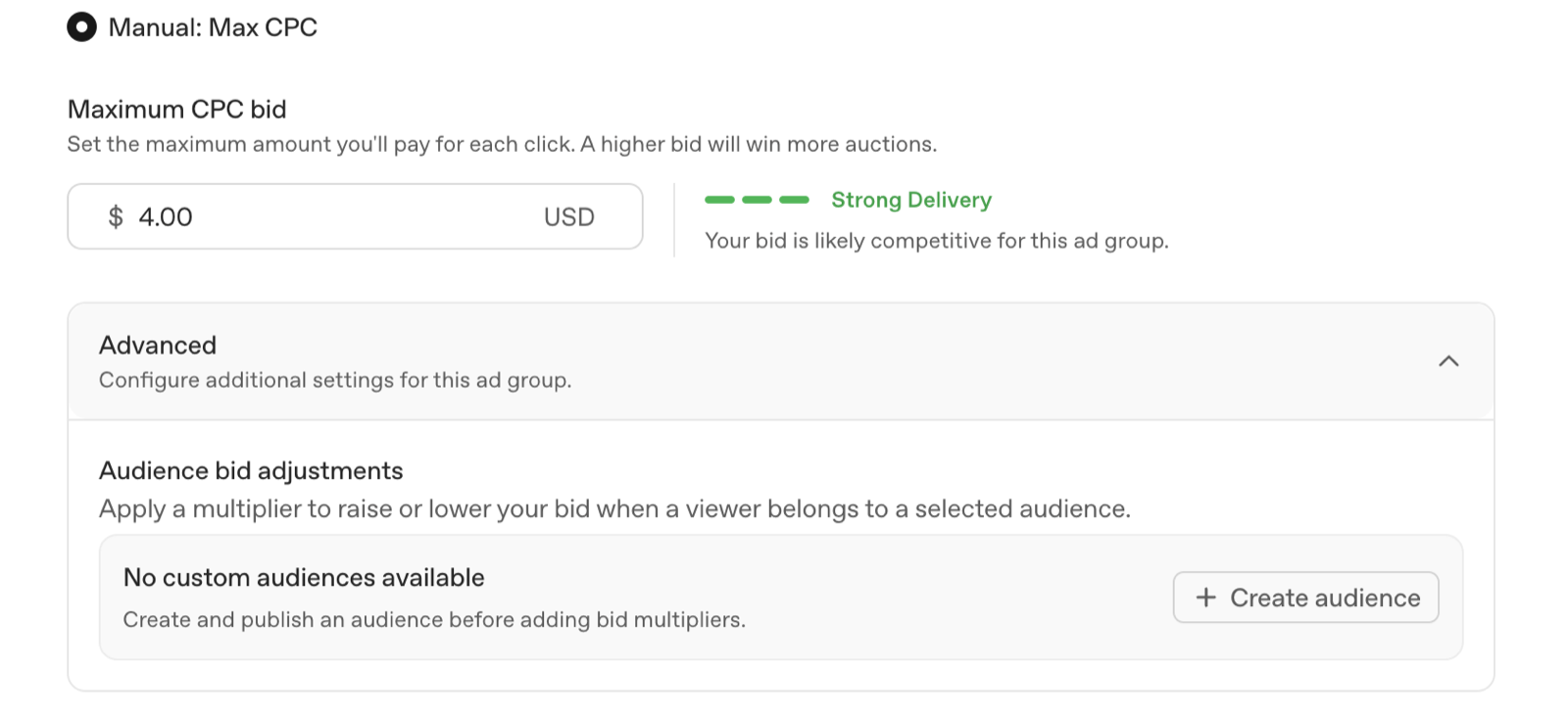
ChatGPT targets moments. There are no keywords and no audience segments to buy. Matching runs on the current conversation topic, past chats, and past ad interactions. Advertisers steer it with context hints - OpenAI recommends 5-15 discrete, 1-2-sentence descriptions of buyer moments per ad group, and hints guide matching rather than acting as exact-match rules (OpenAI Ads Manager, 2026). Geographic controls go down to country, region, DMA, and postal code, with custom audiences and bid multipliers - but no demographic profiles are sold, and user data is not sold to advertisers (OpenAI, 2026).
The practical shift: on Meta you describe your customer; on ChatGPT you describe the situations in which someone needs you. Writing good hints looks more like writing FAQ answers than building an audience. Our setup guide walks through the hint-writing step in detail.
Creative burden: the fatigue treadmill vs one evergreen unit
Ask any D2C team what Meta actually costs and they will point past the media bill to the creative pipeline: hooks, UGC, statics, variations, and a refresh cycle that never stops because performance decays as audiences see the same asset repeatedly.
ChatGPT's format removes most of that treadmill. The unit is text-first and tightly constrained - 50-character title, 100-character description, one square image of at least 256×256, a favicon rendering at 32×32. There is no feed to win with a thumb-stopping hook, because the slot renders only when the conversation already matches. Since June 2026, product feed ads go further: upload a Google Shopping-format catalog (100 SKU minimum, up to 1M SKUs) and ChatGPT auto-generates the product ads from your feed (OpenAI Ads Manager docs; Digiday, June 2026).
The work moves upstream - from producing creative volume to maintaining feed quality and writing precise context hints. Our guide to optimizing your product catalog for AI covers why the same feed hygiene also drives organic visibility.
What each costs, honestly
ChatGPT's published reference points, mid-2026: recommended starting bids of $3-5 CPC in the US, rising to $8-18 in software and finance; CPM options from roughly $25-60; a relevance-weighted second-price auction; and a $25 minimum daily budget (WebFX; OpenAI docs; practitioner reports, 2026). That is a long way from the February launch terms of $60 CPMs and a $200,000 minimum - both since dropped (OpenAI, 2026).
Meta's pricing moves with vertical, audience, and season, so we won't pin a number on it here - but the comparison that matters is not CPC against CPC. It is cost per incremental conversion, and that depends on what a click represents. Chatbot ad click-through runs around 0.9% versus roughly 6.4% for Google search ads (eMarketer, 2026); our own US campaigns since July 2026 have averaged ~1.3% CTR (our campaign data). Clicks are scarcer - but AI-referred visits to US retail sites convert 60% better than non-AI traffic (Adobe Analytics via Digital Commerce 360, July 2026 data). Fewer, cheaper, far warmer clicks is a different economic shape than either Meta or Google, which is why we treat ChatGPT vs Google as its own comparison.
Measurement: maturity vs beta reality
Here Meta wins, clearly. Years of pixel and Conversions API tooling, incrementality testing, and third-party verification make Meta's measurement stack far more mature - even after the signal loss of recent privacy changes.
ChatGPT's stack is real but young: an OpenAI pixel with a click-id cookie, a server-side Conversions API, event deduplication on shared event IDs, and a default 30-day conversion window (OpenAI, 2026). Delivery also ramps slowly during beta by design (OpenAI onboarding). Agencies still report measurement gaps and unproven outcomes (eMarketer/Digiday, 2026) - and the channel already hit $100M in annualized revenue anyway (eMarketer, 2026). Budget is arriving faster than proof. Compounding this, much AI-referred traffic lands in GA4 as Direct; our guide to dark agentic commerce traffic shows how to surface it.
Where each fits a D2C budget
Meta remains the demand engine. Prospecting at scale, retargeting, and creative-driven discovery have no substitute in ChatGPT's single-slot format. Reach objectives exist in ChatGPT's Ads Manager, but a conversational slot is not a feed.
ChatGPT is the intent-capture test. Our recommendation: carve out 10-15% of paid budget as an incremental test, not a reallocation. Run conversion-optimized CPC - OpenAI optimizes delivery toward your selected conversion event while still charging per click (OpenAI Help Center, 2026) - install the pixel and Conversions API on day one, and judge the channel on cost per incremental conversion after 60-90 days. At a $25 daily minimum, the floor is low enough that most brands' real constraint is setup discipline, not spend. Full cost mechanics live in our ecommerce cost breakdown, and everything in the cluster is indexed on our ChatGPT Ads hub.
The boring-but-true answer: intent and interruption are complements. Meta fills the top of the funnel; ChatGPT stands at the moment of decision.
Where Tru Commerce fits
One more asymmetry, and it is the big one. Ads appear only to logged-in adults on the Free and Go tiers - Plus, Pro, Business, Enterprise, and Education users never see them, and ads never influence ChatGPT's answers (OpenAI, 2026). As our founder put it in The Hindu BusinessLine (Aug 28, 2026): "Brands cannot buy influence over ChatGPT's answers."
So every brand now competes on two layers: the sponsored placement you rent per conversation, and the organic recommendation you earn - the only layer premium users ever see. Meta has no equivalent of that second layer. Before you spend a dollar renting the conversation, find out whether ChatGPT already recommends you in it. Run the free Citation Rank scan - results in 24 hours, no login, no credit card - and see where you stand on the layer money can't buy.
Worth checking what this channel already drives for you: for MyMuse, GA4 reported ₹11.5K/mo of AI revenue when the real number was ₹81.2K/mo - read the MyMuse case study. The usual first step is ChatGPT Ads for ecommerce brands.
FAQ
They do different jobs. Meta creates demand by interrupting a feed at scale; ChatGPT captures an active decision with one sponsored slot per matched conversation. Most D2C teams should treat them as complementary, not substitutes, and test ChatGPT with 10-15% of paid budget.
OpenAI recommends $3-5 starting CPCs in the US, rising to $8-18 in software and finance, with CPM options from roughly $25-60 and a $25 minimum daily budget (WebFX; OpenAI docs, 2026). Meta pricing varies widely by vertical, audience, and season.
No. There are no keywords, interest segments, or lookalikes. Matching is conversational - current topic, past chats, past ad interactions - steered by 5-15 short context hints per ad group (OpenAI Ads Manager, 2026). No demographic profiles are sold to advertisers.
Not wholesale. Meta's measurement stack is mature; ChatGPT's is early, and agencies still report gaps (eMarketer/Digiday, 2026). Shift a 10-15% test budget, run the OpenAI pixel plus Conversions API from day one, and judge on incremental conversions.
Only logged-in adults on the Free and Go tiers. Plus, Pro, Business, Enterprise, and Education users never see ads, and ads never influence ChatGPT's answers (OpenAI, 2026). Reaching paid-tier users requires earning the organic recommendation.
Sources
- 1.Ads in ChatGPT: The Basics - OpenAI Help Center, 2026
- 2.ChatGPT ads will soon reach more users — proven results still missing - eMarketer, 2026
- 3.AI-driven traffic converts 42% better than non-AI traffic - Adobe Analytics via Digital Commerce 360, 2026
- 4.Adobe: AI referral traffic to retail sites converts 60% higher, July 2026 data - Digital Commerce 360, 2026
Continue reading
October 10, 2026
ChatGPT Ads in India: six weeks in, on the record
ChatGPT Ads switched on in India on 27 August 2026. Six weeks on, eight articles in five outlets quoted us and TechTimes cited our benchmarks. Every question the press asked, every answer verbatim and linked, and the numbers behind each one.
September 4, 2026
Criteo Prompt Smart Ads: 2,000 Brands on ChatGPT and a 4x Spend Lift
Criteo was the first ad-tech partner inside OpenAI's ChatGPT ads pilot. Its Prompt Smart Ads product auto-generates creatives and context hints matched to how people actually prompt - here is what it is, the numbers behind it, and what its creative reports teach every advertiser.
September 2, 2026
ChatGPT Ads Conversion Strategies: What the Query-Mix Data Says to Do
Only ~1 in 10 ChatGPT conversations carries commercial intent, 76.4% of shopping answers already show an ad, and market leaders buy almost none of them. Four strategies built on that data - not on search-ads instinct.