
ChatGPT Ads Reporting: What You Can Measure and What You Cannot (Yet)
Ads Manager reports spend, impressions, clicks, CPC, and linked conversions - and stops there. Agencies already call the gaps out (eMarketer, 2026). Here is the measurement stack to build around it.
Viren Inaniyan · August 29, 2026 · ChatGPT Ads
OpenAI's Ads Manager tells you what you spent and what you got clicked. It does not tell you what conversation you appeared in, which context hint matched, or who converted a week later on another device. Until the reporting catches up, the difference between a measurable ChatGPT ads program and an expensive guess is the stack you build around the dashboard.
What Ads Manager reports today
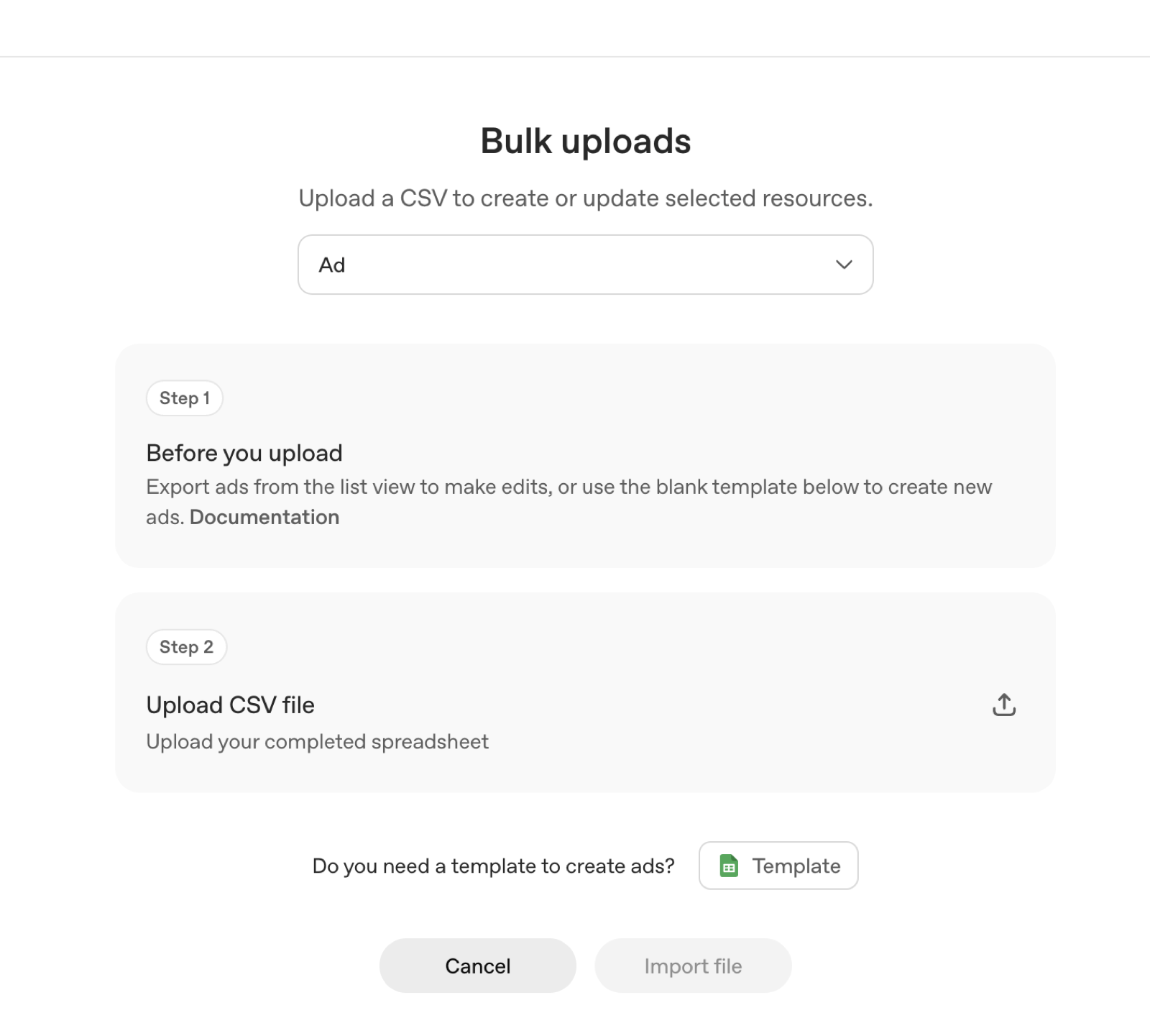
The self-serve Ads Manager at ads.openai.com - open since May 2026 with no minimum lifetime spend (OpenAI, May 2026) - reports the campaign basics: spend, impressions, clicks, and CPC, plus any conversion events you have linked to a campaign through OpenAI's measurement tools.
That set answers three questions well:
- Pacing. Is the campaign spending against its budget? Delivery ramps slowly during the beta by design (OpenAI onboarding), so this is the first thing to watch in week one.
- Cost efficiency. Is your CPC landing inside the $3-5 recommended starting range, or drifting toward the $8-18 seen in software and finance (WebFX; OpenAI docs, 2026)?
- Click volume. Are you near benchmark? Chatbot ad CTR runs around 0.9% (eMarketer, 2026); our own US campaigns since July 2026 average ~1.3% (our campaign data).
Under conversion-optimized CPC, OpenAI optimizes delivery toward your selected conversion event but still charges per click (OpenAI Help Center, article 20001210) - so linked conversion events are not just reporting, they are the campaign's steering input. The full setup sequence is in our conversion tracking walkthrough.
The conversion layer: pixel plus Conversions API
Conversion reporting runs on two paths. The browser path is the OpenAI pixel - oaiq.min.js - which captures the click id into a first-party __oppref cookie on your landing page and attaches it to later events. The server path is the Conversions API at bzr.openai.com/v1/events. Events from both paths deduplicate on a shared event_id: same pixel, same event name, same id, counted once. The default conversion window is 30 days.
Two consequences worth internalizing:
- Redundancy is the design, not a workaround. The pixel loses events to blockers and cookie hygiene; the API loses nothing the browser did but knows nothing the browser saw. Together, deduplicated, they are one honest count. Our OpenAI pixel guide covers the implementation details.
- The window only looks backward. A conversion on day 31 after the click does not report. A click that landed before the pixel existed never reports. Tracking goes in before the first dollar does.
What you cannot measure (yet)
There is no search-terms report, and there cannot be one. ChatGPT ads have no keywords. Matching runs on the current conversation topic, past chats, and past ad interactions, and OpenAI has stated since February 2026 that conversations are kept private from advertisers. The query-mining loop that funds every Google Ads optimization cycle - see what matched, cut what shouldn't, bid up what converts - has no equivalent here.
You cannot see which context hint fired. You steer matching with 5-15 discrete buyer-moment descriptions per ad group (OpenAI Ads Manager; help docs), but hints guide matching rather than acting as exact-match rules, and reporting does not break performance out by hint. Testing hints today means structural separation - different ad groups, different hint sets - not reading a report.
No demographic breakdowns. OpenAI sells no demographic profiles and does not sell user data to advertisers (OpenAI). Targeting is geographic - country, region, DMA, postal code - plus custom audiences with bid multipliers, and reporting follows the same shape.
No incrementality read. With one advertiser per matched conversation and a relevance-weighted second-price auction, there is no auction-insights view, no overlap report, and no lift study product. You know what the click cost; you do not know what would have happened without it.
The industry has noticed. Agencies report measurement gaps and unproven outcomes so far (eMarketer/Digiday, 2026) - striking for a format that has already crossed $100M in annualized revenue (eMarketer, 2026). We read that criticism as fair, and as an argument for building your own measurement floor rather than waiting for OpenAI to pour one.
The stack to build yourself
1. UTM discipline on every destination link. Ads Manager will not populate your analytics for you. Tag every destination URL - utm_source=chatgpt, utm_medium=paid, a campaign name that matches your Ads Manager naming - before the ad goes live. Untagged clicks from AI surfaces have a habit of landing in GA4 as Direct and disappearing into the bucket we call dark agentic commerce traffic; a tagged click cannot be misfiled.
2. A weekly GA4 cross-check. Build a custom channel group on your UTM parameters, then reconcile GA4 sessions against Ads Manager clicks every week. The two numbers will never match exactly - blockers, redirects, and lost referrers see to that - but the ratio should be stable. A stable 85% one week and 40% the next is a broken redirect or a stripped parameter, and Ads Manager alone would never show it.
3. Pixel and Conversions API together, from day one. Even if the server side ships later, generate an event_id for every conversion event now - it is the dedup key that makes adding the API painless instead of a double-counting incident. Then treat the deduplicated Ads Manager conversion count, your GA4 conversions by channel, and your platform-of-record orders as three views you reconcile, not one number you trust.
That floor will not give you conversation-level insight - nothing will, by policy. But it turns "the dashboard says 214 clicks" into a click-to-session-to-order funnel you can defend in a budget meeting, which is the standard the ChatGPT-vs-Google budget question ultimately turns on. If you are still setting up, start with our step-by-step setup guide or the rest of our ChatGPT Ads hub.
Where Tru Commerce fits
Everything above measures the layer you rent. There is a second layer Ads Manager will never report on: the organic recommendation inside ChatGPT's answer itself. As our founder put it in The Hindu BusinessLine (Aug 28, 2026), "Brands cannot buy influence over ChatGPT's answers." Brands now compete on two layers - the earned recommendation and the bought, labelled placement - and Plus, Pro, Business, Enterprise, and Education users never see ads at all (OpenAI), which means your highest-value audience only ever sees the earned layer.
That layer is measurable too - just not in Ads Manager. Our free Citation Rank scan shows where your brand stands in AI answers across ChatGPT, Gemini, Perplexity, and the other agent surfaces, in 24 hours, before you spend anything on the rented one. Measure both layers; pay for one.
Worth checking what this channel already drives for you: for MyMuse, GA4 reported ₹11.5K/mo of AI revenue when the real number was ₹81.2K/mo - read the MyMuse case study. If you want to see where you stand before committing, start with ChatGPT Ads for ecommerce brands.
FAQ
Spend, impressions, clicks, CPC, and any conversion events you link to a campaign through the OpenAI pixel or Conversions API. That covers pacing and cost efficiency. It does not report the prompts that triggered your ad, which context hint matched, or any demographic breakdown.
No. There are no keywords, and OpenAI keeps conversations private from advertisers - a policy stated repeatedly since February 2026. Matching runs on conversation topic, past chats, and past ad interactions, so there is no equivalent of a Google Ads search-terms report.
Ads Manager will not push data into GA4, so tag every destination link with UTMs (for example utm_source=chatgpt, utm_medium=paid) and build a channel group on those parameters. Then cross-check GA4 sessions against Ads Manager clicks each week to catch attribution drift.
Some AI-referred visits land in GA4 stripped of referrer data and get bucketed as Direct - untagged links make it worse. UTM discipline closes most of the gap; the OpenAI pixel's __oppref click-id cookie plus the Conversions API covers conversions the browser loses.
Not if you implement it correctly. Events sent from both the pixel and the server-side Conversions API deduplicate on a shared event_id - same pixel, same event name, same event_id counts once. Generate that ID for every conversion from day one, even before the server side exists.
Sources
- 1.Ads in ChatGPT: The Basics - OpenAI Help Center, 2026
- 2.Ads Measurement Pixel documentation - OpenAI Developers, 2026
- 3.Ads Conversions API documentation - OpenAI Developers, 2026
- 4.Conversion measurement - OpenAI Help Center, 2026
Continue reading
October 10, 2026
ChatGPT Ads in India: six weeks in, on the record
ChatGPT Ads switched on in India on 27 August 2026. Six weeks on, eight articles in five outlets quoted us and TechTimes cited our benchmarks. Every question the press asked, every answer verbatim and linked, and the numbers behind each one.
September 4, 2026
Criteo Prompt Smart Ads: 2,000 Brands on ChatGPT and a 4x Spend Lift
Criteo was the first ad-tech partner inside OpenAI's ChatGPT ads pilot. Its Prompt Smart Ads product auto-generates creatives and context hints matched to how people actually prompt - here is what it is, the numbers behind it, and what its creative reports teach every advertiser.
September 2, 2026
ChatGPT Ads Conversion Strategies: What the Query-Mix Data Says to Do
Only ~1 in 10 ChatGPT conversations carries commercial intent, 76.4% of shopping answers already show an ad, and market leaders buy almost none of them. Four strategies built on that data - not on search-ads instinct.