
ChatGPT Ads Specs: Image Sizes, Logo Requirements, and Character Limits
The full ChatGPT ads spec sheet: square image at least 256×256, logo requirements at 32×32, title capped at 50 characters, description at 100, one destination URL. Plus the creative rules that keep a unit this small from getting ignored — or rejected.
Viren Inaniyan · August 29, 2026 · AI Search Visibility
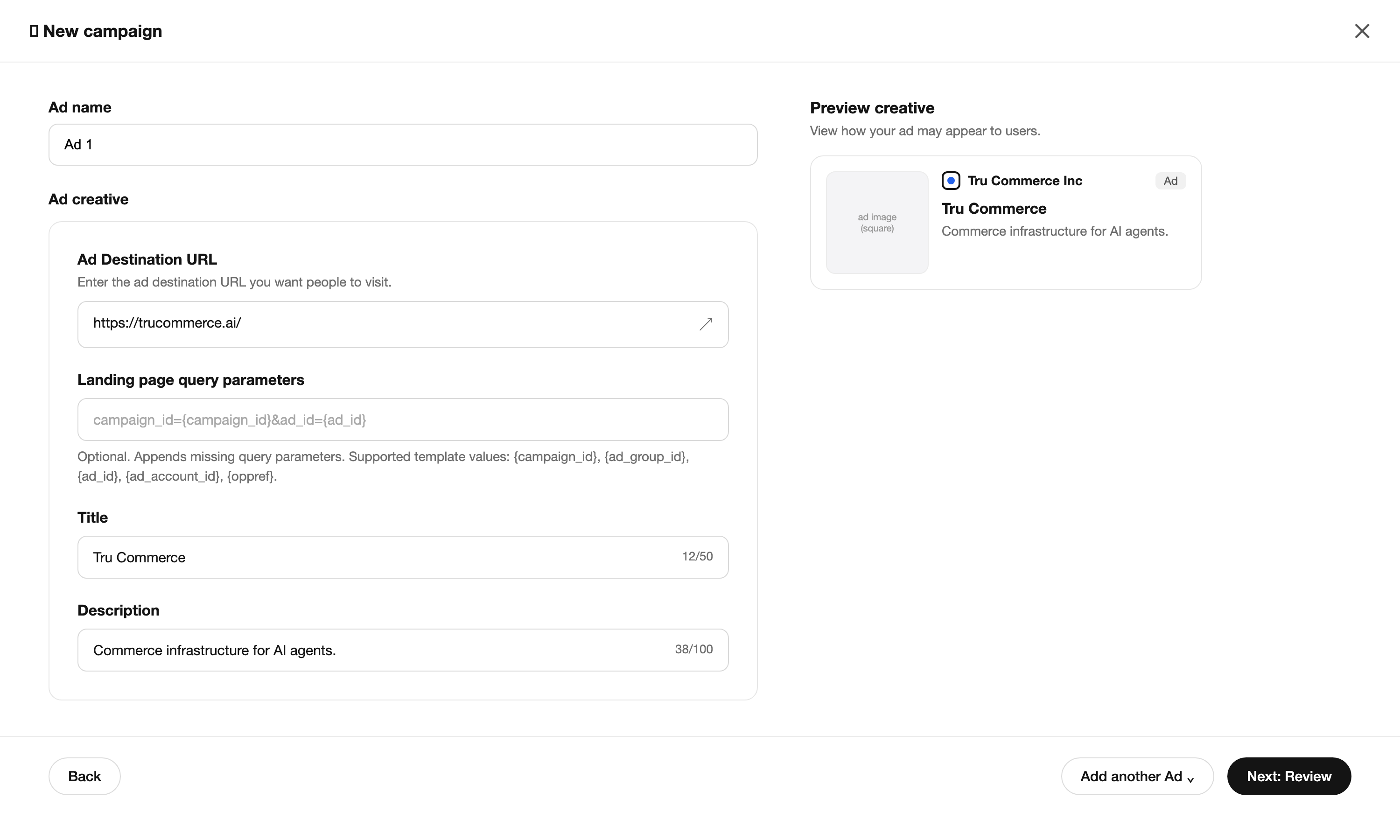
Every ChatGPT ad is one small card: a square image of at least 256×256, a logo that renders at 32×32, a title capped at 50 characters, a description capped at 100, and exactly one destination URL. This post is the spec sheet — and the creative rules that matter when your entire ad is about half a tweet.
The complete spec sheet
Here is every creative requirement in the OpenAI Ads Manager, in one table.
| Element | Spec | Notes |
|---|---|---|
| Advertiser name | Your verified business name | Set at account level, not per ad |
| Logo | Renders at 32×32 | Uploaded during account setup; required before serving |
| Title | ≤50 characters | Roughly 6–8 words |
| Description | ≤100 characters | One sentence |
| Image | Square, ≥256×256 | Static only — no video, GIF, or carousel |
| Destination | One URL | No sitelinks, callouts, or extensions |
| Placement | One labeled sponsored box below the answer | One advertiser per matched conversation |
That is the entire format. There are no asset variants for the system to rotate; what you upload is what renders. We cover where the unit appears in our full anatomy post, and the account setup sequence in our Ads Manager walkthrough.
Image specs: upload big, design for small
The floor is 256×256 (OpenAI Ads Manager docs, 2026). Upload well above it — the platform downscales cleanly from a high-resolution square, and an upload at the bare minimum leaves you nothing in reserve if OpenAI renders the unit larger on some surfaces later.
The harder discipline is the opposite one: design for how small the image actually renders. The card sits below a text answer on what is often a phone screen. In practice that means:
One subject, filling the frame. A single product on a clean background beats a lifestyle scene every time at this size. If a viewer cannot tell what the product is at thumbnail scale, the image is decoration, not communication.
No text in the image. Small type becomes unreadable once the card renders at phone scale — and image text duplicating your title is one of the patterns we see get creative flagged in review. Your 150 characters of copy live in the title and description fields; let the image do the one job copy cannot.
High contrast against both themes. ChatGPT runs in light and dark mode. An image with a white background disappears into light mode's card edge; a near-black one does the same in dark mode. A defined product silhouette or a solid mid-tone background survives both.
If you are running product feed ads — the June 2026 format where ChatGPT auto-generates ads from an uploaded Google Shopping-format catalog, 100 SKU minimum (OpenAI Ads Manager docs; Digiday, June 2026) — the same logic applies to your feed images. Your catalog's primary image field is your creative. We cover the feed side in our feed requirements guide.
Character limits: 150 characters, one argument
Fifty characters of title. One hundred of description. Together that is about half a tweet, so the format punishes anything that tries to do two jobs.
Make the title the outcome, not the brand. Your advertiser name and logo already render on the card, so a brand-name title says what the unit says twice already. "Ships in 2 days, free returns" earns its 29 characters. "BrandCo — Quality You Can Trust" earns none of its 31.
Make the description the proof. One specific claim: a price, a concrete spec, a shipping promise, a named ingredient. Vague benefit copy ("elevate your routine") reads as filler at any length; at 100 characters it is fatal.
Match the buyer moment, not the category. There are no keywords in this system. Matching is conversational — the current conversation topic, past chats, past ad interactions — and you steer it with 5–15 context hints per ad group, each a 1–2 sentence description of a buyer moment (OpenAI Ads Manager docs, 2026). Your title should read as the natural next line of the conversation your hints describe. If your hint targets "someone comparing running shoes for wide feet," a title about wide-fit sizing will outperform a generic brand line. We go deep on hint-writing in our context hints guide.
ChatGPT ads logo requirements: your logo at 32×32
The logo requirement itself is simple: one account-level logo, uploaded during setup, required before any ad can serve - the review screen blocks campaigns with "We couldn't find a business logo" if you skip it. It renders next to your advertiser name on every ad at 32×32 pixels.
Thirty-two pixels square is favicon territory, and most brand logos were never designed for it. Full wordmarks collapse into a gray smear; detailed marks lose every distinguishing feature.
Before launch, export your logo at actual 32×32 and look at it on a phone. If you cannot identify the brand, neither can anyone else — and because the logo is part of the sponsor identification on a labeled unit, an unreadable one is a rejection pattern, not just a performance problem. If your primary mark fails the test, upload the simplified icon version — the same asset you would use as an app icon or favicon.
Common rejection reasons
Persona verification, business details, tax ID, and an account logo are all required before an account serves at all. Past that gate, these are the creative-level patterns that get ads rejected or sent back in review:
Destination domain mismatch. The single most common one. Your destination URL must belong to the business you verified. Sending clicks to a link shortener, an unrelated microsite, or a marketplace listing under a different seller name reads as misrepresentation. Use your verified domain; use UTM parameters, not redirects, for tracking — your conversion measurement runs through the OpenAI pixel and Conversions API regardless.
Claims the landing page does not support. A "50% off" title pointing at a full-price page is a straightforward reject. The title is a promise; the URL is where it gets checked.
Illegible creative. Logos that are noise at 32×32, images stuffed with baked-in text, low-resolution uploads stretched to the minimum.
Category and policy restrictions. Standard ad-platform exclusions apply. If your vertical is restricted on Google and Meta, assume it needs review here too.
A reject is not a ban — fix the mismatch and resubmit. But every review cycle costs days of delivery in a system that already ramps slowly during beta by design (OpenAI onboarding).
Related: Meta Muse, the app above ChatGPT in the charts
Meta's Muse agent has held number one on the US App Store since 18 September 2026 and buys from merchant sites with a one-time Link by Stripe card (Stripe, 8 September 2026). Which retailers signed, and what a brand without a deal already has by default, is in Meta Muse retailers: who is on, and how each got there.
Related: six weeks of ChatGPT Ads in India, on the record
ChatGPT Ads switched on in India on 27 August 2026 and, by 1 September, OpenAI was reporting a $1 billion annualised run rate (exchange4media, 1 September 2026). What the Indian business press asked us in those six weeks, every answer verbatim with the data behind it, is in ChatGPT Ads in India: six weeks in, on the record.
Where Tru Commerce fits
Getting the specs right earns you a well-formed ad. It does not earn you the recommendation. Every ChatGPT conversation has two layers: the organic answer, where ChatGPT names the products it actually recommends, and the labeled sponsored box below it. As our founder put it in The Hindu BusinessLine (Aug 28, 2026): "Brands cannot buy influence over ChatGPT's answers." Plus and Pro users never see the ad layer at all — for them, the earned recommendation is the only surface you have.
And the earned layer is where the economics live: AI-referred visits to US retail sites convert 60% better than non-AI traffic (Adobe Analytics via Digital Commerce 360, July 2026 data), while the ad unit itself clicks through at roughly 0.9% industry-wide (eMarketer, 2026) — about 1.3% in our own US campaigns since July 2026 (our campaign data).
So before you spend a rupee or a dollar on the sponsored box, find out whether ChatGPT already recommends you organically. Our free Citation Rank scan shows where your brand stands across AI surfaces in 24 hours — no login, no credit card. Then use our ChatGPT Ads hub to decide whether the paid layer is worth adding on top, and our shopping teardown to understand how the organic layer actually picks products.
FAQ
One square image, minimum 256×256 pixels (OpenAI Ads Manager docs, 2026). Upload at a higher resolution and let the platform downscale. The image must be square — there is no landscape or vertical format, and no carousel or video option.
Title: up to 50 characters. Description: up to 100 characters. That is 150 characters of text total, plus your advertiser name and logo. There are no headline variants or extended assets (OpenAI Ads Manager docs, 2026).
One account-level logo, uploaded during setup and required before ads serve. It renders at 32×32 pixels next to your advertiser name on every ad, so use a simplified icon version - full wordmarks are unreadable at that size (OpenAI Ads Manager, 2026).
No. Each ad carries exactly one destination URL. There are no sitelinks, callouts, or extensions. Send the click to the page that matches the buyer moment in your context hints, not to your homepage by default.
The common patterns we see: a destination URL that does not match your verified business domain, a logo that is unreadable at 32×32, text baked into the image, and title claims your landing page does not support. Fix the mismatch and resubmit.
No. As of 2026 the unit is a single static card: name, logo, title, description, one square image, one link — rendered below the answer to Free and Go users only (OpenAI, 2026).
Sources
- 1.Ads in ChatGPT: The Basics - OpenAI Help Center, 2026
- 2.Create campaigns for ChatGPT - OpenAI Help Center, 2026
- 3.Ads Manager Beta: account setup - OpenAI Help Center, 2026
- 4.Adobe: AI referral traffic to retail sites converts 60% higher, July 2026 data - Digital Commerce 360, 2026
Continue reading
October 10, 2026
ChatGPT Ads in India: six weeks in, on the record
ChatGPT Ads switched on in India on 27 August 2026. Six weeks on, eight articles in five outlets quoted us and TechTimes cited our benchmarks. Every question the press asked, every answer verbatim and linked, and the numbers behind each one.
September 4, 2026
Criteo Prompt Smart Ads: 2,000 Brands on ChatGPT and a 4x Spend Lift
Criteo was the first ad-tech partner inside OpenAI's ChatGPT ads pilot. Its Prompt Smart Ads product auto-generates creatives and context hints matched to how people actually prompt - here is what it is, the numbers behind it, and what its creative reports teach every advertiser.
September 2, 2026
ChatGPT Ads Conversion Strategies: What the Query-Mix Data Says to Do
Only ~1 in 10 ChatGPT conversations carries commercial intent, 76.4% of shopping answers already show an ad, and market leaders buy almost none of them. Four strategies built on that data - not on search-ads instinct.