
ChatGPT Product Feed Specification: Format, Requirements, and the 100-SKU Gate
ChatGPT product feed ads take a Google Shopping-format catalog with a 100 SKU minimum and a 1M SKU cap. Here is what the feed needs, who gets filtered out, and the data fixes that move approval.
Viren Inaniyan · August 29, 2026 · ChatGPT Ads
ChatGPT product feed ads take one input: a Google Shopping-format catalog with at least 100 SKUs. There is no new spec to learn - but there is a gate, and the brands getting filtered out are almost always failing on catalog data, not on budget. Here is the full requirements list and the fixes that actually move approval.
What product feed ads are
In June 2026, OpenAI added product feed ads to the ChatGPT Ads Manager: you upload a product catalog, and ChatGPT auto-generates shoppable ad units from it (OpenAI Ads Manager docs; Digiday, June 2026). No per-product creative, no keyword lists. The system matches products to conversations - current topic, past chats, past ad interactions - and renders a single labeled sponsored box below the answer, one advertiser per matched conversation.
That auto-generation is the whole point, and the whole risk. ChatGPT builds the ad from your feed fields. If your titles are truncated, your images are cropped lifestyle shots, or your availability is stale, that is what gets generated - at scale, across your entire catalog.
For how the broader ad product works - bidding, matching, and what a campaign costs - see our ChatGPT ads for ecommerce breakdown or start at our ChatGPT Ads hub.
The 100-SKU gate and the 1M cap
The eligibility band is explicit: minimum 100 SKUs, maximum 1 million SKUs per catalog (OpenAI Ads Manager docs; Digiday, June 2026).
The ceiling is an operational limit - 1 million SKUs covers all but the largest marketplaces. The floor is the interesting number. A 100-SKU minimum is an eligibility filter, and our read is that it exists for one reason: conversational matching needs inventory depth to work.
There are no keywords in ChatGPT ads. Matching runs on conversation context, and advertisers steer it with 5-15 context hints per ad group - short buyer-moment descriptions, not exact-match rules (OpenAI Ads Manager docs). A system like that needs enough products to plausibly answer a wide range of buyer moments. A 12-SKU catalog gives the auction almost nothing to match against; the same conversations would surface the same handful of products regardless of fit - a poor experience in a relevance-weighted auction built around answer quality.
What to do if you are under 100 SKUs. Do not pad the feed with duplicates or near-identical variants dressed up as separate products - that is the kind of thin-catalog signal the gate exists to catch. Two honest routes: expand the feed with legitimate variants (size, color, pack count) that are genuinely distinct SKUs in your source catalog, or skip feed ads for now and run standard sponsored placements while you compete on the organic layer, where no SKU minimum applies. Our ChatGPT setup guide covers the non-feed campaign path step by step.
The format: Google Shopping, unchanged
OpenAI did not invent a feed spec. Product feed ads accept a Google Shopping-format catalog (OpenAI Ads Manager docs; Digiday, June 2026), which means the file you already maintain for Google Merchant Center maps over directly.
The required attribute set is the Google Shopping standard:
- Title - the product name buyers recognize. In the generated ad unit, titles render at ≤50 characters, so front-load the identifying words.
- Image - the ad unit uses a square image at ≥256×256. Clean product-on-plain-background images survive the square crop; wide lifestyle shots do not.
- Price - current, currency-correct, matching the landing page.
- Availability - in stock, out of stock, preorder. Stale availability is the fastest way to burn a click on an unbuyable product.
This is deliberate low-friction design: OpenAI wants merchants who already run Google Shopping to be live in minutes, not weeks. If you have a Merchant Center export, you have a ChatGPT feed.
The flip side: every quality problem in your Google feed comes with it. The feed does not get a fresh start - it gets a second, less forgiving surface.
Delivery methods and the two-week expiry
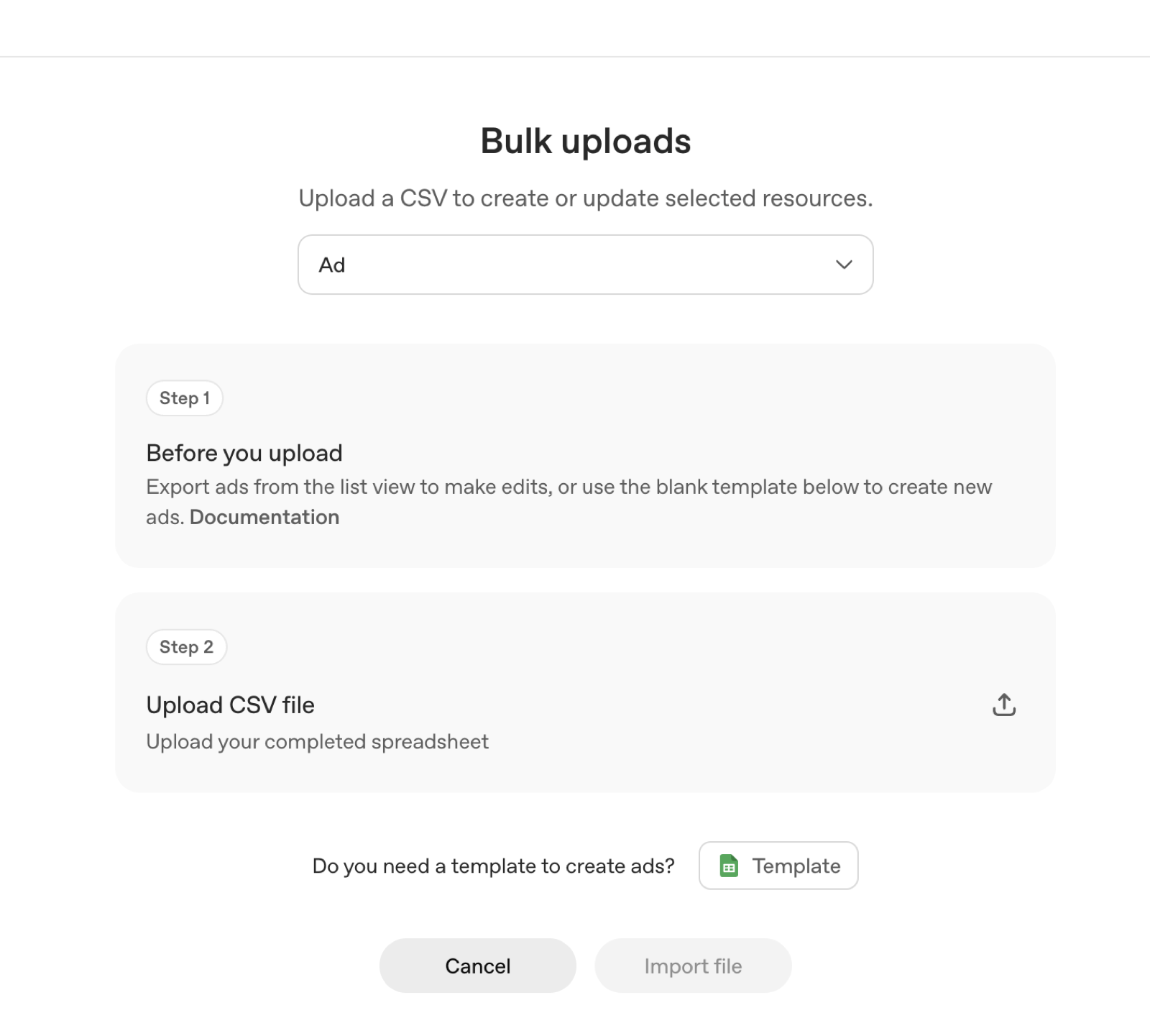
Three ways to get the feed in (Ads Manager → Tools → Feeds → Create Feed): upload a CSV or TXT for manual updates, a hosted HTTPS URL, or an SFTP connection for automated server-to-server uploads. The catch that makes the choice for you: feed items expire after two weeks, so OpenAI recommends hosted URL or automated SFTP for anything beyond a first test (OpenAI Help Center, August 2026). Items in a feed are ads-eligible by default unless explicitly marked false — and if the standard filters can't slice your catalog the way you want, custom ads_metadata values (like bidding_tier or product_line) can.
Eligibility beyond the feed
The catalog is necessary, not sufficient. Before anything serves, the account itself has to clear setup: business details, tax ID, billing method, Persona identity verification, and an account logo (OpenAI Ads Manager docs). Billing is postpay. Minimum daily budget is $25 - and from September 4, 2026, Indian merchants get self-serve access at a ₹725 minimum daily budget (Storyboard18, Aug 2026).
Two constraints worth internalizing before you project revenue:
- Ads reach only logged-in adults on Free and Go tiers. Plus, Pro, Business, Enterprise, and Education users never see ads (OpenAI).
- Delivery ramps slowly during beta by design (OpenAI onboarding). A perfect feed does not mean immediate volume. Chatbot ad CTR is running around 0.9% industry-wide (eMarketer, 2026); our own US campaigns since July 2026 have averaged roughly 1.3% CTR (our campaign data).
Data-quality fixes that move approval
When a feed stalls in review or serves poorly, the cause is almost always in the data. Work this list in order:
Fix the four required attributes first. Every SKU needs a valid title, image, price, and availability. A feed where 15% of rows are missing an image is a feed where 15% of your catalog cannot generate an ad.
Rewrite titles for 50 characters. Google Shopping tolerates much longer titles; the ChatGPT ad unit renders ≤50 (OpenAI Ads Manager docs). "Brand + product + key variant" in the first 50 characters, modifiers after.
Re-shoot or re-crop for the square. Audit your images at 256×256 square. Whatever is illegible at that size is illegible in the ad.
Kill stale availability. Automate feed refreshes from your source of truth. An ad click on an out-of-stock product is spend with no possible return - and a trust signal against you in a relevance-weighted auction.
Reconcile feed price with landing-page price. Mismatches are the classic disapproval trigger in Google Shopping; there is no reason to expect a conversational surface to be more forgiving.
Deduplicate genuinely identical rows. Variants are fine; copies are not.
The deeper version of this work - structuring catalog data so AI systems can parse, trust, and recommend it - is the same discipline whether the surface is paid or organic. We cover it fully in how to optimize your product catalog for AI.
Where Tru Commerce fits
A product feed buys you the sponsored box. It does not buy the answer. "Brands cannot buy influence over ChatGPT's answers" - our co-founder said it on record in The Hindu BusinessLine (Aug 28, 2026), and OpenAI has said the same since February 2026.
That means every brand now competes on two layers. The sponsored placement is bought, labeled, and only visible to Free and Go users. The organic recommendation is earned, unlabeled, and the only layer Plus and Pro subscribers ever see. The same catalog quality work that clears feed approval is the work that earns the organic citation - and AI-referred visits to US retail sites convert 60% better than non-AI traffic (Adobe Analytics via Digital Commerce 360, July 2026 data), so the earned layer is where the compounding return sits.
Before you spend on the rented layer, find out where you stand on the earned one. Run the free Citation Rank scan - two fields, results in 24 hours - and see whether ChatGPT already recommends you, your competitors, or nobody. Then decide where the next dollar goes.
For a sense of what winning this channel is worth, we took House of Zelena from #6 to #1 across 3 LLMs in 6 months - read the House of Zelena case study. If you want to see where you stand before committing, start with ChatGPT Ads for ecommerce brands.
FAQ
100 SKUs. OpenAI's product feed ads, launched June 2026, require at least 100 products in your uploaded catalog and accept up to 1 million SKUs (OpenAI Ads Manager docs; Digiday, June 2026).
The Google Shopping catalog format. If you already run Google Shopping or a Merchant Center feed, that same file maps over directly - no new spec to build (OpenAI Ads Manager docs; Digiday, June 2026).
The most common blockers we see: under 100 SKUs, missing or malformed required attributes (title, image, price, availability), stale availability data, or incomplete account setup - business details, tax ID, billing, Persona verification, and an account logo are all required before serving.
Yes. ChatGPT product feed ads accept a Google Shopping-format catalog, so an existing Merchant Center export is the fastest path. Upload it through Ads Manager at ads.openai.com and ChatGPT auto-generates the product ads (OpenAI Ads Manager docs).
No. Ads never influence ChatGPT's answers (OpenAI, stated repeatedly since February 2026). The feed powers a labeled sponsored unit below the answer. Organic recommendations are a separate, earned layer - and the only layer Plus and Pro users ever see.
Sources
- 1.Ads in ChatGPT: The Basics - OpenAI Help Center, 2026
- 2.OpenAI makes it easier to run shopping ads in ChatGPT - Digiday, 2026
- 3.Create campaigns for ChatGPT - OpenAI Help Center, 2026
- 4.Adobe: AI referral traffic to retail sites converts 60% higher, July 2026 data - Digital Commerce 360, 2026
Continue reading
October 10, 2026
ChatGPT Ads in India: six weeks in, on the record
ChatGPT Ads switched on in India on 27 August 2026. Six weeks on, eight articles in five outlets quoted us and TechTimes cited our benchmarks. Every question the press asked, every answer verbatim and linked, and the numbers behind each one.
September 4, 2026
Criteo Prompt Smart Ads: 2,000 Brands on ChatGPT and a 4x Spend Lift
Criteo was the first ad-tech partner inside OpenAI's ChatGPT ads pilot. Its Prompt Smart Ads product auto-generates creatives and context hints matched to how people actually prompt - here is what it is, the numbers behind it, and what its creative reports teach every advertiser.
September 2, 2026
ChatGPT Ads Conversion Strategies: What the Query-Mix Data Says to Do
Only ~1 in 10 ChatGPT conversations carries commercial intent, 76.4% of shopping answers already show an ad, and market leaders buy almost none of them. Four strategies built on that data - not on search-ads instinct.