
ChatGPT Ads for Indian D2C Brands: A First-Mover Playbook
ChatGPT Ads Manager opens to every Indian business on September 4, 2026, with a ₹725 daily minimum. A readiness playbook for D2C beauty, food, and electronics brands.
Viren Inaniyan · August 29, 2026 · ChatGPT Ads
ChatGPT ads went live in India on August 27, 2026, and on September 4 the self-serve Ads Manager opens to every Indian business at a ₹725 daily minimum. For D2C brands in beauty, food, and electronics, this is the rare moment when a new high-intent channel is open, cheap, and almost empty. But the sponsored box is only the second-best placement in the conversation - here is how to win both layers.
Why conversational placement fits considered-purchase D2C
Indian D2C's best categories - beauty, food and nutrition, personal electronics - are considered purchases. Nobody types "serum" and buys the first result. They ask a question with constraints attached: oily skin in humid weather, a protein powder without artificial sweeteners, earbuds under a budget that survive a Mumbai monsoon commute.
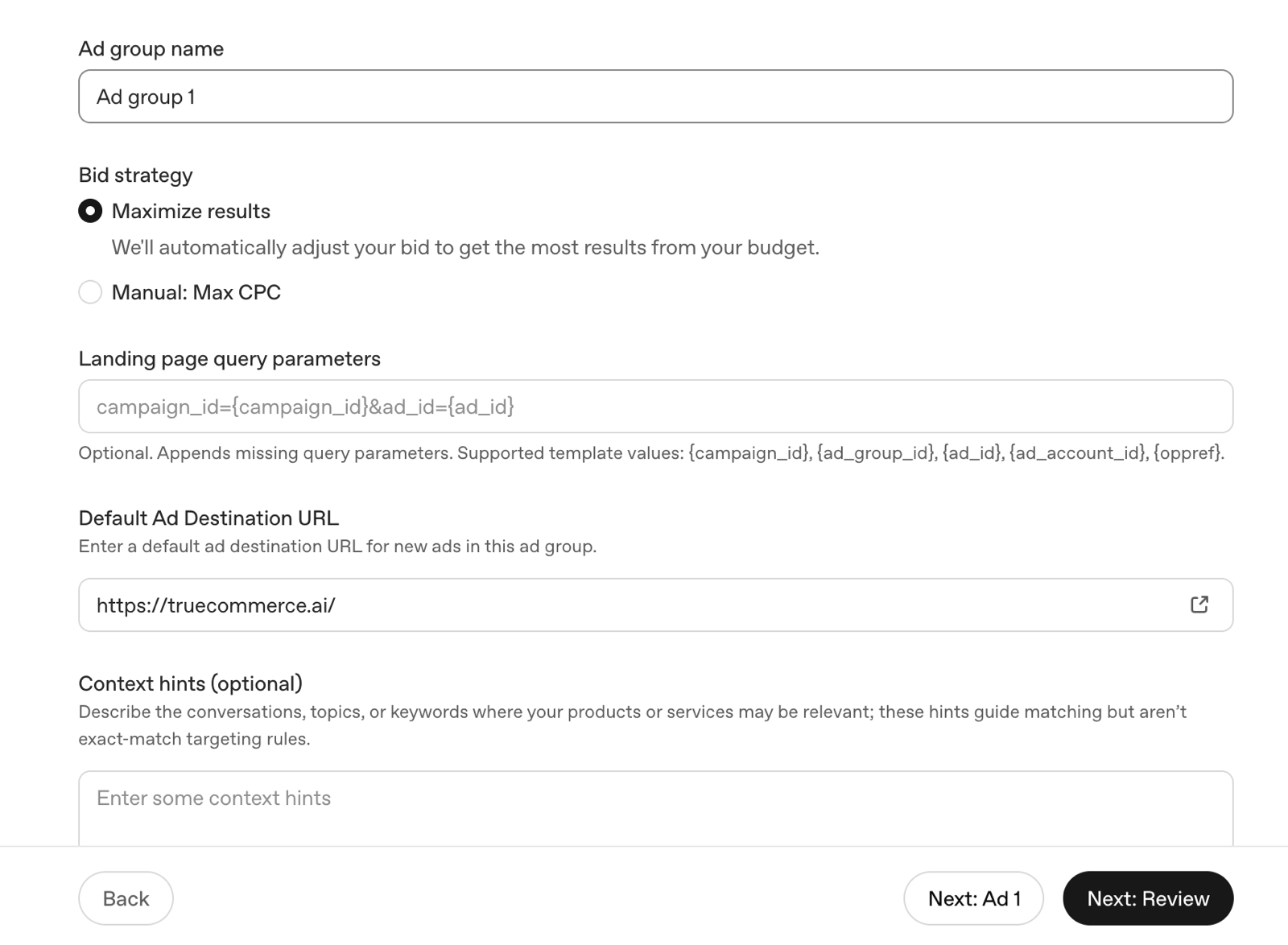
That is exactly the input ChatGPT ads are built on. There are no keywords to bid on. Matching runs on the current conversation topic, past chats, and past ad interactions, and advertisers steer it with context hints - OpenAI recommends 5-15 discrete, 1-2-sentence descriptions of buyer moments per ad group (OpenAI Ads Manager docs). A hint like "a shopper is asking for a fragrance-free moisturizer for sensitive, acne-prone skin" targets the exact moment your product is the answer, in a way no keyword ever could.
Three properties make the unit unusually strong for considered D2C:
- One advertiser per matched conversation. The ad unit is a single labeled sponsored box below the answer. No auction clutter, no four competitors stacked above you (OpenAI, 2026).
- The shopper arrives pre-qualified. AI-referred visits to US retail sites convert 60% better than non-AI traffic (Adobe Analytics via Digital Commerce 360, July 2026 data). The conversation does the qualifying before the click.
- Honest volume expectations. Chatbot ad CTR averages ~0.9% against ~6.4% for Google search (eMarketer, 2026). In our own US campaigns running since July 2026, CTR has averaged ~1.3% (our campaign data). This is a precision channel, not a volume channel.
What went live on August 27 - and what changes on September 4
OpenAI switched ads on for Indian Free and Go users on August 27, 2026. More than 50 brands went live in the first week, with WPP and Omnicom as the first agency partners (The Hindu BusinessLine, Aug 28, 2026; Storyboard18, Aug 2026).
The date that matters for D2C is September 4, 2026: ChatGPT Ads Manager opens to any Indian business, self-serve, at a minimum daily budget of ₹725 (Storyboard18, Aug 2026). You do not need WPP. You do not need Omnicom. You need a verified account and a card on file - billing is postpay, and there is no minimum lifetime spend, a policy that has held since the self-serve beta opened globally in May 2026 (OpenAI, May 2026).
Two guardrails to internalize before you spend a rupee:
- Ads never influence ChatGPT's answers, and conversations are kept private from advertisers (OpenAI, stated repeatedly since Feb 2026).
- Paying subscribers never see ads. Plus, Pro, Business, Enterprise, and Education tiers are ad-free (OpenAI). Your ad only ever reaches Free and Go users.
For the full mechanics - ad unit anatomy, auction design, bid models - see our breakdowns of how ChatGPT ads work for ecommerce and what they cost and the full rollout timeline.
The two-layer strategy: earn first, then top up
Our founder put the frame on record the day after the India launch: "Brands cannot buy influence over ChatGPT's answers" (The Hindu BusinessLine, Aug 28, 2026). Brands now compete on two layers - the organic recommendation, which is earned, and the sponsored placement, which is bought and labeled.
Layer one is the recommendation itself. When a shopper asks ChatGPT what to buy, the brands named in the answer got there through catalog quality, third-party citations, and entity presence - not spend. This layer reaches every user on every tier, including the Plus and Pro users your ads can never touch. Start here: run a free Citation Rank scan to see whether ChatGPT recommends you today, and read our teardown of how ChatGPT shopping actually picks products to see what drives the organic layer.
Layer two is the ad - a top-up, not a substitute. The sponsored box wins you the conversations where you are not yet the organic answer, in your best buyer moments, on the free tiers. Agencies are still reporting measurement gaps and unproven outcomes across chatbot advertising (eMarketer/Digiday, 2026) - which is precisely why the earned layer should carry the strategy and the paid layer should extend it, not the other way around.
Sequencing matters because the two layers compound: the catalog work that earns organic recommendations is the same work that makes product feed ads perform.
The September 4 readiness checklist
Everything below can be done this week. Delivery ramps slowly during beta by design (OpenAI onboarding), so accounts that are verified and live on day one accumulate learning while competitors are still filling in tax forms.
- Verify the account. Setup requires business details, tax ID, a billing method, Persona identity verification, and an account logo before ads serve. Start now - verification is the slowest step.
- Prepare creative to spec. Advertiser name, logo (favicon renders at 32×32), title ≤50 characters, description ≤100 characters, square image ≥256×256, destination link. Write the title as the answer to a question, not a slogan.
- Draft 5-15 context hints per ad group. Describe buyer moments in 1-2 sentences each. For a beauty brand: skin concerns, climate, ingredient exclusions. For food: dietary constraints, use occasions. For electronics: use cases, budget bands, compatibility questions. Hints guide matching; they are not exact-match rules (OpenAI help docs).
- Install measurement before the first click. Place the OpenAI pixel (oaiq.min.js) and wire the server-side Conversions API, deduplicating on a shared event_id. The default conversion window is 30 days.
- Ready the product feed if you carry 100+ SKUs. Product feed ads launched June 2026: upload a Google Shopping-format catalog and ChatGPT auto-generates product ads, from 100 SKUs up to 1M (OpenAI Ads Manager docs; Digiday, June 2026). Feed quality decides both layers - our guide to optimizing your product catalog for AI applies directly.
- Pick the right objective and bid model. Campaign objectives are Clicks or Reach; bidding is Maximize results (auto) or Manual Max CPC in a relevance-weighted second-price auction. Conversion-optimized CPC steers delivery toward your conversion event but still charges per click (OpenAI Help Center, article 20001210).
Step-by-step screenshots live in our ChatGPT ads setup guide.
What ₹725 a day actually buys
There are no published India CPC benchmarks yet - the market is only days old. In the US, recommended starting bids run $3-5 CPC, rising to $8-18 in software and finance (WebFX; OpenAI docs; practitioner reports, 2026). Indian auction prices will find their own level, and with 50-odd brands live at launch, early density is low.
A pragmatic starter structure:
- Prove - ₹725/day (about ₹22,000/month). One campaign, Clicks objective, Maximize results bidding, two ad groups: your hero product and your best-selling category. Ten hints each. Goal: confirm matching quality and measured conversions, not volume.
- Learn - ₹1,500-2,500/day. Add a third ad group for your highest-consideration buyer moment. Test Manual Max CPC against auto bidding once you have a read on auction prices.
- Scale - budget follows CPA. With postpay billing, no lifetime minimum, and a 30-day conversion window, the honest scaling rule is simple: fund whatever ad groups beat your blended CPA, pause what does not, and revisit weekly while the beta ramps.
At ₹725 per day the cost of learning is a fraction of one influencer post. The cost of waiting is watching a competitor's hints get matched to your category's buyer moments for a quarter before you show up.
Where Tru Commerce fits
Ads rent the conversation. The recommendation is earned - and it is the only layer Plus and Pro users ever see. The order of operations for an Indian D2C brand is therefore fixed: find out whether ChatGPT recommends you today, fix the catalog and citation gaps that decide the organic answer, then spend ₹725 a day to top up the buyer moments you have not yet earned.
We built the first step to be free. Run the Citation Rank scan - work email and brand URL, results in 24 hours - and you will know exactly where you stand on the earned layer before September 4. For everything on the paid layer, start at our ChatGPT Ads hub.
Before writing the channel off, measure it - MyMuse's real AI revenue turned out to be 7× what GA4 reported - see the MyMuse case study. The usual first step is ChatGPT Ads for ecommerce brands.
FAQ
Ads went live for Indian Free and Go users on August 27, 2026, with 50+ brands in the first week. Self-serve access through ChatGPT Ads Manager opens to any Indian business on September 4, 2026 (Storyboard18, Aug 2026).
₹725 per day, per Storyboard18 (Aug 2026). There is no minimum lifetime spend and billing is postpay. That is a fraction of the $25 daily minimum in the US market.
No. WPP and Omnicom were the first agency partners at launch, but from September 4, 2026, self-serve Ads Manager is open to all Indian merchants directly (Storyboard18, Aug 2026).
Early signal, honest caveats: chatbot ad CTR averages ~0.9% vs ~6.4% for Google search (eMarketer, 2026), but AI-referred visits to US retail sites convert 60% better than non-AI traffic (Adobe Analytics via Digital Commerce 360, July 2026 data). Treat it as a high-intent test channel.
No. Ads never influence ChatGPT's answers - the sponsored box sits below the organic answer and is labeled (OpenAI, 2026). The recommendation itself has to be earned, which is why we run the organic layer first.
Sources
- 1.Ads in ChatGPT: The Basics - OpenAI Help Center, 2026
- 2.ChatGPT Ads set to rewrite the rules of digital advertising in India - The Hindu BusinessLine, 2026
- 3.Create campaigns for ChatGPT - OpenAI Help Center, 2026
- 4.ChatGPT ads will soon reach more users — proven results still missing - eMarketer, 2026
- 5.AI-driven traffic converts 42% better than non-AI traffic - Adobe Analytics via Digital Commerce 360, 2026
- 6.Adobe: AI referral traffic to retail sites converts 60% higher, July 2026 data - Digital Commerce 360, 2026
Continue reading
October 10, 2026
ChatGPT Ads in India: six weeks in, on the record
ChatGPT Ads switched on in India on 27 August 2026. Six weeks on, eight articles in five outlets quoted us and TechTimes cited our benchmarks. Every question the press asked, every answer verbatim and linked, and the numbers behind each one.
September 4, 2026
Criteo Prompt Smart Ads: 2,000 Brands on ChatGPT and a 4x Spend Lift
Criteo was the first ad-tech partner inside OpenAI's ChatGPT ads pilot. Its Prompt Smart Ads product auto-generates creatives and context hints matched to how people actually prompt - here is what it is, the numbers behind it, and what its creative reports teach every advertiser.
September 2, 2026
ChatGPT Ads Conversion Strategies: What the Query-Mix Data Says to Do
Only ~1 in 10 ChatGPT conversations carries commercial intent, 76.4% of shopping answers already show an ad, and market leaders buy almost none of them. Four strategies built on that data - not on search-ads instinct.