
The OpenAI Ads API: What Exists, What Does Not, and How to Automate Anyway
There is no public OpenAI ads API for campaign management yet. What exists in August 2026: a Conversions API for measurement, a nine-column bulk CSV workflow, and a partner-only credential path.
Viren Inaniyan · August 29, 2026 · AI Search Visibility
Searches for "openai ads api" outnumber the endpoints that actually exist. As of August 2026 there is no fully public campaign-management API for ChatGPT ads: credentials are provisioned for approved partners, and the rest of us get a bulk CSV workflow and a Conversions API. Here is the honest state of programmatic access, and how to automate anyway.
What "ads API" searchers want vs what ships
When a marketer searches "openai ads api" or "chatgpt ads api", they usually want one of four things: create and edit campaigns from code, pull performance reports into a warehouse, sync product catalogs programmatically, or send conversion data server-side.
As of August 2026, OpenAI ships exactly one of those four as a public surface: conversion data. The other three run through the Ads Manager UI at ads.openai.com, with one meaningful escape hatch for ad creation that we cover below.
That gap is worth stating plainly because most content on this keyword implies a Meta-style Marketing API exists. It does not. If a tool vendor tells you they have "full API access" to ChatGPT ads, ask whether they are an approved partner or whether they are automating a browser. The difference matters for account safety.
The partner-only campaign API
OpenAI's developer documentation says API credentials are "provisioned through Ads Manager or the Ads API for approved partners." Two things follow from that sentence.
First, an Ads API exists. OpenAI is not building from zero. The infrastructure runs today for approved partners, which in practice means the large agency groups and ad-tech platforms working directly with OpenAI's ads team.
Second, approval is the gate, not technology. API keys already appear in Ads Manager Settings for accounts that have them. The provisioning path runs through your OpenAI ads contact, not a self-serve developer portal. If you manage meaningful spend and want access, the ask goes to your account team; there is no form to fill.
This mirrors how most ad platforms launched. Google and Meta both ran partner-gated APIs before opening self-serve developer access. We expect the same arc here, but OpenAI has announced no date, so plan around what is available now.
Bulk CSV upload: the automation everyone gets today
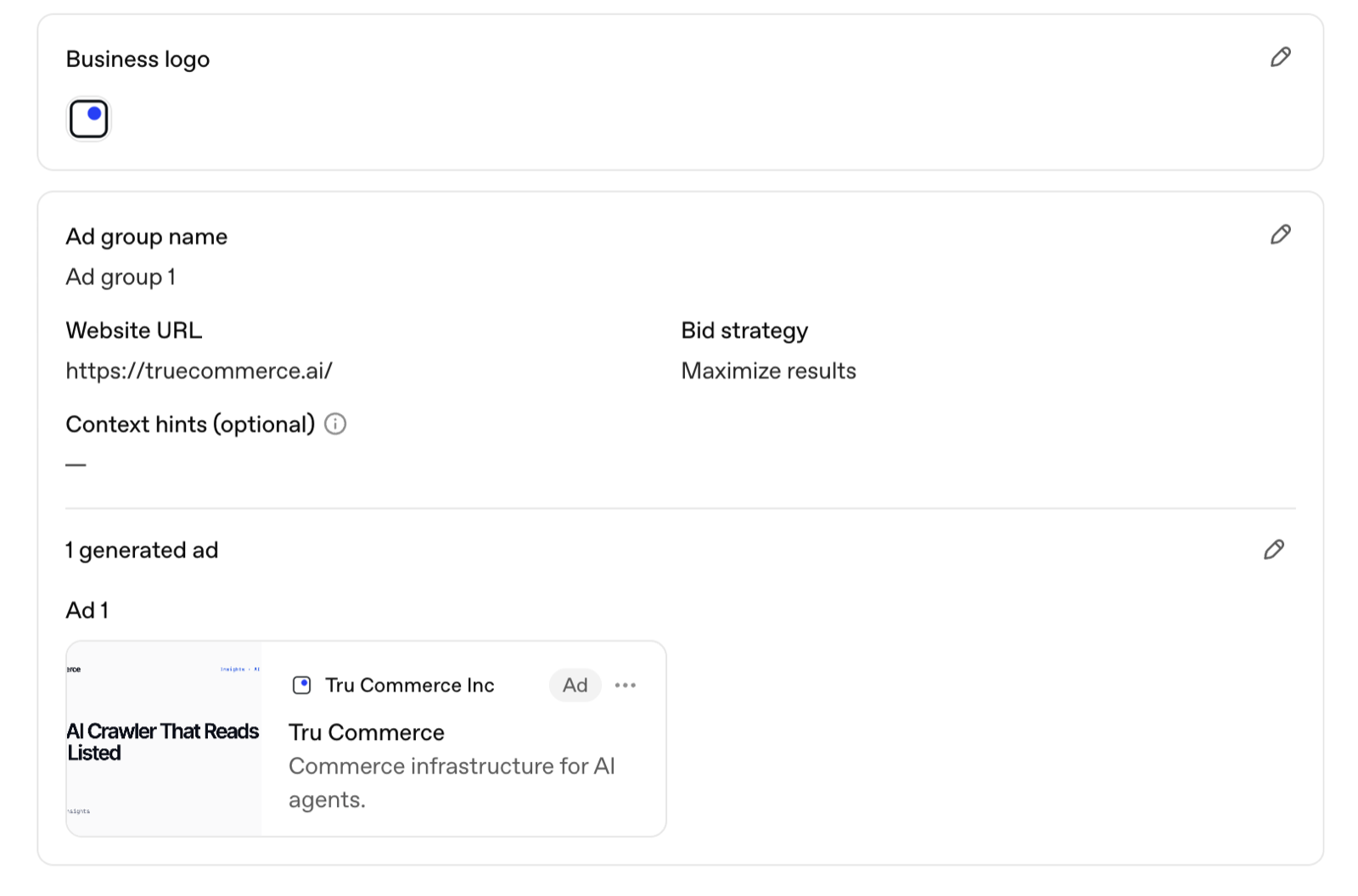
The workflow that actually scales ad creation in August 2026 is bulk CSV upload inside Ads Manager. It is not glamorous, but it turns ad management into a spreadsheet problem, and spreadsheet problems are automatable.
The template has nine columns:
ad_idad_group_idadgroup_namead_nametitlecopylinkimage_urlimage_file_id
The create-versus-update rule is one field. Leave ad_id empty and the row creates a new ad. Fill ad_id with an existing ad's ID and the row updates that ad. That single convention lets one CSV mix new ads and revisions in the same import.
The round-trip workflow, step by step:
- Open the ads list view in Ads Manager and export the current ads to CSV. This gives you every live
ad_idandad_group_id, so you never guess at identifiers. - Edit in a spreadsheet or generate rows from a script: new headline tests with empty
ad_id, copy fixes on existing rows with thead_idkept. - Keep titles at or under 50 characters and descriptions at or under 100, the ad unit's limits, and point
image_urlat a square image of at least 256 by 256 pixels. - Reimport the file. Ads Manager validates rows and applies creates and updates in one pass.
Because the input is plain CSV, any script, spreadsheet formula, or LLM prompt that emits nine columns is effectively your ads API. Generating 40 headline variants across 8 ad groups is a ten-minute job. The walkthrough in our OpenAI Ads Manager complete guide covers where the import lives and what the validation errors mean.
One boundary to respect: campaigns, budgets, and bids are not in the CSV. Those still require the UI, which is exactly the surface the partner API covers. Bulk upload automates creative and structure within ad groups, not money.
The Conversions API: the programmatic surface that is public
While campaign management stays gated, the measurement side is open to every advertiser. The Conversions API accepts server-side conversion events at:
POST https://bzr.openai.com/v1/eventsAuthentication is a bearer key you create yourself in Ads Manager under Conversions, then Conversion keys. No partner approval, no waitlist.
The intended setup pairs it with the OpenAI pixel. The pixel (oaiq.min.js) captures the click ID in the __oppref cookie on your site; your server then posts purchase, lead, or signup events to the endpoint. Events that arrive from both browser and server deduplicate on a shared event_id, so double-firing does not inflate results. The default conversion window is 30 days.
If you build one piece of ChatGPT ads automation this quarter, build this one. Conversion-optimized CPC bidding steers delivery toward your selected conversion event, so the quality of the events you send directly shapes what your budget buys. Our conversion tracking guide walks through the full pixel-plus-server setup, and the OpenAI pixel guide covers the client side in detail.
What to watch for next
Three signals will tell you the public API is close:
- Developer docs expanding beyond the partner provisioning note into endpoint references for campaigns, reporting, or catalogs.
- API keys in Settings becoming self-serve rather than partner-provisioned. The UI slot already exists; the gate is policy.
- Reporting exports gaining a programmatic path. Warehouse-bound performance data is the most requested missing piece, and usually the first one platforms open.
Until then, the practical stack is: bulk CSV for creative scale, Conversions API for measurement, and the UI for campaigns and budgets. If you are still setting up your first campaign, start with our setup guide and the rest of our ChatGPT Ads hub; we track API changes there as OpenAI ships them.
Where Tru Commerce fits
The missing API is a reminder of what ads on ChatGPT can and cannot do. Ads rent the conversation: a labeled sponsored box below the answer, shown only to Free and Go users. The organic recommendation inside the answer is earned, cannot be bought, and is the only layer Plus and Pro users ever see. As our founder put it in The Hindu BusinessLine (August 2026), "Brands cannot buy influence over ChatGPT's answers."
That earned layer has no waitlist and no partner gate. Run the free Citation Rank scan: we show you where your brand ranks in AI answers across ChatGPT, Gemini, and Perplexity within 24 hours, before you spend a rupee or a dollar renting the sponsored slot.
The same measurement-first loop drove our Amazon India engagement, where Top-5 presence rose +2.4% in 6 weeks - see the Amazon case study. The usual first step is Visibility Score.
FAQ
Not a fully public one for campaign management, as of August 2026. OpenAI's developer docs say API credentials are provisioned through Ads Manager or the Ads API for approved partners. The Conversions API for measurement is open to every advertiser today.
For the Conversions API, create a bearer key in Ads Manager under Conversions, then Conversion keys. Broader API credentials appear in Ads Manager Settings but are provisioned for approved partners only. There is no self-serve developer signup yet.
Yes. Ads Manager supports bulk CSV upload with a nine-column template. Leave ad_id empty to create new ads, fill it to update existing ones. Export from the list view, edit in a spreadsheet, and reimport (Ads Manager, August 2026).
Server-side conversion events post to https://bzr.openai.com/v1/events with a bearer key created in Ads Manager under Conversions, then Conversion keys. Events sent from both the pixel and the server deduplicate on a shared event_id.
OpenAI has not announced a date. The infrastructure signals are there: partner credentials exist, API keys surface in Ads Manager Settings, and the Conversions API is already public. Watch the developer docs and our rollout tracker for changes.
Sources
- 1.Ads in ChatGPT: The Basics - OpenAI Help Center, 2026
Continue reading
October 10, 2026
ChatGPT Ads in India: six weeks in, on the record
ChatGPT Ads switched on in India on 27 August 2026. Six weeks on, eight articles in five outlets quoted us and TechTimes cited our benchmarks. Every question the press asked, every answer verbatim and linked, and the numbers behind each one.
September 4, 2026
Criteo Prompt Smart Ads: 2,000 Brands on ChatGPT and a 4x Spend Lift
Criteo was the first ad-tech partner inside OpenAI's ChatGPT ads pilot. Its Prompt Smart Ads product auto-generates creatives and context hints matched to how people actually prompt - here is what it is, the numbers behind it, and what its creative reports teach every advertiser.
September 2, 2026
ChatGPT Ads Conversion Strategies: What the Query-Mix Data Says to Do
Only ~1 in 10 ChatGPT conversations carries commercial intent, 76.4% of shopping answers already show an ad, and market leaders buy almost none of them. Four strategies built on that data - not on search-ads instinct.