
How Do ChatGPT Ads Work? Matching, Auction, and Delivery Explained
ChatGPT ads have no keywords. Matching is conversational, the auction is a relevance-weighted second price, and one advertiser wins a single slot below the answer. Here is the full mechanism, end to end.
Viren Inaniyan · August 29, 2026 · ChatGPT Ads
ChatGPT ads have no keyword field, no search terms report, and no ad rank you can brute-force with budget. Matching is conversational, the auction is a relevance-weighted second price, and exactly one advertiser wins a single labeled slot below the answer. If you plan campaigns the way you plan Google Ads, the system will quietly ignore you.
The unit: one labeled box below the answer
Start with what actually renders. A ChatGPT ad is a single labeled sponsored box below the model's answer: advertiser name, logo (the favicon renders at 32×32), a title up to 50 characters, a description up to 100 characters, a square image of at least 256×256, and a destination link. One advertiser per matched conversation - there is no second slot.
That single-slot design shapes everything upstream. There is no page of ten blue links to spread impressions across. Either your ad is the best match for this conversation, or it does not appear at all.
Matching: conversational, not keyword-based
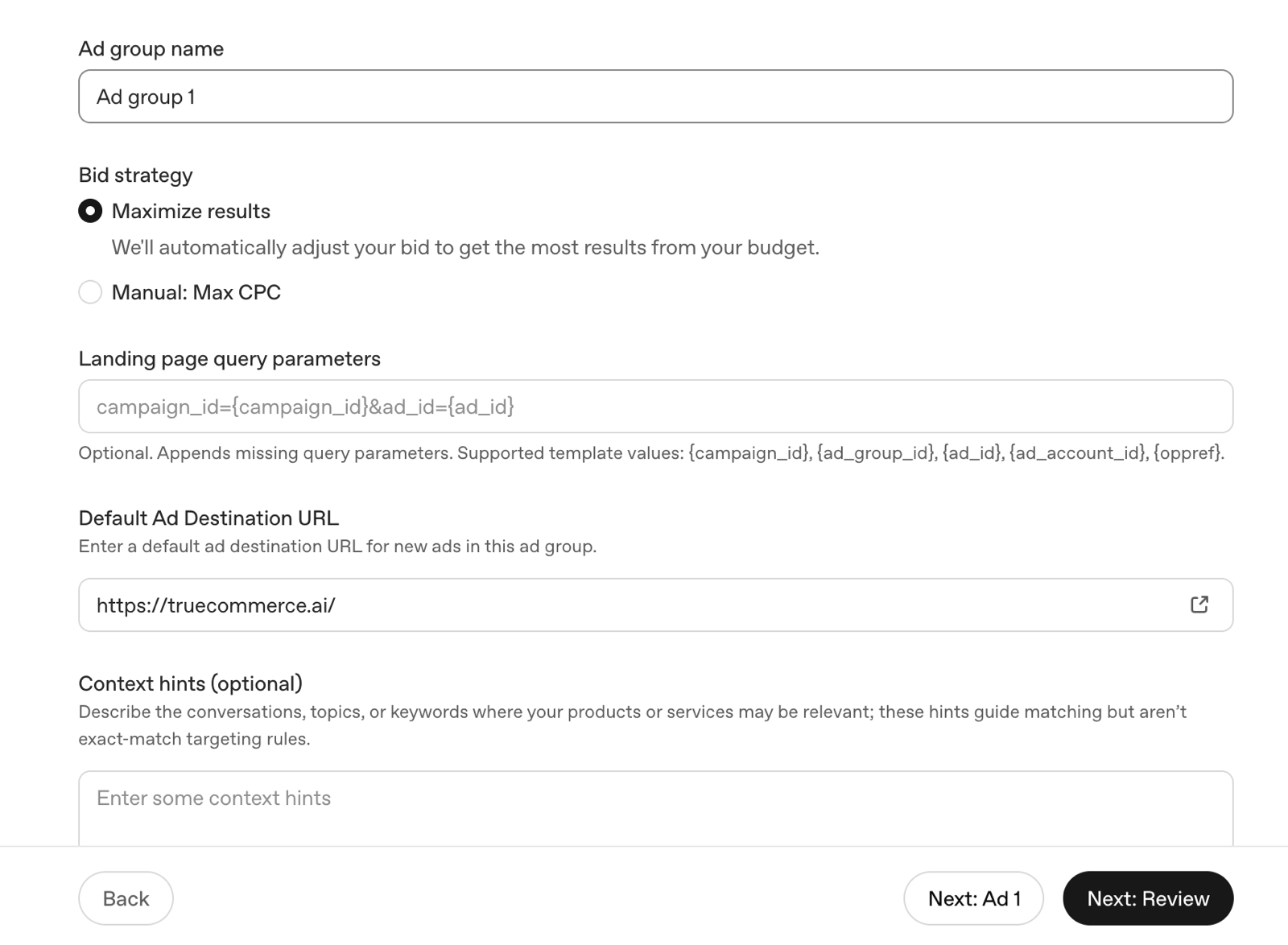
There are no keywords in ChatGPT Ads Manager. None to bid on, none to negative-match, none to mine from a search terms report. The system decides whether your ad fits a conversation using three signals (OpenAI Ads Manager):
- The current conversation topic. Not a query string - the actual subject of a multi-turn conversation. Someone comparing running shoes for flat feet across six messages is a running-shoe conversation, even if no single message reads like a search query.
- The user's past chats. ChatGPT carries memory of what a logged-in user has discussed before, which sharpens who is genuinely in-market.
- Past ad interactions. Users who clicked or dismissed previous ads teach the system what to show them next.
This is closer to how a salesperson reads a customer than how a search engine reads a query. We walked through what this means for merchants specifically in our ecommerce guide to ChatGPT ads.
Context hints: steering, not targeting
Advertisers do get a steering wheel: context hints. A context hint is a 1-2 sentence description of a buyer moment - "a shopper is asking for hypoallergenic skincare for sensitive skin under $40" - and OpenAI recommends adding 5-15 discrete hints per ad group (OpenAI Ads Manager; help docs).
The critical distinction: hints guide matching, they are not exact-match rules. You are describing situations to a model, not registering strings with an index. A well-written hint can match conversations that share none of its literal words; a keyword-stuffed hint can fail to match anything. Write hints the way you would brief a store associate on which customers to approach, and cover distinct moments - research, comparison, gifting, replenishment - rather than restating one moment fifteen ways. Our step-by-step setup guide covers hint-writing in detail.
The auction: relevance-weighted second price
When a conversation could match multiple advertisers, ChatGPT runs a relevance-weighted second-price auction (OpenAI Ads Manager docs). Two properties matter:
- Relevance-weighted: your bid is multiplied by how well your ad fits the conversation. A highly relevant ad with a modest bid can beat a barely relevant ad with a large one. Budget cannot buy its way into conversations it does not fit.
- Second price: the winner pays based on the runner-up's weighted bid, not their own maximum. Overbidding slightly is less punishing than in first-price systems, and honest bidding is the rational default.
Bidding runs in two modes - Maximize results (automatic) or Manual Max CPC - under two campaign objectives, Clicks or Reach, with a $25 minimum daily budget. Typical 2026 CPCs: $3-5 recommended starting bids, rising to $8-18 in software and finance categories, with CPM options from roughly $25-60 (WebFX; OpenAI docs; practitioner reports, 2026). For context on how far pricing has moved: the February launch started at a $60 CPM with a $200,000 minimum - both since dropped or eliminated.
Bid models: CPM, CPC, and conversion-optimized CPC
Three ways to pay (OpenAI Help Center, "Create campaigns for ChatGPT"):
- CPM - pay per thousand impressions. Built for awareness and reach in matched conversations.
- CPC - pay per click. The default for traffic.
- Conversion-optimized CPC - OpenAI optimizes delivery toward your selected conversion event (purchase, signup, lead) but still charges per click. This requires measurement plumbing: the OpenAI pixel plus the server-side Conversions API, with a default 30-day conversion window.
Layered on top: geographic targeting by country, region, DMA, or postal code, and custom audiences with bid multipliers. There are no demographic profiles for sale - user data is not sold to advertisers (OpenAI).
Delivery: one slot, two tiers, and a deliberate ramp
Three delivery facts routinely surprise advertisers coming from search:
Only Free and Go users see ads. Logged-in adults on those two tiers, nobody else. Plus, Pro, Business, Enterprise, and Education users never see a sponsored slot (OpenAI). Your paid reach excludes ChatGPT's paying users entirely.
Delivery ramps slowly during beta - by design (OpenAI onboarding). New campaigns often underspend their budgets for days or weeks. That is conservative matching doing its job, not a broken account. The fix is usually better context hints, not higher bids.
Click-through runs around 0.9% across chatbot ads versus roughly 6.4% for Google search ads (eMarketer, 2026). In our own US campaigns running since July 2026, CTR has averaged ~1.3% (our campaign data). Fewer clicks per impression - but from conversations, not queries. For whether that trade is worth your next dollar, see ChatGPT ads vs Google Ads.
Why keyword thinking fails here
Every habit search advertising taught you assumes a query, an index, and a results page. ChatGPT ads have none of the three.
- You cannot buy a term. There is no "running shoes" to own. There are running-shoe conversations, and the model decides which ones fit your hints.
- You cannot brute-force position. The relevance weight means an irrelevant ad loses at any bid, and there is only one slot to win.
- You cannot optimize what you cannot see per-query. There is no search terms report; conversations are kept private from advertisers (OpenAI). You optimize hints, creative, and conversion events - not term lists.
- You cannot buy the answer. Ads never influence ChatGPT's recommendations (OpenAI, stated repeatedly since February 2026). The organic layer is a separate system with its own mechanics - we took it apart in our ChatGPT shopping teardown.
Advertisers who port keyword lists into hints get stalled spend. Advertisers who describe buyer moments get delivery.
Where Tru Commerce fits
The mechanics above describe the layer you can rent. There is a second layer you can only earn: the recommendation inside the answer itself. As we put it to The Hindu BusinessLine in August 2026, "Brands cannot buy influence over ChatGPT's answers." Brands now compete on both layers - the organic recommendation (earned) and the sponsored placement (bought and labeled) - and premium users, the ones who never see ads, see only the earned layer.
That is why we tell brands to sequence the work: find out where you stand organically before you spend. Run the free Citation Rank scan - two fields, results in 24 hours - to see whether ChatGPT already recommends you, and to whom it recommends your competitors. Then use our ChatGPT Ads hub to decide where paid fits on top. Ads rent the conversation for a click; the recommendation compounds.
The upside here is measurable: House of Zelena went from 22% to 56% ChatGPT mention share in 6 months with us - see the House of Zelena case study. The usual first step is ChatGPT Ads for ecommerce brands.
FAQ
No. There are no keywords anywhere in ChatGPT Ads Manager. Matching is conversational - based on the current conversation topic, the user's past chats, and past ad interactions. Advertisers steer matching with context hints: short descriptions of buyer moments, not exact-match rules (OpenAI Ads Manager).
It is a relevance-weighted second-price auction. Your bid is weighted by how well your ad fits the conversation, and the winner pays based on the runner-up's weighted bid - so the most relevant ad can beat the highest bid (OpenAI Ads Manager docs).
No. OpenAI has stated since February 2026 that ads never influence ChatGPT's answers, and conversations are kept private from advertisers. The ad is a separate labeled sponsored box below the answer - the organic recommendation is generated independently.
Only logged-in adults on the Free and Go tiers. Plus, Pro, Business, Enterprise, and Education users never see ads (OpenAI). One advertiser appears per matched conversation, in a single sponsored slot below the answer.
Delivery ramps slowly during beta by design (OpenAI onboarding). Matching is also conservative: your ad serves only when a conversation genuinely fits your context hints. Broaden or add hints - OpenAI recommends 5-15 per ad group - before raising bids.
Sources
- 1.Ads in ChatGPT: The Basics - OpenAI Help Center, 2026
- 2.ChatGPT ads will soon reach more users — proven results still missing - eMarketer, 2026
Continue reading
October 10, 2026
ChatGPT Ads in India: six weeks in, on the record
ChatGPT Ads switched on in India on 27 August 2026. Six weeks on, eight articles in five outlets quoted us and TechTimes cited our benchmarks. Every question the press asked, every answer verbatim and linked, and the numbers behind each one.
September 4, 2026
Criteo Prompt Smart Ads: 2,000 Brands on ChatGPT and a 4x Spend Lift
Criteo was the first ad-tech partner inside OpenAI's ChatGPT ads pilot. Its Prompt Smart Ads product auto-generates creatives and context hints matched to how people actually prompt - here is what it is, the numbers behind it, and what its creative reports teach every advertiser.
September 2, 2026
ChatGPT Ads Conversion Strategies: What the Query-Mix Data Says to Do
Only ~1 in 10 ChatGPT conversations carries commercial intent, 76.4% of shopping answers already show an ad, and market leaders buy almost none of them. Four strategies built on that data - not on search-ads instinct.