
ChatGPT Self-Serve Ads: Who Qualifies, How It Works, and When You Still Need an Agency
ChatGPT ads launched at a reported $200K minimum through agencies. By May 2026 any US business could self-serve from $25/day, and India follows on September 4 at ₹725/day. Here is who qualifies and when an agency still earns its fee.
Viren Inaniyan · August 29, 2026 · AI Search Visibility
ChatGPT ads started life in February 2026 as an agency-managed product with a reported $200,000 minimum. Fifteen months of platform history got compressed into four: by May, any US business could open an account at ads.openai.com and spend $25 a day. The gate is gone. The question left is whether you should walk through it alone.
From $200K managed to $25 self-serve in four months
When OpenAI began testing ads in ChatGPT in the US on February 9, 2026, the product was closed. Campaigns ran through agency partners at a reported $200,000 minimum commitment and $60 CPM. Mid-size brands read about it; they could not buy it.
That lasted one quarter. In May 2026 OpenAI opened the Ads Manager Beta at ads.openai.com to any US business. No minimum lifetime spend. No agency requirement. No partner certification. The only floor is a $25 minimum daily budget per campaign, with recommended starting bids of $3 to $5 CPC for most categories (WebFX; OpenAI docs, 2026).
Through the rest of 2026 the map filled in: the UK launched June 6 as OpenAI's first European market, alongside Canada, Australia, New Zealand, Japan, and Korea (OpenAI expansion posts, 2026). India switched on ads for Free and Go users on August 27, 2026, with 50+ brands live in the first week, and opens self-serve to any Indian business on September 4 at a ₹725 minimum daily budget (The Hindu BusinessLine, Aug 28, 2026; Storyboard18, Aug 2026).
This is the same trajectory Google and Meta followed: launch with large managed accounts, then open the doors and let the auction set prices. ChatGPT ads compressed that arc into months. Our OpenAI Ads Manager guide tracks the current state of every market.
Who qualifies for self-serve
The bar is verification, not budget. Before a single ad serves, OpenAI requires:
- Business details and tax ID. You register as a business, not an individual.
- Identity verification through Persona. KYC-style checks on the account owner. This is the step that takes hours to days, so start it before you plan a launch date.
- A billing method. Billing is postpay: you spend first and are invoiced against your payment method.
- An account logo. The ad unit renders your favicon at 32×32 inside a labeled sponsored box. No logo, no serving. Ugly logo, weak ad.
There is no revenue threshold and no spend commitment. If you can pass verification in a supported market, you can run.
What self-serve actually includes
The Ads Manager Beta is not a stripped-down teaser. The self-serve product carries the full toolset:
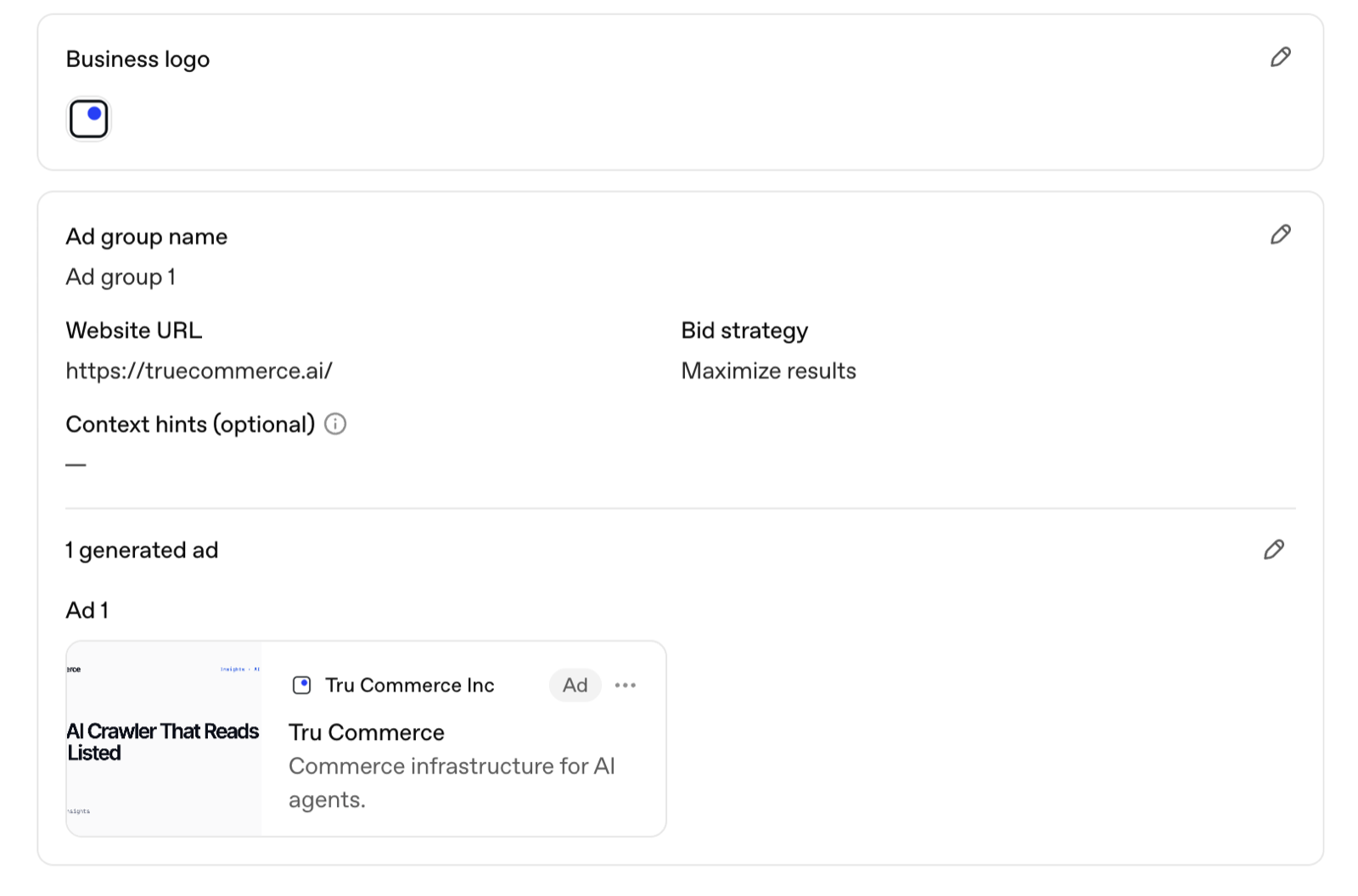
- A guided campaign flow. Objective (Clicks or Reach), budget, geography down to DMA and postal code, then ad creation with title, description, image, and destination link. Our ChatGPT ads setup guide walks the whole flow screen by screen.
- Context hints instead of keywords. There is no keyword bidding. You describe 5 to 15 buyer moments per ad group in one or two sentences each, and matching runs on conversation topic, past chats, and past ad interactions (OpenAI Ads Manager docs, 2026).
- Bulk CSV upload. Structured campaign builds at scale without an API integration, which matters once you run dozens of ad groups.
- Conversion measurement. The OpenAI pixel plus a server-side Conversions API, with events deduplicated on a shared event_id and a 30-day default window.
- Product feed ads. Since June 2026 you can upload a Google Shopping-format catalog and ChatGPT auto-generates product ads, with a 100 SKU minimum and support up to 1M SKUs (OpenAI Ads Manager docs; Digiday, June 2026).
In short: everything the launch-wave agencies had, minus the $200,000 invoice.
When an agency still earns its fee
Access is free now, so an agency has to justify itself on operations. Three situations where it genuinely does:
- Large budgets with real risk. If you are moving six figures a quarter into a beta channel where delivery ramps slowly by design (OpenAI onboarding), you are paying for pacing discipline, bid management, and someone accountable when CPCs in software and finance hit $8 to $18 (WebFX; practitioner reports, 2026).
- Creative operations at volume. Fifty-character titles and 100-character descriptions look trivial until you need hundreds of variants tested against different context hints. Agencies with production pipelines win here.
- Multi-market rollouts. Running the US, UK, Japan, and India simultaneously means different budgets, currencies, tax registrations, and conversational norms per market. Coordinating that in-house is a job, not a task. For the India-specific version of this decision, see our breakdown of agency versus self-serve in India.
If none of those describe you, self-serve first. A $25/day pilot teaches you more about how ChatGPT matches your brand to conversations than any agency deck will.
For agencies: no partner status required
WPP and Omnicom were the first agency partners at the India launch (Storyboard18, Aug 2026), which created a mistaken impression that ChatGPT ads is a partner-gated channel. It is not. The Ads Manager Beta has no certification program and no reseller tier. Any agency can set up or access client accounts self-serve, complete the same Persona verification, and run campaigns exactly as a brand would.
That cuts both ways. Agencies can pitch ChatGPT ads to every client today without waiting for a badge, and clients should evaluate them on test results, not claimed status. Agencies themselves report measurement gaps and unproven outcomes so far (eMarketer/Digiday, 2026), so demand real campaign data against the industry's roughly 0.9% chatbot CTR benchmark (eMarketer, 2026). In our own US campaigns running since July 2026, CTR has averaged about 1.3% (our campaign data): beating the benchmark is possible, but nobody should promise it.
For everything upstream of the self-serve decision, our ChatGPT Ads hub collects the full cluster.
Where Tru Commerce fits
Self-serve access changes who can buy the sponsored box. It changes nothing about the layer above it. Ads rent the conversation: one labeled placement, below the answer, shown only to Free and Go users. The organic recommendation inside the answer is earned, cannot be bought, and is the only layer Plus and Pro users ever see. As Viren put it in The Hindu BusinessLine (Aug 28, 2026), "Brands cannot buy influence over ChatGPT's answers."
So before you verify a business account anywhere, find out where you stand in the earned layer. Our free Citation Rank scan shows how often ChatGPT and the other AI surfaces already recommend your brand, and what to fix first. Run the scan, then decide what the $25/day is for.
We ran this at marketplace scale with Amazon India, lifting AI Share of Voice +0.98% across 6 categories in 6 weeks - read the Amazon case study. The usual first step is Visibility Score.
FAQ
Any US business can self-serve through the Ads Manager Beta at ads.openai.com since May 2026, with no minimum lifetime spend and a $25 daily budget floor. No agency or partner status is required. India self-serve opens September 4, 2026 at ₹725/day (Storyboard18, Aug 2026).
A business in a supported market, business details and tax ID, a billing method (billing is postpay), identity verification through Persona, and an account logo. Ads will not serve until verification and the logo are in place (OpenAI Ads Manager docs, 2026).
No minimum lifetime spend. The only floor is a $25 minimum daily budget per campaign in the US, or ₹725/day in India from September 4, 2026. The $200,000 minimum from the February 2026 launch was eliminated when self-serve opened in May (OpenAI, 2026).
Yes. WPP and Omnicom ran the early managed campaigns, but the Ads Manager Beta has no certification gate. Any agency can create or access client accounts self-serve, complete verification, and run campaigns the same way a brand would (OpenAI, 2026).
A guided campaign flow, bulk CSV upload, Clicks and Reach objectives, context hints for matching, conversion tracking via the OpenAI pixel and server-side Conversions API, and product feed ads from a Google Shopping-format catalog with a 100 SKU minimum (OpenAI docs, 2026).
Sources
- 1.Ads in ChatGPT: The Basics - OpenAI Help Center, 2026
Continue reading
October 10, 2026
ChatGPT Ads in India: six weeks in, on the record
ChatGPT Ads switched on in India on 27 August 2026. Six weeks on, eight articles in five outlets quoted us and TechTimes cited our benchmarks. Every question the press asked, every answer verbatim and linked, and the numbers behind each one.
September 4, 2026
Criteo Prompt Smart Ads: 2,000 Brands on ChatGPT and a 4x Spend Lift
Criteo was the first ad-tech partner inside OpenAI's ChatGPT ads pilot. Its Prompt Smart Ads product auto-generates creatives and context hints matched to how people actually prompt - here is what it is, the numbers behind it, and what its creative reports teach every advertiser.
September 2, 2026
ChatGPT Ads Conversion Strategies: What the Query-Mix Data Says to Do
Only ~1 in 10 ChatGPT conversations carries commercial intent, 76.4% of shopping answers already show an ad, and market leaders buy almost none of them. Four strategies built on that data - not on search-ads instinct.