
ChatGPT Ads vs Perplexity Ads: The Two AI Ad Platforms Compared
ChatGPT ads are open self-serve with a $25 daily minimum. Perplexity's program is smaller and historically partner-led. Here is how the two conversational ad platforms actually compare.
Viren Inaniyan · August 29, 2026 · ChatGPT Ads
Two AI assistants now sell ads next to their answers, and they run on opposite models. ChatGPT gives any business self-serve access to one of the largest consumer audiences on the internet with a $25 daily minimum. Perplexity's program is smaller, CPM-based, and has been sold brand-by-brand. For most advertisers, only one of these is testable this quarter.
Two ad programs, two philosophies
Perplexity moved first. It announced advertising in November 2024, roughly fifteen months before OpenAI began testing ads in ChatGPT in the US on February 9, 2026 (OpenAI announcement). But the two programs were built for different buyers.
Perplexity launched with a hand-picked set of brand partners and sold placements directly - the classic premium-publisher model. OpenAI started the same way (the February launch carried a $60 CPM and a $200,000 minimum) and then did something Perplexity has not: it dropped the minimum entirely and opened a self-serve Ads Manager beta in May 2026 at ads.openai.com, followed by product feed ads in June 2026 that auto-generate ads from a Google Shopping-format catalog (OpenAI Ads Manager docs; Digiday, June 2026).
That single decision - open platform versus direct sales - determines almost everything else in this comparison.
Reach: this is not a close race
ChatGPT is one of the largest consumer products ever built. Its ad program now spans the US, UK, Canada, Australia, New Zealand, Japan, Korea (OpenAI expansion posts, 2026), and India, where ads switched on August 27, 2026 with 50+ brands live in the first week (The Hindu BusinessLine, Aug 28, 2026).
Perplexity is a serious product with a much smaller footprint. It is a strong AI-native search challenger, but no public figure puts Perplexity's audience anywhere near ChatGPT's. Its users also skew toward research-heavy early adopters, which is exactly why some B2B brands find the audience attractive despite its size.
One caveat cuts in Perplexity's favor: ChatGPT ads reach only logged-in adults on the Free and Go tiers - Plus, Pro, Business, Enterprise, and Education users never see ads (OpenAI, 2026). The addressable ad audience is large, but it is a subset of ChatGPT's total user base.
Formats: a sponsored answer box vs a sponsored question
ChatGPT's unit is a single labeled sponsored box below the answer. Advertiser name, logo, a title up to 50 characters, a description up to 100 characters, a square image, and a destination link - one advertiser per matched conversation. There are no keywords; matching is conversational, steered by 5-15 context hints per ad group describing the buyer moments you want to reach (OpenAI Ads Manager docs, 2026). We covered the full mechanics in our teardown of how ChatGPT ads work for ecommerce.
Perplexity's signature unit has been the sponsored follow-up question. At launch in November 2024, brands paid to place a suggested next question alongside an answer - tap it and the assistant generates a response related to the sponsor's category, with the sponsorship labeled. Side media placements accompanied the program. It is a genuinely native format, but it is an awareness format: you are buying curiosity, not a click to your product page.
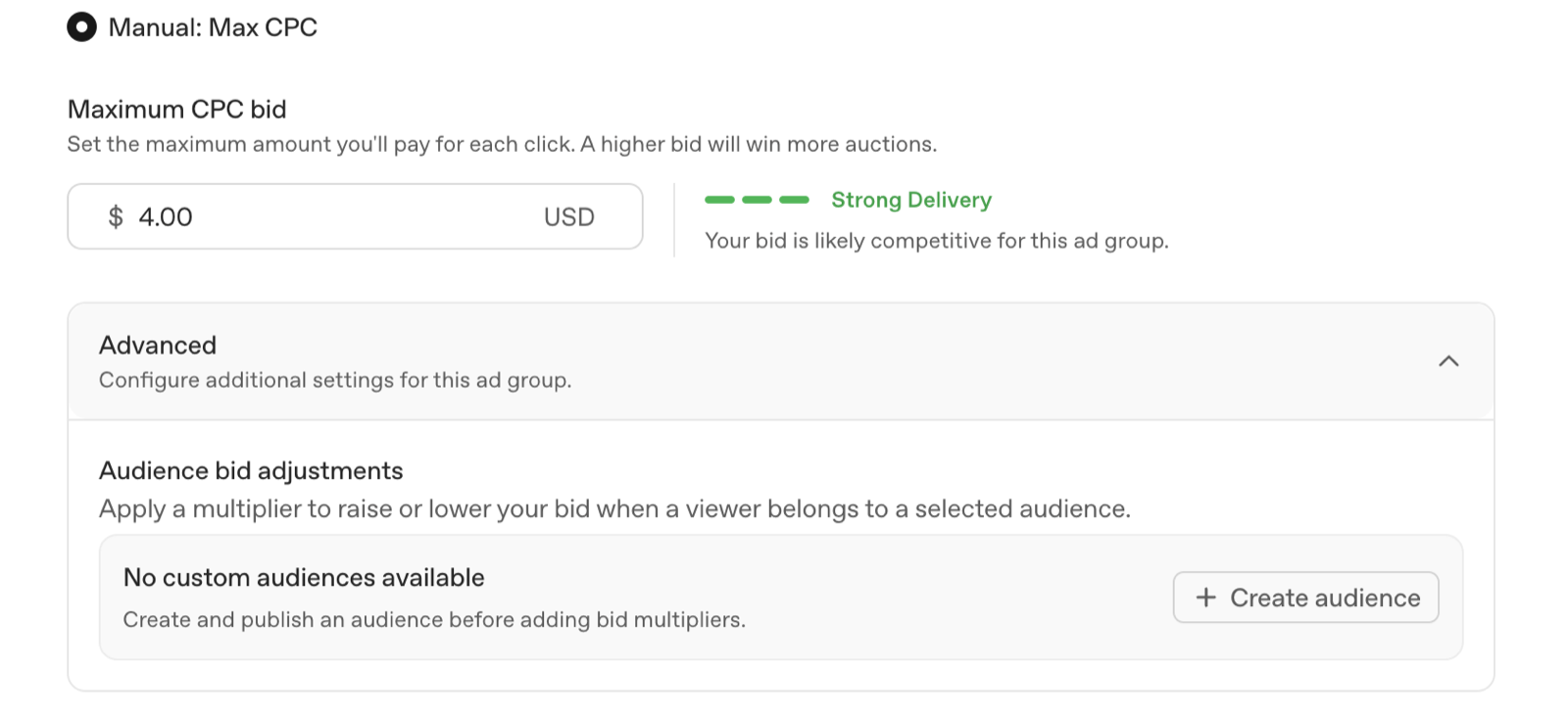
The practical difference: ChatGPT's unit carries a destination link, CPC and conversion-optimized bidding, an OpenAI pixel, and a server-side Conversions API with a 30-day default window (OpenAI Help Center, 2026). It is built to be measured. Perplexity's formats have been sold the way sponsorships are sold - on reach and adjacency.
Access and pricing: self-serve vs sales call
ChatGPT: open to any business. Sign up at ads.openai.com, verify the account, and launch with a $25 minimum daily budget. Recommended starting bids run $3-5 CPC, rising to $8-18 in software and finance, with CPM options around $25-60 for reach campaigns (WebFX; OpenAI docs; practitioner reports, 2026). Billing is postpay. In India, self-serve opens to any business on September 4, 2026 with a minimum daily budget of ₹725 (Storyboard18, Aug 2026). The step-by-step setup guide walks through the whole flow.
Perplexity: historically a direct conversation. The program launched CPM-based and partner-led, with early reported rates at a premium to standard display (Adweek, 2024). Perplexity has not published an open self-serve rate card comparable to OpenAI's, so current pricing is whatever your sales conversation produces. If your media budget is under six figures, that is usually a non-starter.
There is also an honest caveat that applies to both: agencies report measurement gaps and unproven outcomes across conversational ad platforms so far (eMarketer/Digiday, 2026). Chatbot ad CTR benchmarks sit around 0.9% versus roughly 6.4% for Google search (eMarketer, 2026) - in our own US campaigns running since July 2026, CTR has averaged about 1.3% (our campaign data). These are early-days numbers on both platforms.
Which one should you test first?
For most brands the answer is ChatGPT, for four unglamorous reasons.
- You can actually get in. Self-serve access with no minimum lifetime spend beats waiting on a partner deal.
- The budget floor is $25 a day. You can run a real test for the cost of one agency lunch.
- It is built for response, not just reach. CPC bidding, conversion optimization, pixel plus Conversions API - the measurement stack exists, even if it is young.
- The audience is an order of magnitude larger, and AI-referred visits to US retail sites convert 60% better than non-AI traffic (Adobe Analytics via Digital Commerce 360, July 2026 data).
Perplexity earns a place on the plan when you have an awareness budget, a research-heavy audience, and a media team that negotiates direct deals - or once a true self-serve product opens. Until then, treat it the way you would a premium publisher: interesting, but not the first dollar. For how ChatGPT stacks against the incumbent, see ChatGPT ads vs Google Ads, and track availability by market in our rollout tracker.
Where Tru Commerce fits
Here is what neither platform will sell you: the answer itself. "Brands cannot buy influence over ChatGPT's answers" - that is our founder's on-record framing (The Hindu BusinessLine, Aug 28, 2026), and it holds for Perplexity too. Brands now compete on two layers: the organic recommendation, which is earned, and the sponsored placement, which is bought and labeled. ChatGPT's paying subscribers - the highest-intent shoppers on the platform - see only the earned layer.
That is why we tell brands to measure the earned layer before renting the bought one. Run the free Citation Rank scan to see where AI assistants rank you today - results in 24 hours, no login, no credit card. Then, if the organic baseline justifies it, layer paid on top using our ChatGPT Ads hub as the playbook.
For a sense of what winning this channel is worth, we took House of Zelena from #6 to #1 across 3 LLMs in 6 months - read the House of Zelena case study. If you want to see where you stand before committing, start with ChatGPT Ads for ecommerce brands.
FAQ
Historically, no. Perplexity's ad program launched in November 2024 as a partner-led, CPM-based program sold directly to selected brands and agencies. There has been no open self-serve platform comparable to ChatGPT's Ads Manager, which any business can access at ads.openai.com.
For most brands, ChatGPT is the practical first test: a far larger audience, self-serve access, a $25 minimum daily budget, and CPC bidding. Perplexity's audience is smaller and access has been direct-sold, which suits larger awareness budgets.
ChatGPT recommends $3-5 starting CPC bids, $8-18 in software and finance, with CPM options around $25-60 and a $25 daily minimum (WebFX; OpenAI docs, 2026). Perplexity has been sold on a CPM basis at premium reported rates, without published self-serve pricing.
No on both platforms. OpenAI has stated since February 2026 that ads never influence ChatGPT's answers, and Perplexity's sponsored units sit alongside answers rather than inside them. The organic recommendation is earned separately - ads cannot buy it.
Only logged-in adults on the Free and Go tiers. Plus, Pro, Business, Enterprise, and Education users never see ads (OpenAI, 2026). That means paying subscribers only ever see the organic recommendation layer.
Sources
- 1.Ads in ChatGPT: The Basics - OpenAI Help Center, 2026
- 2.ChatGPT ads will soon reach more users — proven results still missing - eMarketer, 2026
- 3.AI-driven traffic converts 42% better than non-AI traffic - Adobe Analytics via Digital Commerce 360, 2026
- 4.Adobe: AI referral traffic to retail sites converts 60% higher, July 2026 data - Digital Commerce 360, 2026
Continue reading
October 10, 2026
ChatGPT Ads in India: six weeks in, on the record
ChatGPT Ads switched on in India on 27 August 2026. Six weeks on, eight articles in five outlets quoted us and TechTimes cited our benchmarks. Every question the press asked, every answer verbatim and linked, and the numbers behind each one.
September 4, 2026
Criteo Prompt Smart Ads: 2,000 Brands on ChatGPT and a 4x Spend Lift
Criteo was the first ad-tech partner inside OpenAI's ChatGPT ads pilot. Its Prompt Smart Ads product auto-generates creatives and context hints matched to how people actually prompt - here is what it is, the numbers behind it, and what its creative reports teach every advertiser.
September 2, 2026
ChatGPT Ads Conversion Strategies: What the Query-Mix Data Says to Do
Only ~1 in 10 ChatGPT conversations carries commercial intent, 76.4% of shopping answers already show an ad, and market leaders buy almost none of them. Four strategies built on that data - not on search-ads instinct.