
ChatGPT Ads vs Amazon Sponsored Products: Different Ends of the Funnel
Amazon Sponsored Products buys shelf space at the point of purchase. AI-referred visits to US retail sites converted at a rate 60% higher than non-AI traffic in July 2026, the eleventh straight month ahead (Adobe Analytics, via Digital Commerce 360, 19 August 2026). Here is how brands selling on both should split spend.
Viren Inaniyan · August 29, 2026 · ChatGPT Ads
Amazon Sponsored Products buys shelf space at the moment of purchase. ChatGPT ads buy presence in the conversation where the shortlist gets made - often before the shopper ever opens Amazon. Brands selling on both need both, but they should never come out of the same mental budget line.
Two ad products, two moments in the purchase
The comparison "ChatGPT ads vs Amazon ads" sounds like a budget fight. It mostly is not, because the two products intercept the shopper at different points.
Amazon Sponsored Products fires at the point of purchase. The shopper is on a marketplace, typing a category or brand term, one click from a cart. You bid on keywords, pay per click, and the ad sits inside the results grid. The job is to be on the shelf when the hand reaches for it.
ChatGPT ads fire during the decision. The shopper is asking "what's the best cold brew maker under $100" or "which running shoes are good for flat feet" - comparing, not checking out. There are no keywords. Matching is conversational, driven by the current topic, past chats, and past ad interactions, and advertisers steer it with context hints - OpenAI recommends 5-15 short buyer-moment descriptions per ad group (OpenAI Ads Manager; help docs). What renders is a single labeled sponsored box below the answer: name, logo, title, description, image, link. One advertiser per matched conversation.
By the time that shopper lands on Amazon, the shortlist may already be written. That is the moment Amazon Sponsored Products never sees - and the one ChatGPT ads sell.
What the Amazon shelf still buys
None of this argues for cutting Amazon spend. Sponsored Products does three things nothing upstream can:
- Defends branded search. When a shopper types your brand name, the paid slot above your own organic listing is either yours or a competitor's.
- Captures category intent you never influenced. Plenty of purchases start and end on Amazon with no prior research. Those shoppers are only reachable on the shelf.
- Converts at near-zero distance. The gap between ad click and purchase is one page. No other retail media placement sits that close to the buy button.
The strategic problem is not that the shelf stopped working. It is that a growing slice of the decision now happens before the shelf - and that slice is invisible to keyword bidding.
What the ChatGPT conversation buys
The economics of the decision stage look different, and the honest version has numbers on both sides.
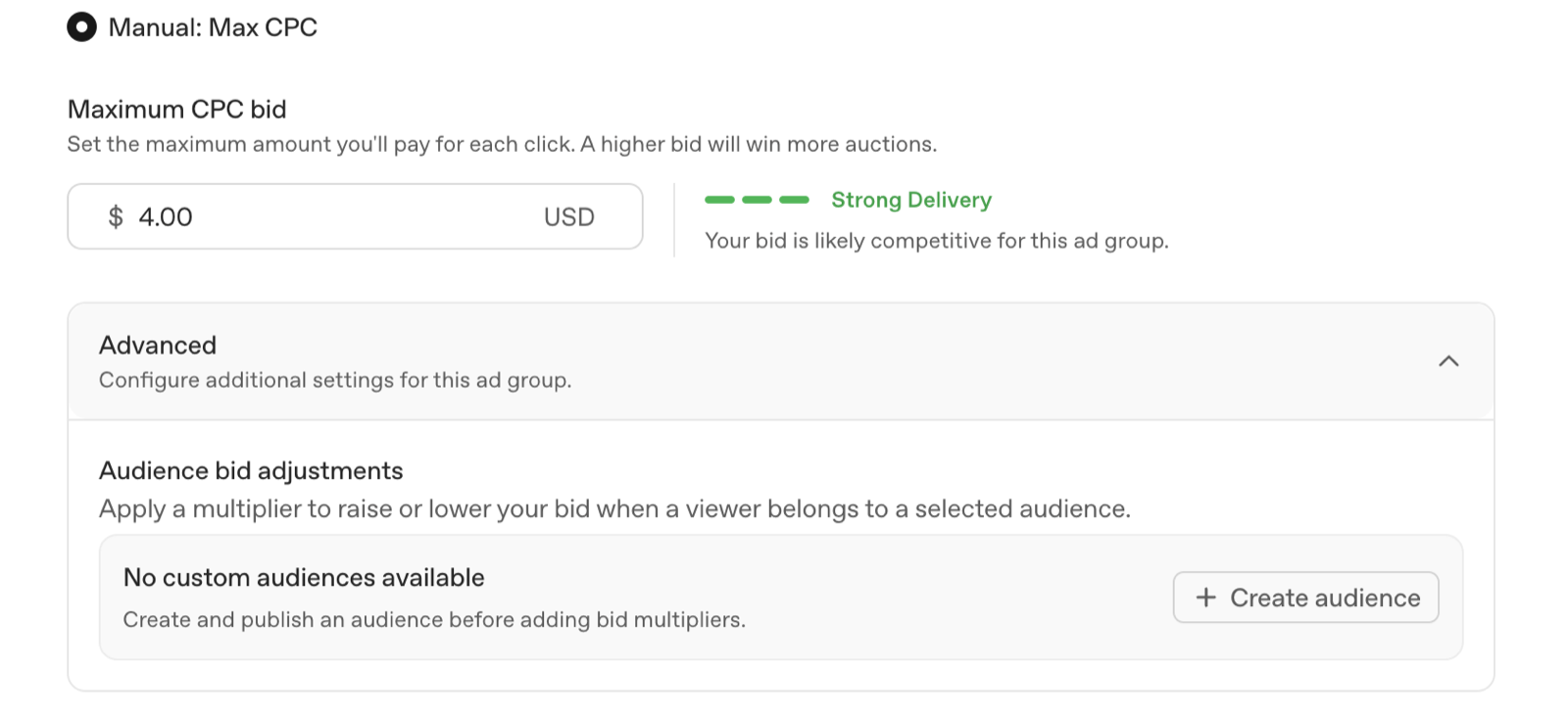
The case for it. AI-referred visits to US retail sites convert 60% better than non-AI traffic (Adobe Analytics via Digital Commerce 360, July 2026 data) - the visitor arrives pre-qualified because the comparison already happened in the conversation. Entry costs are low: recommended starting bids of $3-5 CPC and a $25 minimum daily budget (WebFX; OpenAI docs, 2026), with conversion-optimized CPC available - OpenAI optimizes delivery toward your conversion event but still charges per click (OpenAI Help Center, 2026). Since June 2026, product feed ads let you upload a Google Shopping-format catalog - 100 SKUs minimum, up to 1M - and ChatGPT auto-generates the product ads (OpenAI Ads Manager docs; Digiday, June 2026). If your feed already runs on Amazon, the marginal setup work is small; our guide on preparing a catalog for AI surfaces covers what actually matters in that feed.
The case against overcommitting. Chatbot ad CTR sits around 0.9%, versus a ~6.4% Google search benchmark (eMarketer, 2026). Our own US campaigns have done somewhat better - roughly 1.3% CTR since July 2026 (our campaign data) - but this is a low-click, high-quality channel, not a volume machine. Delivery ramps slowly during beta by design (OpenAI onboarding), and agencies still report measurement gaps and unproven outcomes (eMarketer/Digiday, 2026). The channel has hit $100M annualized revenue (eMarketer, 2026), which makes it real, not proven.
Full mechanics and cost detail are in our breakdown of how ChatGPT ads work for ecommerce and what they cost, and the wider paid-search comparison lives in ChatGPT ads vs Google Ads.
Rufus is Amazon conceding the point
Amazon built Rufus, its own AI shopping assistant, precisely because shoppers want to ask questions instead of typing keywords. That has two consequences for anyone weighing this split.
First, the conversational layer now exists inside Amazon too. When a shopper asks Rufus rather than searching, the classic keyword-bid shelf is not the surface being read. Product content, reviews, and structured data - the inputs an assistant reasons over - start doing the work your keyword bids used to do.
Second, it validates the upstream bet. If Amazon believes the assistant conversation is where decisions form, the same logic applies with more force to ChatGPT, which reaches shoppers before they have chosen a marketplace at all. We break down when each assistant wins in Rufus vs ChatGPT: when Amazon wins.
The split for D2C brands selling on both
Treat the two channels as different jobs with different success metrics.
Defend the shelf first. Keep Amazon Sponsored Products funded on branded terms and your top-converting category keywords. This budget protects revenue you already have; cutting it hands shelf position to competitors the same day.
Fund the conversation as a test, not a tithe. The $25 daily minimum makes a ChatGPT pilot cheap. Start with your best-margin hero products, write 5-15 context hints per ad group describing real buyer moments rather than keyword lists, and judge on conversion rate, not CTR.
Instrument before you judge. Install the OpenAI pixel and the server-side Conversions API; the default conversion window is 30 days (OpenAI docs, 2026). Given the channel's acknowledged measurement gaps (eMarketer/Digiday, 2026), a pilot without clean conversion tracking tells you nothing.
Remember who the ads cannot reach. Ads appear only to logged-in adults on Free and Go tiers (OpenAI). Your highest-spending prospects on Plus and Pro never see a sponsored box - which is why the paid pilot is the second move, not the first.
Setup steps, account verification, and campaign structure are in our ChatGPT ads setup guide, and every rollout date and market is tracked on our ChatGPT Ads hub.
Where Tru Commerce fits
As our founder put it on the record: "Brands cannot buy influence over ChatGPT's answers." (The Hindu BusinessLine, Aug 28, 2026.) Every brand now competes on two layers - the organic recommendation, which is earned, and the sponsored placement, which is bought and labeled. Amazon Sponsored Products rents the shelf; ChatGPT ads rent the conversation. The recommendation is the only asset you own on either surface, and the only layer premium users ever see.
So before splitting a single dollar, find out where you stand in the earned layer. Our free Citation Rank scan shows how often AI assistants recommend your products today, and where competitors are cited instead - results in 24 hours, no login, no credit card. Defend the shelf, buy the conversation where the math works, and earn the recommendation everywhere else.
For proof at marketplace scale, our work with Amazon India lifted AI Share of Voice +0.98% across 6 categories in 6 weeks - read the Amazon case study. If you want to see where you stand before committing, start with ChatGPT Ads for ecommerce brands.
FAQ
Both, for different jobs. Amazon Sponsored Products defends your shelf at the point of purchase. ChatGPT ads reach shoppers earlier, while they are still deciding what to buy. If budget forces a choice, protect Amazon branded terms first, then test ChatGPT at the $25 daily minimum.
ChatGPT ads run on a relevance-weighted second-price auction with $3-5 recommended starting CPC bids and a $25 minimum daily budget (WebFX; OpenAI docs, 2026). There is no keyword bidding - matching is conversational, steered by 5-15 context hints per ad group.
AI-referred visits to US retail sites convert 60% better than non-AI traffic (Adobe Analytics via Digital Commerce 360, July 2026 data). Shoppers arrive having already compared options in the conversation. Ad CTRs are lower - around 0.9% (eMarketer, 2026) - so the case rests on visit quality, not volume.
Rufus is Amazon's own AI shopping assistant, answering product questions inside Amazon. It moves part of Amazon discovery from keyword search to conversation - which means the conversational layer matters even on the marketplace you already pay to appear on. See our Rufus vs ChatGPT breakdown.
No. They occupy different funnel stages. Amazon ads capture shoppers at checkout distance; ChatGPT ads shape the shortlist before the marketplace visit. Dropping Amazon spend cedes shelf space to competitors instantly. Treat ChatGPT as an upstream addition, not a substitute.
Sources
- 1.Ads in ChatGPT: The Basics - OpenAI Help Center, 2026
- 2.ChatGPT ads will soon reach more users — proven results still missing - eMarketer, 2026
- 3.AI-driven traffic converts 42% better than non-AI traffic - Adobe Analytics via Digital Commerce 360, 2026
- 4.Adobe: AI referral traffic to retail sites converts 60% higher, July 2026 data - Digital Commerce 360, 2026
Continue reading
October 10, 2026
ChatGPT Ads in India: six weeks in, on the record
ChatGPT Ads switched on in India on 27 August 2026. Six weeks on, eight articles in five outlets quoted us and TechTimes cited our benchmarks. Every question the press asked, every answer verbatim and linked, and the numbers behind each one.
September 4, 2026
Criteo Prompt Smart Ads: 2,000 Brands on ChatGPT and a 4x Spend Lift
Criteo was the first ad-tech partner inside OpenAI's ChatGPT ads pilot. Its Prompt Smart Ads product auto-generates creatives and context hints matched to how people actually prompt - here is what it is, the numbers behind it, and what its creative reports teach every advertiser.
September 2, 2026
ChatGPT Ads Conversion Strategies: What the Query-Mix Data Says to Do
Only ~1 in 10 ChatGPT conversations carries commercial intent, 76.4% of shopping answers already show an ad, and market leaders buy almost none of them. Four strategies built on that data - not on search-ads instinct.