
ChatGPT Ads Policy: Restricted Categories, Review, and Why Ads Stop Serving
Every ChatGPT campaign goes through review, and a 'Not serving' status has four common causes. What OpenAI's ads policy actually says, which categories advertisers report being excluded, and how to fix a stalled campaign.
Viren Inaniyan · August 29, 2026 · AI Search Visibility
OpenAI reviews every ChatGPT campaign after submission, and it rejects ads for reasons Google advertisers rarely think about: a destination domain that does not match the verified business, a logo that renders illegibly at 32x32, an AI rewrite toggle left on for compliance-locked copy. Here is what the policy actually says, what advertisers report about restricted categories, and the four fixes when a campaign reads "Not serving".
The stated principles: what OpenAI has committed to
Before the mechanics, the frame. Since ads began testing in the US on February 9, 2026, OpenAI has repeated a consistent set of principles that function as the public face of its ads policy:
- Every ad is clearly labeled. The unit is a single sponsored box below the answer, marked as such. One advertiser per matched conversation.
- Ads never alter ChatGPT's answers. The organic recommendation and the sponsored placement are separate layers, and money only buys the second one.
- Conversations stay private from advertisers. You see campaign metrics, not chats.
- User data is not sold. Targeting runs on conversation context, not on demographic profiles sold to buyers (OpenAI).
- Ads only reach Free and Go users. Paying subscribers on Plus, Pro, Business, Enterprise, and Education never see ads (OpenAI).
Our co-founder put the practical consequence on record in The Hindu BusinessLine (Aug 28, 2026): "Brands cannot buy influence over ChatGPT's answers." Everything below, the review queue, the rejections, the category exclusions, exists to enforce that separation.
Review happens after submission, not before
There is no pre-clearance step. You build the campaign, submit it, and it enters review (OpenAI Help Center, Quickstart). While it sits there, or after review flags something, the campaign or ad shows a "Not serving" status in Ads Manager. Hover it and the status explains itself. The common causes fall into four buckets:
- Fixable edits. Something in the ad needs a change: a character limit, a broken link, a creative problem. Edit and resubmit.
- Policy rejections. The ad or the advertiser hit a policy line. These need an appeal or a rethink, not a tweak.
- Pending business verification. Your account has not cleared identity checks yet, so nothing serves regardless of ad quality.
- Billing actions. A missing or failed billing method pauses delivery until resolved (OpenAI Help Center, Quickstart).
The practical habit: check the status tooltip before touching the ad. Half of "my ads got rejected" cases we hear about are actually verification or billing holds, which no amount of creative editing will fix.
What gets rejected in practice
Two failure modes dominate advertiser reports and our own campaign experience since July 2026.
Mismatched destination domains. Your verified business and your destination URL need to line up. Sending clicks to a domain that does not match the business you verified, a link shortener, an unrelated landing-page domain, a reseller URL, is a rejection pattern. Keep destinations on the domain you verified, and set redirects up server-side if you must route traffic.
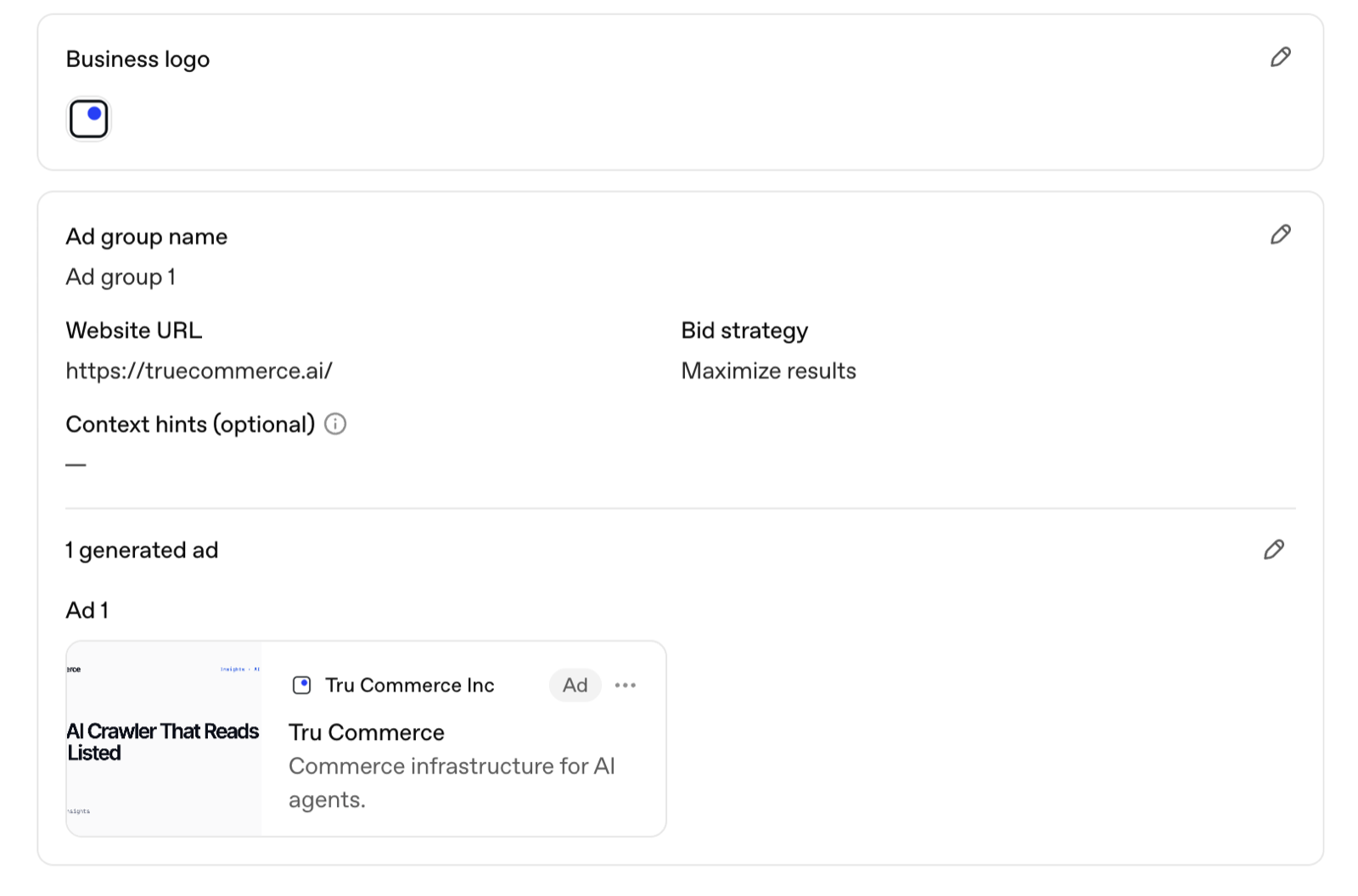
Unreadable creative. The ad unit is small and unforgiving: the logo renders as a 32x32 favicon, the square image must be at least 256x256, the title caps at 50 characters and the description at 100. Creative that is technically valid but illegible at those sizes, dense wordmarks, text baked into images, low-contrast logos, gets flagged. Our image size and specs guide covers the exact dimensions and how to test legibility before you submit.
Restricted categories: what is reported, not published
OpenAI has not published a full restricted-category list for ChatGPT ads. What exists instead is a consistent pattern of advertiser reports: healthcare advertisers and others in regulated or sensitive verticals report being excluded from the beta (advertiser reports on r/PPC, 2026).
Treat that with the caution it deserves. It is practitioner-reported, not documented policy, and beta access rules change. But the direction matches how every major ad platform started, and it matches the principles above: a system that promises answers are never influenced by money has the most to lose from sensitive-category ads sitting under health or finance answers.
If you operate in a regulated vertical, the honest planning assumption for 2026 is: expect exclusion or heavy friction on the paid layer, and invest in the organic layer, which has no such gate. Our teardown of how ChatGPT shopping picks products covers that earned layer in detail.
Account-level gates: verification, logo, billing
Plenty of "policy problems" are onboarding problems. Before any ad serves, the account itself must clear three gates: business details with a tax ID, Persona identity verification, and a billing method, plus an uploaded account logo, since the ad unit displays it on every impression (OpenAI). Billing is postpay, so a billing hold stops delivery even on an approved campaign.
Clear these before you build campaigns, not after. The sign-up walkthrough covers each gate step by step, and our broader setup guide covers what comes next.
The Text customization trap for regulated copy
One Ads Manager setting deserves its own warning. The Text customization toggle allows AI to rewrite or translate your headlines and descriptions to better fit the conversation, and it is a toggle you must actively turn off (Ads Manager UI, Aug 2026).
For most advertisers this is a useful relevance feature. For anyone whose copy is compliance-reviewed, finance, insurance, supplements, anything where legal signed off on specific wording, it is a liability: the text a user sees may not be the text your reviewers approved. If your copy is regulated, turn Text customization off per ad, and document that you did.
Fixing and appealing
The fix path depends on the bucket the status tooltip puts you in:
- Fixable edit: change the flagged element in Ads Manager and resubmit. Review runs again.
- Policy rejection: appeal through the Help Center flow, or rebuild the ad to comply. Do not resubmit the identical ad and hope.
- Verification pending: finish the Persona flow and wait; nothing else unblocks it.
- Billing action: update the payment method; delivery resumes without re-review.
And remember the baseline: delivery ramps slowly during the beta by design (OpenAI onboarding), so a compliant, approved campaign underdelivering in week one is normal, not a policy problem. Judge delivery against your reporting data, not against day-one impressions.
Where Tru Commerce fits
The policy layer is the clearest proof of the two-layer market. Ads are bought, labeled, reviewed, and revocable: OpenAI can reject your creative, exclude your category, or pause your account, because you are renting space in the conversation. The organic recommendation runs on none of those gates. No review queue, no restricted-category reports, no tier limits: it is the only layer Plus and Pro shoppers ever see, and it is earned through catalog quality, third-party evidence, and structured data.
That is the layer we build for. Before you spend a rupee or a dollar on the rented layer, find out where you stand on the earned one: run the free Citation Rank scan and see how ChatGPT, Gemini, and Perplexity actually rank your brand today. Then use our ChatGPT Ads hub to decide whether paid is worth layering on top.
The same measurement-first loop drove our Amazon India engagement, where Top-5 presence rose +2.4% in 6 weeks - see the Amazon case study. If you want to see where you stand before committing, start with Visibility Score.
FAQ
The most common practical causes are a destination URL whose domain does not match your verified business, and creative that fails legibility checks, such as an unreadable logo or image. Hover the 'Not serving' status in Ads Manager: it states the specific reason (OpenAI Help Center, 2026).
Four common causes: the ad needs a fixable edit, it was rejected on policy, your business verification is still pending, or a billing action is required. The status explains itself on hover in Ads Manager (OpenAI Help Center, Quickstart, 2026).
OpenAI has not published a full restricted-category list. Advertisers in healthcare and other regulated or sensitive verticals report being excluded from the beta (advertiser reports on r/PPC, 2026). If you operate in a regulated category, expect stricter review or no access yet.
OpenAI does not publish a fixed review window. Campaigns enter review after submission, and delivery also ramps slowly during the beta by design (OpenAI onboarding, 2026). Budget days, not minutes, and check the campaign status in Ads Manager rather than waiting on email.
No. OpenAI has stated since February 2026 that ads never influence ChatGPT's answers, every ad is clearly labeled, conversations stay private from advertisers, and user data is not sold. Ads also appear only to logged-in adults on the Free and Go tiers (OpenAI).
Sources
- 1.Ads in ChatGPT: The Basics - OpenAI Help Center, 2026
Continue reading
October 10, 2026
ChatGPT Ads in India: six weeks in, on the record
ChatGPT Ads switched on in India on 27 August 2026. Six weeks on, eight articles in five outlets quoted us and TechTimes cited our benchmarks. Every question the press asked, every answer verbatim and linked, and the numbers behind each one.
September 4, 2026
Criteo Prompt Smart Ads: 2,000 Brands on ChatGPT and a 4x Spend Lift
Criteo was the first ad-tech partner inside OpenAI's ChatGPT ads pilot. Its Prompt Smart Ads product auto-generates creatives and context hints matched to how people actually prompt - here is what it is, the numbers behind it, and what its creative reports teach every advertiser.
September 2, 2026
ChatGPT Ads Conversion Strategies: What the Query-Mix Data Says to Do
Only ~1 in 10 ChatGPT conversations carries commercial intent, 76.4% of shopping answers already show an ad, and market leaders buy almost none of them. Four strategies built on that data - not on search-ads instinct.