
ChatGPT Ads Minimum Budget: $25 a Day, ₹725 in India, No Lifetime Spend
ChatGPT ads launched in February 2026 behind a $200,000 minimum. Today the floor is $25 a day in the US and ₹725 a day in India - here is what a starter budget actually buys.
Viren Inaniyan · August 29, 2026 · ChatGPT Ads
OpenAI opened ChatGPT advertising in February 2026 behind a $200,000 commitment and a $60 CPM - enterprise pricing for an unproven format. By May, self-serve killed the lifetime minimum entirely. Today the floor is $25 a day in the US and ₹725 a day in India, which means the real question is no longer whether you can afford to test, but what a small test actually buys.
From $200,000 to $25 in three months
ChatGPT ads have had two pricing eras, and conflating them is the most common budgeting mistake we see.
The launch era (February 2026). When OpenAI began testing ads in the US on February 9, 2026, buying in meant a $60 CPM and a $200,000 minimum commitment (OpenAI announcement). That structure filtered the market to large brands and their agencies - it was a managed pilot, not a channel.
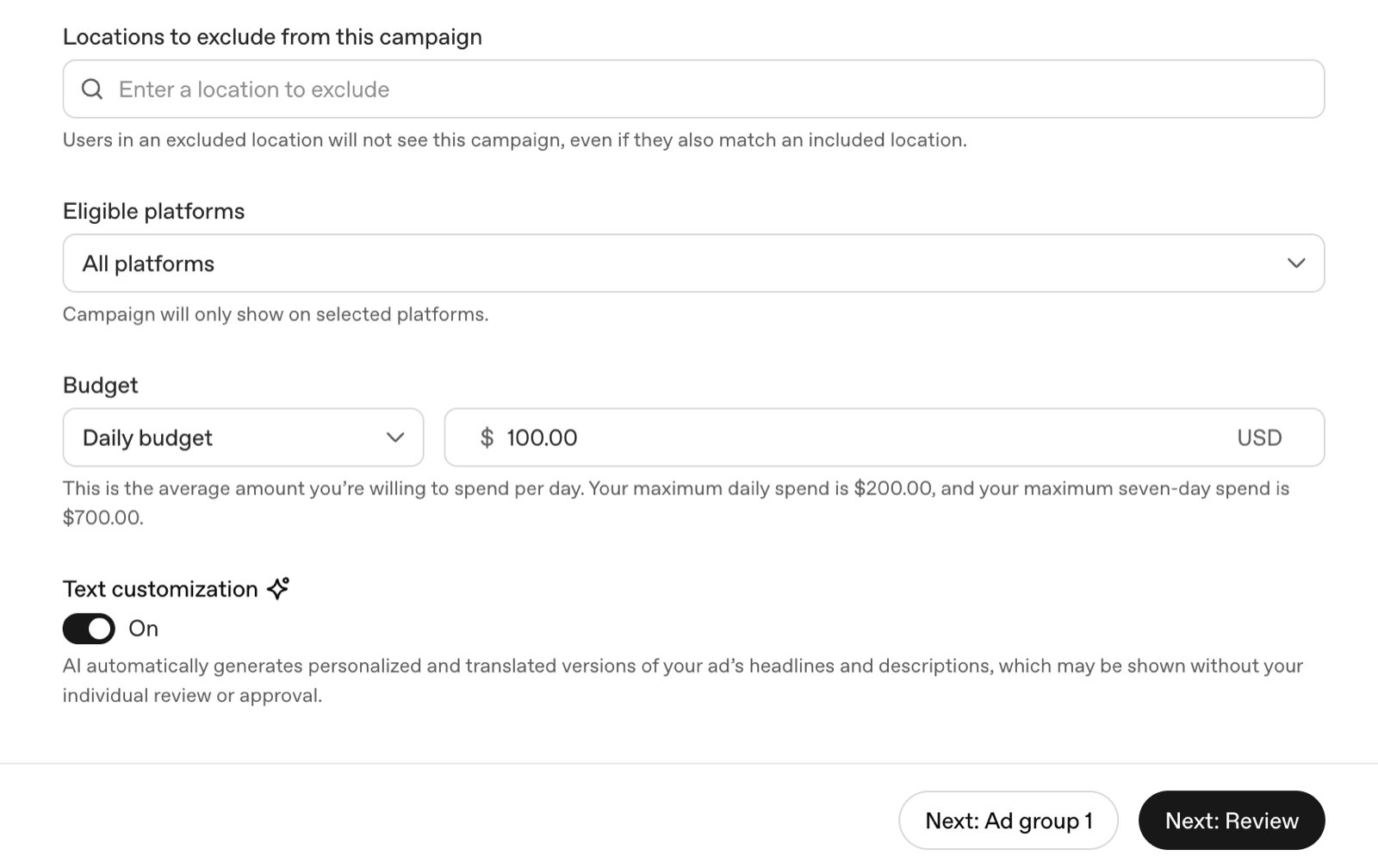
The self-serve era (May 2026 onward). The Ads Manager Beta at ads.openai.com opened in May 2026 with no minimum lifetime spend (OpenAI, May 2026). The only floor that survives is the $25 minimum daily budget per campaign. Product feed ads followed in June 2026 - upload a Google Shopping-format catalog of 100 to 1M SKUs and ChatGPT auto-generates the product ads (OpenAI Ads Manager docs; Digiday, June 2026).
If you read commentary citing the $200K figure as current, it is describing a pricing model that no longer exists. Our rollout tracker logs each of these shifts as they happen.
The minimums today, market by market
United States: $25 per day. Self-serve since May 2026. Campaign objectives are Clicks or Reach; bidding is Maximize results (auto) or Manual Max CPC in a relevance-weighted second-price auction (OpenAI Ads Manager). Billing is postpay - you are invoiced after spend, not charged up front.
India: ₹725 per day. Ads switched on August 27, 2026 for Free and Go users, with 50+ brands live in the first week through WPP and Omnicom as the first agency partners (The Hindu BusinessLine, Aug 28, 2026; Storyboard18, Aug 2026). The important date for smaller merchants is September 4, 2026, when ChatGPT Ads Manager opens to any Indian business at a ₹725 minimum daily budget - no agency required (Storyboard18, Aug 2026).
Other live markets. The UK launched June 6, 2026 as OpenAI's first European market, alongside Canada, Australia, New Zealand, Japan, and Korea (OpenAI expansion posts, 2026).
One constraint applies everywhere: ads appear only to logged-in adults on the Free and Go tiers. Plus, Pro, Business, Enterprise, and Education users never see ads (OpenAI).
What $25 a day actually buys
Run the arithmetic before you set expectations with anyone upstream of you.
Clicks. Recommended starting bids in most categories are $3-5 CPC, rising to $8-18 in software and finance (WebFX; OpenAI docs; practitioner reports, 2026). At $3-5, a $25 daily budget clears roughly 5-8 clicks a day. Over a 30-day test - about $750 - that is 150-250 clicks. In a $10+ CPC category, the same budget buys 2-3 clicks a day, which is closer to a smoke test than a test.
Impressions behind those clicks. Chatbot ad CTR runs around 0.9% (eMarketer, 2026); our own US campaigns since July 2026 have averaged ~1.3% (our campaign data). At roughly 1%, those 150-250 clicks imply your ad was matched into something like 15,000-25,000 conversations. Delivery also ramps slowly during the beta by design (OpenAI onboarding), so expect the first week to underspend the cap.
Conversion data - mostly, not yet. AI-referred visits to US retail sites convert 60% better than non-AI traffic (Adobe Analytics via Digital Commerce 360, July 2026 data), but that figure describes organic referrals, not paid clicks. Agencies report measurement gaps and unproven outcomes on the paid side so far (eMarketer/Digiday, 2026). A 150-250 click sample tells you whether the traffic is relevant and whether it behaves on your site; it rarely proves ROAS. Budget month one for learning, and instrument attribution properly - our guide to dark agentic commerce traffic covers why this traffic hides in GA4 if you don't.
A budget ladder for testing
We recommend climbing in rungs, with a promotion rule at each step.
Rung 1 - validate relevance: $25/day (₹725/day) for 30 days. One campaign, one ad group, Manual Max CPC at the low end of the $3-5 range. Write 5-15 context hints - the 1-2-sentence buyer-moment descriptions OpenAI recommends per ad group, since there are no keywords and matching is conversational (OpenAI Ads Manager; help docs). Promote when CTR holds near the ~0.9-1.3% benchmark range and landing-page behavior looks like real shoppers.
Rung 2 - isolate what works: $50-75/day. Split ad groups by buyer moment so each set of context hints gets its own budget and its own read. Keep Manual Max CPC until you trust the data. Promote when one or two ad groups clearly outperform.
Rung 3 - optimize toward conversions: $100-150/day. Switch winning ad groups to conversion-optimized CPC - OpenAI optimizes delivery toward your selected conversion event but still charges per click (OpenAI Help Center, article 20001210). This only works if the OpenAI pixel and Conversions API are feeding events, so wire measurement before this rung, not after. Our setup guide walks through the pixel, the server-side events, and Persona verification.
Rung 4 - scale the catalog: $150+/day with product feed ads. If you sell more than 100 SKUs, the June 2026 feed format lets ChatGPT auto-generate product ads from a Google Shopping-format catalog (OpenAI Ads Manager docs; Digiday, June 2026). At this rung you are comparing the channel against everything else you buy - our ChatGPT ads vs Google Ads comparison is the framework for that decision, and the ecommerce cost breakdown covers the unit economics in depth.
The ladder works because billing is postpay and there is no lifetime commitment: every rung is exit-able at zero sunk cost beyond what you have already learned.
Where Tru Commerce fits
The minimum budget fell from $200,000 to $25 - but a budget only rents the sponsored box below the answer. As our co-founder put it on record: "Brands cannot buy influence over ChatGPT's answers" (The Hindu BusinessLine, Aug 28, 2026). Brands now compete on two layers: the organic recommendation, which is earned, and the sponsored placement, which is bought and labelled. Free and Go users see both. Plus and Pro users - the shoppers paying for the product - see only the earned layer, at any budget.
So before you commit even the $25 floor, find out where you stand on the layer money can't buy. Run the free Citation Rank scan - results in 24 hours, showing whether ChatGPT already recommends you organically and what to fix if it doesn't. Then, if you do spend, everything else in this sprint lives on our ChatGPT Ads hub.
The upside here is measurable: House of Zelena went from 22% to 56% ChatGPT mention share in 6 months with us - see the House of Zelena case study. If you want to see where you stand before committing, start with ChatGPT Ads for ecommerce brands.
FAQ
The minimum daily budget in ChatGPT Ads Manager is $25 per campaign, with no lifetime spend requirement. The $200,000 minimum and $60 CPM from the February 2026 launch were eliminated when self-serve opened in May 2026 (OpenAI, 2026).
Yes - ₹725 per day. ChatGPT Ads Manager opens to any Indian business on September 4, 2026, with no agency required and no lifetime minimum (Storyboard18, Aug 2026). Managed campaigns with 50+ brands began August 27.
No. The $200,000 minimum applied only to the February 2026 US launch, priced at a $60 CPM. Self-serve Ads Manager, open since May 2026 at ads.openai.com, has no minimum lifetime spend - just the $25 daily budget floor (OpenAI, 2026).
Recommended starting bids are $3-5 CPC in most categories, rising to $8-18 in software and finance. CPM options run roughly $25-60 (WebFX; OpenAI docs; practitioner reports, 2026). Billing is postpay in a relevance-weighted second-price auction.
Plan on the $25/day floor for 30 days - about $750. At $3-5 CPC that buys roughly 150-250 clicks, enough to judge relevance and traffic quality but rarely enough for statistically solid conversion data. Scale only after the click data looks clean.
Sources
- 1.Ads in ChatGPT: The Basics - OpenAI Help Center, 2026
- 2.Create campaigns for ChatGPT - OpenAI Help Center, 2026
- 3.Ads Manager Beta: account setup - OpenAI Help Center, 2026
- 4.How much do ChatGPT ads cost? CPC & CPM pricing - WebFX, 2026
- 5.ChatGPT ads will soon reach more users — proven results still missing - eMarketer, 2026
- 6.Adobe: AI referral traffic to retail sites converts 60% higher, July 2026 data - Digital Commerce 360, 2026
Continue reading
October 10, 2026
ChatGPT Ads in India: six weeks in, on the record
ChatGPT Ads switched on in India on 27 August 2026. Six weeks on, eight articles in five outlets quoted us and TechTimes cited our benchmarks. Every question the press asked, every answer verbatim and linked, and the numbers behind each one.
September 4, 2026
Criteo Prompt Smart Ads: 2,000 Brands on ChatGPT and a 4x Spend Lift
Criteo was the first ad-tech partner inside OpenAI's ChatGPT ads pilot. Its Prompt Smart Ads product auto-generates creatives and context hints matched to how people actually prompt - here is what it is, the numbers behind it, and what its creative reports teach every advertiser.
September 2, 2026
ChatGPT Ads Conversion Strategies: What the Query-Mix Data Says to Do
Only ~1 in 10 ChatGPT conversations carries commercial intent, 76.4% of shopping answers already show an ad, and market leaders buy almost none of them. Four strategies built on that data - not on search-ads instinct.