
Can You Advertise on ChatGPT? Eligibility, Countries, and Requirements
Yes - any business in eight eligible countries can run ChatGPT ads self-serve at ads.openai.com, from $25/day in the US and ₹725/day in India. Here is exactly what you need to qualify.
Viren Inaniyan · August 29, 2026 · ChatGPT Ads
Yes - you can advertise on ChatGPT. Since May 2026 the Ads Manager at ads.openai.com is self-serve, with no minimum lifetime spend, and by September 4, 2026 it covers eight countries. What you need is a registered business, a tax ID, identity verification, and $25 a day - plus a clear-eyed view of what a sponsored box can and cannot buy you.
The short answer: yes, self-serve, since May 2026
When OpenAI began testing ads in ChatGPT in the US on February 9, 2026, advertising was effectively closed: $60 CPMs and a $200,000 minimum commitment kept everyone but large brands out (OpenAI announcement; OpenAI docs, 2026).
That changed in May 2026. The self-serve Ads Manager Beta opened at ads.openai.com with no minimum lifetime spend (OpenAI, May 2026). Any eligible business can now create an account, pass verification, and launch a campaign - the same pattern Google and Meta followed when they opened their auctions to everyone.
So the answer to "can I advertise on ChatGPT" is yes, provided you clear three gates: your country is eligible, your account passes verification, and your category is allowed. The rest of this post walks through each gate. For the campaign build itself, see our step-by-step setup guide.
Which countries are eligible
ChatGPT ads are live in eight markets as of August 2026:
- United States - the launch market, testing since February 9, 2026 (OpenAI).
- United Kingdom - launched June 6, 2026, OpenAI's first European market (OpenAI expansion posts, 2026).
- Canada, Australia, New Zealand, Japan, and Korea - live as of the 2026 expansion wave (OpenAI expansion posts, 2026).
- India - ads switched on August 27, 2026 for Free and Go users, with 50+ brands live in the first week and WPP and Omnicom as the first agency partners (The Hindu BusinessLine, Aug 28, 2026; Storyboard18, Aug 2026). Self-serve opens September 4, 2026 - the Ads Manager becomes available to any Indian business, no agency required, at a minimum daily budget of ₹725 (Storyboard18, Aug 2026).
Notably absent: the EU. The UK is OpenAI's only European ad market so far, and OpenAI has not announced EU timing. If your business sells into eligible countries from elsewhere, eligibility follows your business registration and billing setup - check OpenAI's current requirements when you apply. We track every market change in our rollout tracker.
What you need before your first campaign
Account setup is stricter than a typical ad platform signup. Before your ads can serve, OpenAI requires five things:
- Business details. Legal business name and registration information - this is a business product, not a personal one.
- Tax ID. Your business tax identifier for the country you register in.
- Billing method. Billing is postpay - you add a payment method and are charged for delivered spend, not upfront.
- Persona verification. Identity verification through Persona, the same verification provider used across OpenAI's platform. Expect to submit government ID for the account holder.
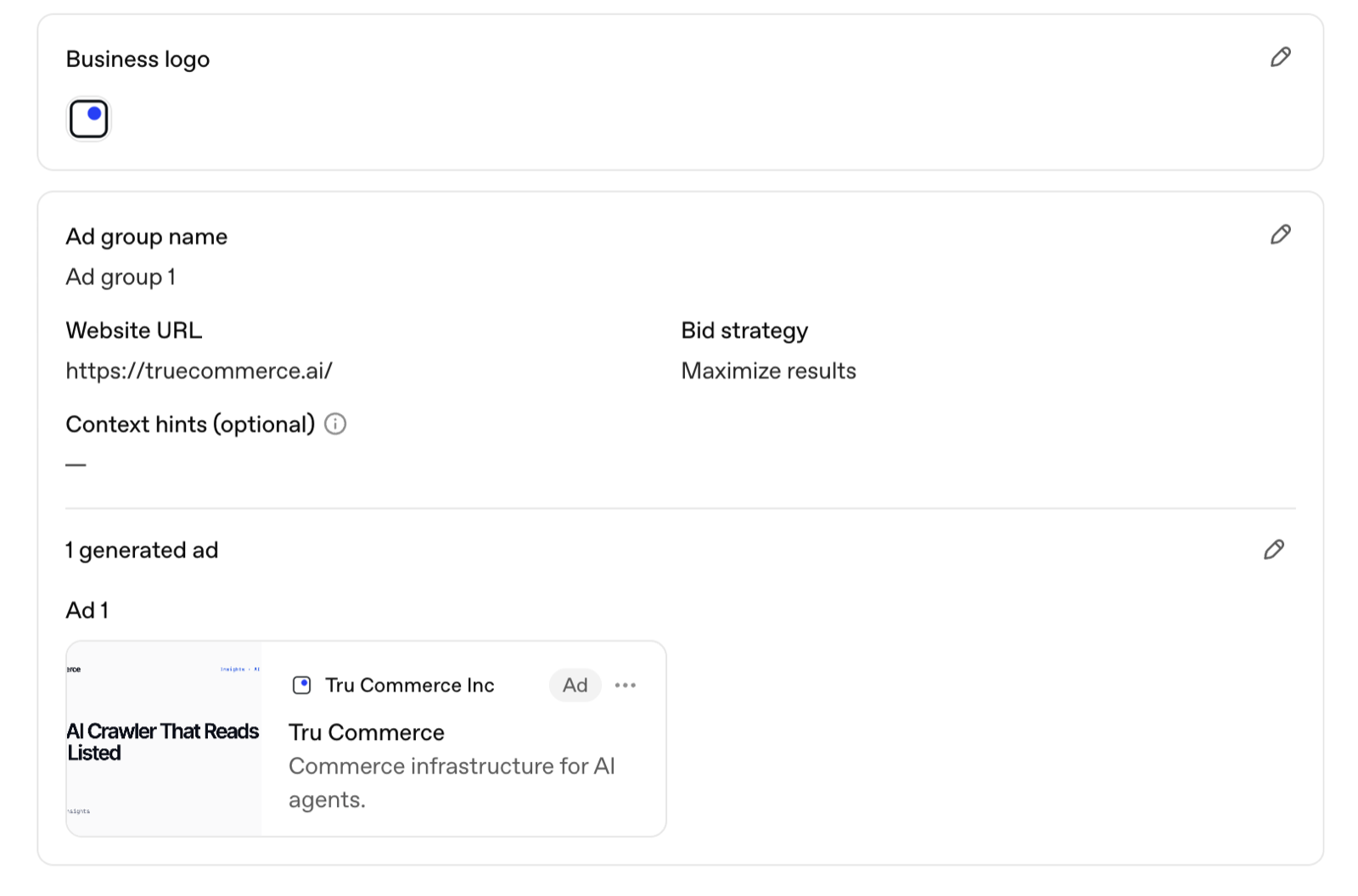
- Account logo. Your logo appears in the ad unit itself (it renders at 32×32 in the sponsored box), so an account logo is required before serving.
None of these steps is difficult, but together they mean you cannot launch in an afternoon on a whim. Budget a few days for verification to clear before your intended start date.
Minimum budgets: $25 a day, or ₹725
There is no minimum contract, no minimum lifetime spend, and no upfront commitment. The only floor is the minimum daily budget: $25 in the US (OpenAI docs), and ₹725 in India when self-serve opens September 4 (Storyboard18, Aug 2026).
At typical 2026 CPCs of $3-5 recommended starting bids - rising to $8-18 in software and finance categories (WebFX; OpenAI docs; practitioner reports, 2026) - a $25 daily budget buys roughly 5-8 clicks a day at the low end. That is enough to start learning, not enough to draw conclusions in a week. Delivery also ramps slowly during the beta by design (OpenAI onboarding), so plan for a patient first month. Our full cost breakdown is in what ChatGPT ads cost for ecommerce.
Who cannot advertise
Three groups are effectively excluded:
- Businesses outside the eight eligible countries. No workaround exists short of a registered entity and billing presence in an eligible market.
- Restricted categories. OpenAI maintains ad policies that restrict certain categories from advertising, as every major ad platform does. We will not paraphrase the policy list here - it is evolving through the beta, and the authoritative version lives in OpenAI's advertising policies, which you accept during account setup. If your category is regulated or age-sensitive, read them before you invest in creative.
- Individuals without a business. The tax ID and business details requirements rule out personal accounts.
One more exclusion worth naming: you cannot buy your way to paid-tier users. Ads appear only to logged-in adults on Free and Go tiers. Plus, Pro, Business, Enterprise, and Education users never see ads (OpenAI). If your buyers skew professional, a meaningful share of them are unreachable by any ChatGPT ad at any budget.
What eligibility gets you - and what it does not
Passing every gate above gets you a single labeled sponsored box below the answer, in matched conversations, for one advertiser at a time. It does not get you influence over the answer itself. Ads never affect what ChatGPT recommends, and conversations are kept private from advertisers (OpenAI, stated repeatedly since Feb 2026).
That distinction matters more than any eligibility rule. Agencies are still reporting measurement gaps and unproven outcomes from the beta (eMarketer/Digiday, 2026), while AI-referred visits to US retail sites convert 60% better than non-AI traffic (Adobe Analytics via Digital Commerce 360, July 2026 data) - and that converting traffic flows through the organic recommendation, not the ad slot. For how the paid dollar compares elsewhere, see ChatGPT ads vs Google Ads, and browse our ChatGPT Ads hub for the full cluster.
Where Tru Commerce fits
As our founder put it in The Hindu BusinessLine (Aug 28, 2026): "Brands cannot buy influence over ChatGPT's answers." Eligibility gets you into the auction for the sponsored box - a rented, labeled placement below the answer. The recommendation inside the answer is earned, and it is the only layer that reaches Plus and Pro users, who never see ads at all.
Brands now compete on both layers. Before you spend your first $25, find out where you stand on the earned one: run the free Citation Rank scan and see how ChatGPT, Gemini, and Perplexity recommend your brand today - results in 24 hours, no login, no credit card.
Worth checking what this channel already drives for you: for MyMuse, GA4 reported ₹11.5K/mo of AI revenue when the real number was ₹81.2K/mo - read the MyMuse case study. The usual first step is ChatGPT Ads for ecommerce brands.
FAQ
Any business in an eligible country can, via self-serve at ads.openai.com. You need business details, a tax ID, a billing method, Persona identity verification, and an account logo. Restricted categories under OpenAI's ad policies cannot run, and individuals without a registered business cannot sign up.
As of August 2026: the US, UK, Canada, Australia, New Zealand, Japan, Korea, and India. The UK launched June 6, 2026 as OpenAI's first European market. India switched on August 27, 2026, with self-serve opening to all Indian businesses on September 4, 2026.
The minimum daily budget is $25 in the US and ₹725 in India. There is no minimum lifetime spend - the $200,000 minimum from the February 2026 test was eliminated when the self-serve Ads Manager Beta opened in May 2026 (OpenAI).
No. WPP and Omnicom were the first agency partners at the August 27, 2026 launch, but from September 4, 2026 the ChatGPT Ads Manager is self-serve for any Indian business, at a minimum daily budget of ₹725 (Storyboard18, Aug 2026).
No. Ads appear as a single labeled sponsored box below the answer and never influence what ChatGPT recommends (OpenAI, stated since Feb 2026). Plus, Pro, Business, Enterprise, and Education users never see ads at all - the organic recommendation is the only layer that reaches them.
Sources
- 1.Ads in ChatGPT: The Basics - OpenAI Help Center, 2026
- 2.ChatGPT ads will soon reach more users — proven results still missing - eMarketer, 2026
- 3.Adobe: AI referral traffic to retail sites converts 60% higher, July 2026 data - Digital Commerce 360, 2026
Continue reading
October 10, 2026
ChatGPT Ads in India: six weeks in, on the record
ChatGPT Ads switched on in India on 27 August 2026. Six weeks on, eight articles in five outlets quoted us and TechTimes cited our benchmarks. Every question the press asked, every answer verbatim and linked, and the numbers behind each one.
September 4, 2026
Criteo Prompt Smart Ads: 2,000 Brands on ChatGPT and a 4x Spend Lift
Criteo was the first ad-tech partner inside OpenAI's ChatGPT ads pilot. Its Prompt Smart Ads product auto-generates creatives and context hints matched to how people actually prompt - here is what it is, the numbers behind it, and what its creative reports teach every advertiser.
September 2, 2026
ChatGPT Ads Conversion Strategies: What the Query-Mix Data Says to Do
Only ~1 in 10 ChatGPT conversations carries commercial intent, 76.4% of shopping answers already show an ad, and market leaders buy almost none of them. Four strategies built on that data - not on search-ads instinct.