
Does ChatGPT Have Ads? Yes - Here's Exactly Who Sees Them
ChatGPT has had ads since February 9, 2026, and they now run in eight countries including India. Only Free and Go users see them - every paid tier is ad-free.
Viren Inaniyan · August 29, 2026 · AI Search Visibility
Yes - ChatGPT has carried ads since February 9, 2026. They now run in eight countries, most recently India, and only logged-in adults on the Free and Go tiers ever see them; every paid plan is ad-free. Most of the questions hiding inside "does ChatGPT have ads" are really about that split - who sees the ads, where they run, and whether you can turn them off.
The short answer: yes, since February 9, 2026
OpenAI began testing ads in ChatGPT in the US on February 9, 2026. That ended years of speculation about whether the company would keep the product ad-free, and it started small: at launch, pricing was a $60 CPM with a $200,000 minimum commitment - enterprise-only by design.
Both barriers fell fast. The self-serve Ads Manager Beta opened in May 2026 at ads.openai.com with no minimum lifetime spend, and product feed ads followed in June 2026, letting merchants upload a Google Shopping-format catalog that ChatGPT turns into auto-generated product ads (OpenAI Ads Manager docs; Digiday, June 2026). By 2026 the format had reached $100M in annualized revenue (eMarketer, 2026).
So if you searched "does ChatGPT have ads now" or "is ChatGPT showing ads" - yes, it is, and has been for over six months. The more useful questions are who sees them and where.
Who sees ChatGPT ads - and who never does
Ads appear only to logged-in adults on the Free and Go tiers. That is the entire audience. If a user pays for ChatGPT at any level - Plus, Pro, Business, Enterprise, or Education - they never see an ad (OpenAI).
This split matters more than it looks. It means the paying audience - the heaviest, most committed users - is reachable only through ChatGPT's organic recommendations, not through any budget. As our founder put it on the record: "Brands cannot buy influence over ChatGPT's answers" (The Hindu BusinessLine, Aug 28, 2026). Brands now compete on two layers: the organic recommendation, which is earned, and the sponsored placement, which is bought and labeled. Premium users see only the earned layer.
Logged-out users don't see ads either. The matching system needs an account - it draws on the current conversation topic, past chats, and past ad interactions - so anonymous sessions serve nothing.
Where ChatGPT ads are live
The rollout has moved in three waves:
- February 9, 2026 - United States. The original test market.
- June 6, 2026 - United Kingdom, OpenAI's first European market, alongside Canada, Australia, New Zealand, Japan, and Korea (OpenAI expansion posts, 2026).
- August 27, 2026 - India. Ads switched on for Free and Go users, with 50+ brands live in the first week and WPP and Omnicom as the first agency partners (The Hindu BusinessLine, Aug 28, 2026; Storyboard18, Aug 2026). India's self-serve access opens September 4, 2026, to any Indian business at a minimum daily budget of ₹725 - no agency required (Storyboard18, Aug 2026).
That is eight countries and counting (as of August 29, 2026). Continental Europe remains conspicuously absent. We track every market change on our rollout tracker, which we update as new countries switch on.
What a ChatGPT ad actually looks like
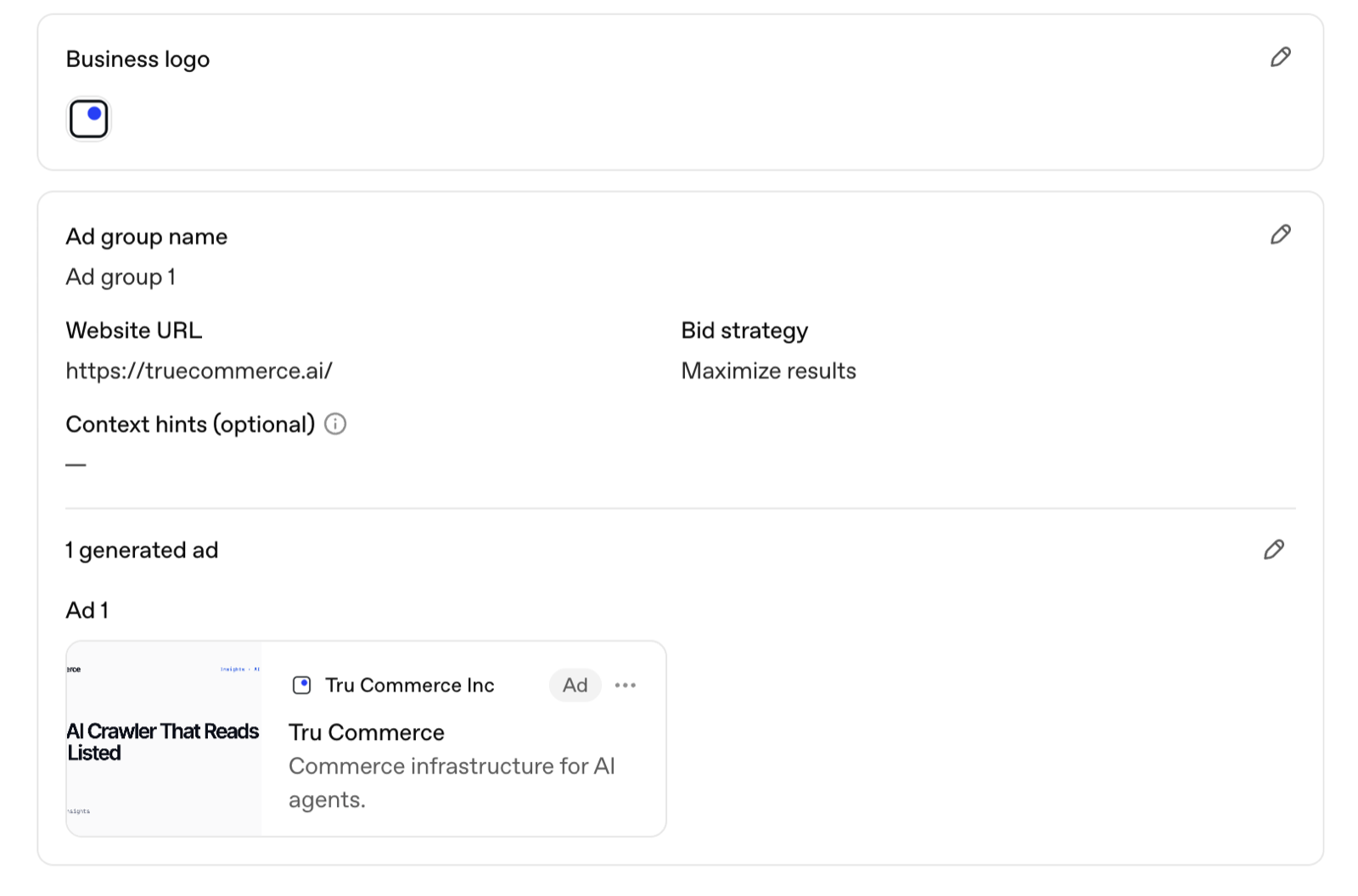
One labeled sponsored box below the answer. The unit carries the advertiser's name, logo, a title of up to 50 characters, a description of up to 100 characters, a square image, and a destination link. Only one advertiser appears per matched conversation - there is no stack of results to scroll past.
No keywords. Unlike search advertising, there is nothing to bid on by query. Matching is conversational: ChatGPT weighs the current conversation topic, past chats, and past ad interactions. Advertisers steer the system with context hints - OpenAI recommends 5-15 short buyer-moment descriptions per ad group - but hints guide matching rather than acting as exact-match rules (OpenAI Ads Manager; help docs).
The placement is separate from the answer. The organic response renders first and the sponsored box sits below it, labeled. We break down the full unit spec and auction mechanics in our guide to how ChatGPT ads work for ecommerce.
What we see in the ads ourselves
We do not rely on secondhand reports to describe this channel - we crawl it. Our research pass submitted 2,560 high commercial-intent US prompts directly to ChatGPT and captured every sponsored placement returned: 220 distinct US advertisers across 1,746 captured ad creatives, 72 of them direct consumer ecommerce brands (our campaign and crawl data, 2026).
The mix says a lot about who has moved first. B2B SaaS accounts for 37.9% of all captured ads and consumer commerce 30.7%, with the remainder split across consumer services, affiliate aggregators, agencies, and B2B supply. The heaviest ecommerce spenders by creative volume include Harbor Freight, Home Depot, JCPenney, Peloton, DreamCloud, Macy's, Dell, SkinCeuticals, Wayfair, and Avocado Green Mattress - and nearly every creative we captured is direct-response, pointing at a specific product or category page rather than running brand awareness (our campaign and crawl data, 2026).
We buy the placements too. In our own US campaigns running since July 2026, CTR has averaged about 1.3% (our campaign data) - ahead of the ~0.9% chatbot ad benchmark eMarketer reports for 2026, and a useful reality check on what the single-slot format delivers when the context hints are tuned.
Can you turn ChatGPT ads off?
Paying is the real opt-out. Every paid tier - Plus, Pro, Business, Enterprise, and Education - is ad-free (OpenAI). There is no setting that removes ads entirely while keeping the full free experience; upgrading to any paid plan is the one route to an ad-free ChatGPT.
Personalization is the part you can control. OpenAI says ad-personalization controls live in ChatGPT's settings, where users can limit how past chats and past ad interactions shape which ads they are matched with (OpenAI). That changes what the sponsored box shows, not whether it shows.
Logging out works, with trade-offs. Ads serve only to logged-in adults, so anonymous sessions see none - but they also lose chat history and the rest of an account's features. For most Free-tier users, the practical choices are living with the labeled box or paying for a tier that never shows one.
The promise: ads never influence answers
OpenAI has stated repeatedly since February 2026 that ads never influence ChatGPT's answers, and that conversations are kept private from advertisers. No demographic profiles are sold, and user data is not sold to advertisers (OpenAI).
That firewall is the defining constraint of the channel. Money buys the labeled box; it cannot buy a mention in the response above it. The recommendation layer - the part every user sees, paid tiers included - is determined by how well ChatGPT understands and trusts your brand's catalog, content, and third-party footprint. We took that layer apart in our ChatGPT Shopping teardown.
How to advertise on ChatGPT (the short version)
Any business can buy in through ads.openai.com. The essentials:
- Budget: $25 minimum daily budget; billing is postpay.
- Bidding: Maximize results (auto) or Manual Max CPC, cleared through a relevance-weighted second-price auction. Bid models are CPM for reach, CPC for traffic, and conversion-optimized CPC. Typical 2026 starting bids run $3-5 CPC, rising to $8-18 in software and finance (WebFX; OpenAI docs; practitioner reports, 2026).
- Setup: business details, tax ID, billing method, Persona verification, and an account logo before serving.
- Expectations: chatbot ad CTR benchmarks sit around 0.9% versus roughly 6.4% for Google search (eMarketer, 2026). In our own US campaigns running since July 2026, CTR has averaged about 1.3% (our campaign data). Delivery ramps slowly during beta by design (OpenAI onboarding).
For the full walkthrough - account setup, context hints, feeds, and the OpenAI pixel - use our step-by-step setup guide, and see our ChatGPT Ads hub for everything else in this series.
Where Tru Commerce fits
Ads rent the conversation. The organic recommendation is earned - and it is the only layer that reaches Plus, Pro, and every other paying user. Agencies are still reporting measurement gaps and unproven outcomes on the paid side (eMarketer/Digiday, 2026), which makes the earned layer the safer first investment: AI-referred visits to US retail sites convert 60% better than non-AI traffic (Adobe Analytics via Digital Commerce 360, July 2026 data).
Before you fund the sponsored box, find out whether ChatGPT already recommends you in the answer above it. Run the free Citation Rank scan - two fields, results in 24 hours - and see exactly where your brand stands across the AI surfaces where shoppers are asking.
We ran this at marketplace scale with Amazon India, lifting AI Share of Voice +0.98% across 6 categories in 6 weeks - read the Amazon case study. The usual first step is Visibility Score.
FAQ
Yes. OpenAI began testing ads in ChatGPT in the US on February 9, 2026. Ads now run in the US, UK, Canada, Australia, New Zealand, Japan, Korea, and India (switched on August 27, 2026).
No. Plus, Pro, Business, Enterprise, and Education users never see ads. Ads appear only to logged-in adults on the Free and Go tiers (OpenAI).
No. As of August 2026 ads run in eight markets: the US, UK, Canada, Australia, New Zealand, Japan, Korea, and India. The UK, launched June 6, 2026, is OpenAI's only European market so far.
No. OpenAI has stated repeatedly since February 2026 that ads never influence ChatGPT's answers, and conversations are kept private from advertisers. The ad is a separate labeled box below the organic response.
Through the self-serve Ads Manager at ads.openai.com, open since May 2026 with no minimum lifetime spend. Minimum daily budget is $25; recommended starting bids are $3-5 CPC (OpenAI docs; WebFX, 2026).
Sources
- 1.Ads in ChatGPT: The Basics - OpenAI Help Center, 2026
- 2.ChatGPT ads will soon reach more users — proven results still missing - eMarketer, 2026
- 3.Adobe: AI referral traffic to retail sites converts 60% higher, July 2026 data - Digital Commerce 360, 2026
Continue reading
October 10, 2026
ChatGPT Ads in India: six weeks in, on the record
ChatGPT Ads switched on in India on 27 August 2026. Six weeks on, eight articles in five outlets quoted us and TechTimes cited our benchmarks. Every question the press asked, every answer verbatim and linked, and the numbers behind each one.
September 4, 2026
Criteo Prompt Smart Ads: 2,000 Brands on ChatGPT and a 4x Spend Lift
Criteo was the first ad-tech partner inside OpenAI's ChatGPT ads pilot. Its Prompt Smart Ads product auto-generates creatives and context hints matched to how people actually prompt - here is what it is, the numbers behind it, and what its creative reports teach every advertiser.
September 2, 2026
ChatGPT Ads Conversion Strategies: What the Query-Mix Data Says to Do
Only ~1 in 10 ChatGPT conversations carries commercial intent, 76.4% of shopping answers already show an ad, and market leaders buy almost none of them. Four strategies built on that data - not on search-ads instinct.