
ChatGPT Ads Bidding: CPM vs CPC vs Conversion-Optimized CPC
ChatGPT Ads offers three bid models - CPM, CPC, and conversion-optimized CPC - inside a relevance-weighted second-price auction. Recommended starting bids run $3-5 in the US, climbing to $8-18 in software and finance.
Viren Inaniyan · August 29, 2026 · ChatGPT Ads
ChatGPT Ads gives you three ways to pay - CPM for reach, CPC for traffic, and conversion-optimized CPC that tunes delivery toward your conversion event while still charging per click. All three clear through the same relevance-weighted second-price auction, which means the cheapest lever is not your bid. It is being the most relevant answer to the conversation.
The three bid models, in plain English
OpenAI's help documentation ("Create campaigns for ChatGPT," article 20001210) defines three ways to buy.
CPM - you pay per thousand impressions. This is the reach model, paired with the Reach campaign objective. You pay whenever your sponsored box renders below an answer, whether or not anyone clicks. Current CPM options run roughly $25-60 (WebFX; OpenAI docs; practitioner reports, 2026). CPM makes sense when the goal is being seen in high-intent conversations - a launch, a category land-grab - not immediate traffic.
CPC - you pay per click. The traffic model, paired with the Clicks objective. Impressions are free; you pay only when someone clicks through to your destination link. This is the default choice for most ecommerce and DTC advertisers, and it is where the $3-5 recommended starting bids apply (WebFX; OpenAI docs, 2026).
Conversion-optimized CPC - delivery optimizes, billing does not change. This is the one people misread. You select a conversion event - a purchase, a trial start, a lead - and OpenAI optimizes delivery toward users likely to complete it. But you are still charged per click, not per conversion (OpenAI Help Center, article 20001210). It is CPC billing with smarter delivery, not CPA billing. For it to work at all, your conversion events have to reach OpenAI: that means the OpenAI pixel, the server-side Conversions API, or both, deduplicating on a shared event_id. We cover the full tracking setup in our step-by-step setup guide.
How the auction decides who wins
Every matched conversation runs a relevance-weighted second-price auction (OpenAI Ads Manager docs, 2026). Two things follow from those four words.
Second-price: you pay just above the runner-up. Your Max CPC is a ceiling, not a price. If you bid $10 and the next effective bid is $4, you pay roughly $4 - which is why bidding your true value rarely burns you the way it would in a first-price auction.
Relevance-weighted: the bid is only half the score. There are no keywords in ChatGPT Ads. Matching is conversational - the current topic, past chats, past ad interactions - and advertisers steer it with context hints, the 5-15 short buyer-moment descriptions OpenAI recommends per ad group (OpenAI Ads Manager; help docs, 2026). An ad that fits the conversation can beat a higher bid that does not. Only one advertiser wins each matched conversation, so relevance is not a tiebreaker; it is the scarce resource.
The practical read: before raising bids, sharpen hints. A better-matched ad lowers your effective cost in every auction it enters.
Maximize results vs Manual Max CPC
The Ads Manager offers two bid strategies (OpenAI Ads Manager docs, 2026).
Maximize results hands bidding to OpenAI: the system spends your budget toward whichever objective you chose, Clicks or Reach. In a beta auction that is still thin - delivery ramps slowly during beta by design (OpenAI onboarding) - automated bidding finds the clearing price faster than you will by hand.
Manual Max CPC caps what you will pay for any single click. It is the right tool once you know your unit economics - when you can say "a click is worth $6 to us, not $9" - and particularly in the $8-18 software and finance ranges, where an uncapped strategy can drain a $25/day budget in two or three clicks.
Our recommendation: launch on Maximize results, collect enough clicks to see your real average CPC and conversion rate, then decide whether a manual cap earns its keep. Switching strategies resets learning, so do not flip back and forth weekly.
What to bid, and how to read delivery
Starting bids: $3-5 in the US. That is OpenAI's recommended range for most categories, with software and finance clearing at $8-18 (WebFX; OpenAI docs; practitioner reports, 2026). Anchor on the second-price mechanics: bid what a click is genuinely worth and let the auction discount it.
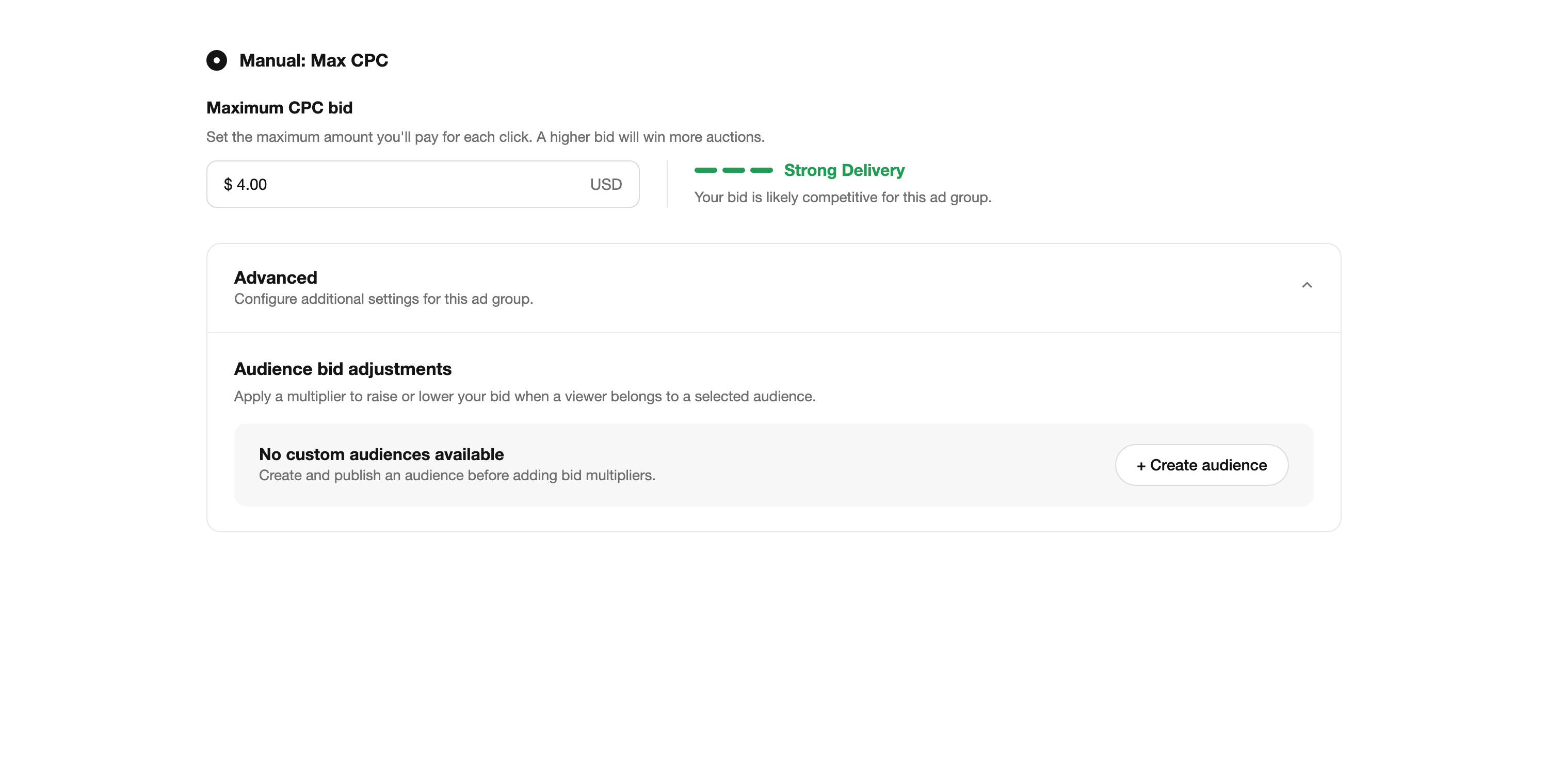
The live delivery meter (recreated view): in our account a $4.00 bid reads "Strong Delivery — your bid is likely competitive for this ad group."
Budget floor: $25 per day. Billing is postpay, and account setup requires business details, a tax ID, a billing method, Persona verification, and an account logo before anything serves (OpenAI, 2026).
Read weak delivery as a relevance problem first. Slow delivery early on usually is not a bid problem - delivery ramps slowly during beta by design (OpenAI onboarding). Delivery that stays weak after the ramp period points at the relevance side of the auction: too few context hints, hints that are too generic, or targeting sliced too thin across country, region, DMA, or postal code. Fix hints before raising bids; the auction rewards relevance at any price.
Judge results against the right benchmark. Chatbot ad CTR averages ~0.9% versus ~6.4% for Google search (eMarketer, 2026); our own US campaigns have averaged ~1.3% CTR since July 2026 (our campaign data). AI-referred visits to US retail sites converted at a rate 60% higher than non-AI traffic in July 2026, the eleventh straight month ahead (Adobe Analytics, via Digital Commerce 360, 19 August 2026). We work through that math in ChatGPT ads vs Google Ads, and the full cost picture in what ChatGPT ads cost for ecommerce.
The delivery meter and audience multipliers
Switch to Manual Max CPC and the bid field answers back: a live delivery-strength indicator estimates whether your bid can win auctions for this ad group. In our own account, a $4.00 bid reads "Strong Delivery — your bid is likely competitive" (Ads Manager UI, August 2026). It's the closest thing the platform offers to a bid simulator — use it to find the floor where delivery stays strong rather than defaulting to the placeholder.
Below it, the Advanced panel holds audience bid adjustments: upload an audience (raw or SHA-256-hashed emails and phone numbers), publish it, and apply a multiplier that raises or lowers your bid when the viewer belongs to it. It's the only viewer-level lever in the system — the targeting post covers what audiences can and can't do.
Which model for which goal
Building category awareness - CPM with the Reach objective. You are buying presence in conversations, at roughly $25-60 per thousand (WebFX; OpenAI docs, 2026).
Driving site traffic - CPC with Maximize results. Start at $3-5 and let the auction discover your price.
Selling with tracking in place - conversion-optimized CPC, once your pixel and Conversions API events are flowing. Delivery skews toward likely converters while billing stays per click (OpenAI Help Center, article 20001210). The default 30-day conversion window means give it weeks, not days, before judging.
Testing on a small budget - CPC with Manual Max CPC at the bottom of your category range, on the $25/day floor. Postpay billing means no deposit at risk.
One honest caveat: agencies still report measurement gaps and unproven outcomes across ChatGPT ad campaigns (eMarketer/Digiday, 2026). The bid models are well defined; the proof layer is younger than the auction. Budget accordingly.
Where Tru Commerce fits
Every bid model above buys the same thing: a labeled sponsored box below the answer. It rents the conversation, one auction at a time. The recommendation inside the answer is a different layer - earned, not bought - and, as we told The Hindu BusinessLine in August 2026, "Brands cannot buy influence over ChatGPT's answers." Plus, Pro, Business, Enterprise, and Education users never see ads at all (OpenAI, 2026), so the earned layer is the only one your highest-spending customers ever encounter.
That is the two-layer game: bid well on the bought layer, but build the earned one, because it compounds and costs nothing per impression. Before you set a single Max CPC, find out where you stand organically. Run the free Citation Rank scan - see where AI assistants rank your brand within 24 hours - and browse our ChatGPT Ads hub for the rest of this series.
The upside here is measurable: House of Zelena went from 22% to 56% ChatGPT mention share in 6 months with us - see the House of Zelena case study. If you want to see where you stand before committing, start with ChatGPT Ads for ecommerce brands.
FAQ
OpenAI recommends starting bids of $3-5 per click in the US, rising to $8-18 in competitive categories like software and finance (WebFX; OpenAI docs; practitioner reports, 2026). Because the auction is second-price, you typically pay less than your max bid.
A bid model where OpenAI optimizes delivery toward the conversion event you select - a purchase, a signup - but still charges you per click, not per conversion (OpenAI Help Center, article 20001210). It needs the OpenAI pixel or Conversions API sending events to work.
Yes. ChatGPT Ads runs a relevance-weighted second-price auction (OpenAI Ads Manager docs, 2026). The winner pays just above the runner-up's effective bid, and relevance to the conversation is weighted alongside the bid - a higher bid alone does not guarantee the slot.
Start with Maximize results - the beta auction is thin and automated bidding finds a clearing price faster. Switch to Manual Max CPC once you have enough click data to know what a click is worth to you, especially in the $8-18 software and finance ranges.
Sources
- 1.Ads in ChatGPT: The Basics - OpenAI Help Center, 2026
- 2.Create campaigns for ChatGPT - OpenAI Help Center, 2026
- 3.Ads Manager Beta: account setup - OpenAI Help Center, 2026
- 4.How much do ChatGPT ads cost? CPC & CPM pricing - WebFX, 2026
- 5.ChatGPT ads will soon reach more users — proven results still missing - eMarketer, 2026
- 6.Adobe: AI referral traffic to retail sites converts 60% higher, July 2026 data - Digital Commerce 360, 2026
Continue reading
October 10, 2026
ChatGPT Ads in India: six weeks in, on the record
ChatGPT Ads switched on in India on 27 August 2026. Six weeks on, eight articles in five outlets quoted us and TechTimes cited our benchmarks. Every question the press asked, every answer verbatim and linked, and the numbers behind each one.
September 4, 2026
Criteo Prompt Smart Ads: 2,000 Brands on ChatGPT and a 4x Spend Lift
Criteo was the first ad-tech partner inside OpenAI's ChatGPT ads pilot. Its Prompt Smart Ads product auto-generates creatives and context hints matched to how people actually prompt - here is what it is, the numbers behind it, and what its creative reports teach every advertiser.
September 2, 2026
ChatGPT Ads Conversion Strategies: What the Query-Mix Data Says to Do
Only ~1 in 10 ChatGPT conversations carries commercial intent, 76.4% of shopping answers already show an ad, and market leaders buy almost none of them. Four strategies built on that data - not on search-ads instinct.