
ChatGPT Ads Account Requirements: Verification, Billing, and Tax Details
Everything OpenAI requires before your first ChatGPT ad serves: Persona identity verification, tax ID, a postpay billing profile, and an account logo. Plus the India-specific requirements from September 4, 2026.
Viren Inaniyan · August 29, 2026 · ChatGPT Ads
Most first campaigns on ChatGPT stall for boring reasons: a missing logo, a pending identity check, a tax ID that doesn't match the legal business name. This is the complete pre-flight checklist for the OpenAI Ads Manager - what you need, in what order, and the India-specific variants that apply from September 4, 2026.
The five things OpenAI requires before ads serve
The self-serve Ads Manager at ads.openai.com opened in May 2026 with no minimum lifetime spend (OpenAI, May 2026) - a long way from the $200,000 minimum at the February launch. But "no minimum spend" does not mean "no setup friction." OpenAI requires five things before a single impression serves (OpenAI Ads Manager docs):
1. Legal business details. Your registered business name, your website, and your business vertical. Use the exact legal name - not your trading name, not your brand name - because it must match your tax documents and your Persona verification. Mismatches here cascade into every later step.
2. Persona identity verification. OpenAI verifies advertiser identity through Persona. An authorized person at your business completes an identity check tied to the business account. Until this clears, your account exists but cannot serve.
3. A tax ID. An EIN for US businesses; the equivalent local business tax registration elsewhere. The name attached to the tax ID needs to match the legal business name from step one.
4. A billing profile with a valid card. ChatGPT ads run on a postpay model: you add a payment method during setup, run campaigns, and OpenAI charges the card after spend accrues. There is no prepay balance to load and no deposit. The practical implication: the card on file needs enough headroom for your daily budgets to accumulate between billing cycles, and a declined charge pauses delivery.
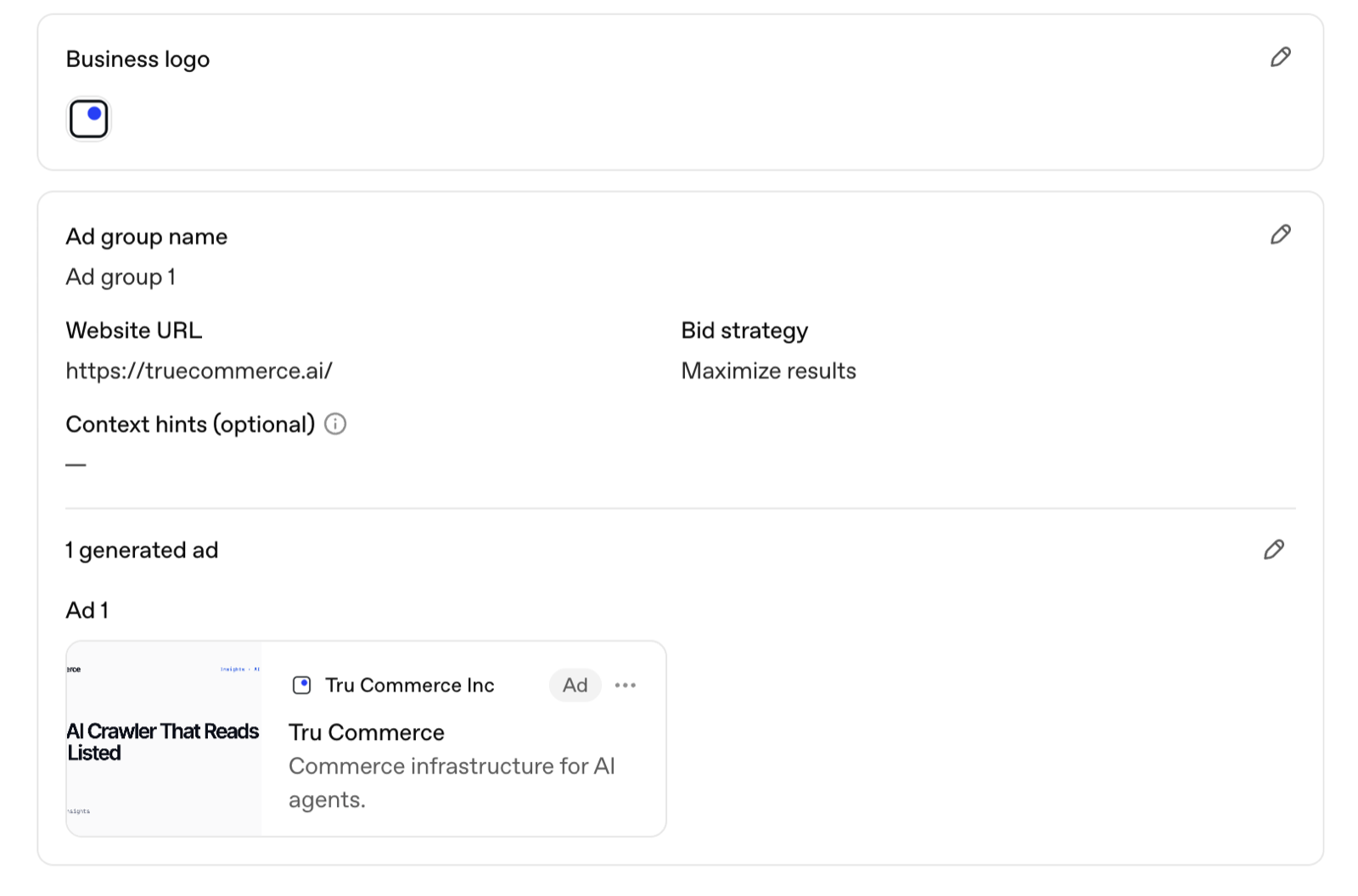
5. An account logo. This one surprises people. The logo is not decoration - it renders inside the ad unit itself, as the advertiser favicon at 32×32 pixels next to your business name. Because the ad cannot render without it, OpenAI treats the logo as a serving requirement, not an optional profile field. No logo, no ads.
The sixth requirement nobody lists: a landing page that works
The ad unit is a single labeled sponsored box below ChatGPT's answer - advertiser name, logo, a title of up to 50 characters, a description of up to 100 characters, a square image of at least 256×256, and a destination link (OpenAI Ads Manager docs). That destination link is part of the ad. If your landing page is broken, redirects through a chain, or does not match the business you verified, expect trouble in review.
Get the destination in order before you build the campaign: a live page, HTTPS, on the domain you registered in your business details. If you plan to measure conversions - and on a channel where agencies already report measurement gaps (eMarketer/Digiday, 2026) - install the OpenAI pixel on that page during setup week, not after launch. Our setup guide walks through the pixel and Conversions API step by step.
The two blockers that stall most accounts
The missing logo. This is the most common reason a fully approved campaign sits at zero impressions. Everything looks green - verification cleared, billing added, campaign approved - but the account has no logo, so nothing serves. Upload it on day one. And because it displays at 32×32, upload a mark that survives that size: a simplified icon, not your full horizontal wordmark with a tagline.
Persona verification delays. Identity verification is the one step you cannot brute-force. Document mismatches - a personal name that differs from the ID, a business name that differs from the tax registration - send you into manual review. Three ways to avoid the queue: use the exact legal entity name everywhere, have the person completing verification be someone whose documents are current and legible, and start verification before you write a single ad. Build campaigns while it processes, not the other way round.
A third, softer blocker: impatience. Delivery ramps slowly during the beta by design (OpenAI onboarding). A verified account with live campaigns and low impressions in week one is normal, not broken - see our ecommerce cost breakdown for what spend and delivery actually look like.
India: what changes on September 4
OpenAI switched ads on in India on August 27, 2026 for Free and Go users, with 50+ brands live in the first week and WPP and Omnicom as the first agency partners (The Hindu BusinessLine, Aug 28, 2026; Storyboard18, Aug 2026). That first wave was brand-led. The date that matters for everyone else is September 4, 2026, when the ChatGPT Ads Manager opens self-serve to any Indian business (Storyboard18, Aug 2026).
The India-specific variants on the checklist:
- Minimum daily budget: ₹725 - the Indian counterpart to the US $25 floor (Storyboard18, Aug 2026).
- No agency required. The August launch ran through agency partners; from September 4, self-serve is open to all merchants directly.
- Local tax registration. The tax ID step applies as everywhere - use your Indian business tax registration in place of a US EIN, matched to your registered business name.
- Same verification, billing, and logo requirements. Persona verification, the postpay billing profile, and the account logo are global requirements; India gets no exemption.
Indian merchants who complete verification in the last days of August are positioned to serve on day one of self-serve. Track availability in other markets on our rollout tracker.
What setup does not require
Worth knowing what is absent from the checklist, because it shapes how fast you can move:
- No minimum lifetime spend since the self-serve beta opened (OpenAI, May 2026).
- No keyword lists. Matching is conversational - current conversation topic, past chats, past ad interactions - steered by 5-15 context hints per ad group, not keywords (OpenAI Ads Manager docs).
- No prepay balance. Postpay means you can complete setup without committing budget upfront.
- No agency relationship, in any market, once self-serve is open there.
The full campaign build - objectives, bids, context hints - is covered on our ChatGPT Ads hub.
Where Tru Commerce fits
An approved ads account rents you a labeled box below the answer, shown only to Free and Go users. It buys you nothing in the answer itself: as we told The Hindu BusinessLine (Aug 28, 2026), brands cannot buy influence over ChatGPT's answers. Every brand now competes on two layers - the sponsored placement, which is bought and labelled, and the organic recommendation, which is earned. Plus and Pro users, who never see ads (OpenAI), only ever see the earned layer.
So before you spend a rupee or a dollar on the rented layer, find out where you stand on the earned one. Our free Citation Rank scan shows how often ChatGPT and the other AI surfaces actually recommend your brand - results in 24 hours, no login, no credit card. Complete the ads checklist with one hand; earn the answer with the other.
For a sense of what winning this channel is worth, we took House of Zelena from #6 to #1 across 3 LLMs in 6 months - read the House of Zelena case study. If you want to see where you stand before committing, start with ChatGPT Ads for ecommerce brands.
FAQ
Five things: your legal business details (name, website, vertical), Persona identity verification, a tax ID, a postpay billing profile with a valid card, and an account logo. Ads will not serve until all five are complete (OpenAI Ads Manager docs).
Yes. OpenAI requires a tax ID during account setup - an EIN for US businesses, or your local business tax registration elsewhere. It must match the legal business name on your verification documents.
The two most common blockers we see are a missing account logo and pending Persona verification. Check both first: the logo is required before serving, and verification must clear before campaigns leave review.
Postpay. You add a billing method during setup and OpenAI charges you after spend accrues, not before. There is no minimum lifetime spend in the self-serve Ads Manager (OpenAI, May 2026).
Yes, from September 4, 2026. Self-serve opens to any Indian business with a minimum daily budget of ₹725 - no agency required (Storyboard18, Aug 2026).
Sources
- 1.Ads in ChatGPT: The Basics - OpenAI Help Center, 2026
- 2.Create campaigns for ChatGPT - OpenAI Help Center, 2026
- 3.Ads Manager Beta: account setup - OpenAI Help Center, 2026
Continue reading
October 10, 2026
ChatGPT Ads in India: six weeks in, on the record
ChatGPT Ads switched on in India on 27 August 2026. Six weeks on, eight articles in five outlets quoted us and TechTimes cited our benchmarks. Every question the press asked, every answer verbatim and linked, and the numbers behind each one.
September 4, 2026
Criteo Prompt Smart Ads: 2,000 Brands on ChatGPT and a 4x Spend Lift
Criteo was the first ad-tech partner inside OpenAI's ChatGPT ads pilot. Its Prompt Smart Ads product auto-generates creatives and context hints matched to how people actually prompt - here is what it is, the numbers behind it, and what its creative reports teach every advertiser.
September 2, 2026
ChatGPT Ads Conversion Strategies: What the Query-Mix Data Says to Do
Only ~1 in 10 ChatGPT conversations carries commercial intent, 76.4% of shopping answers already show an ad, and market leaders buy almost none of them. Four strategies built on that data - not on search-ads instinct.