
Agentic Commerce vs Traditional Ecommerce: What Actually Changes
Most comparisons of agentic and traditional ecommerce overstate the break. Here is a line-by-line look at what genuinely changes when the shopper is an agent.
Tru Commerce Team · September 17, 2026 · Agentic Commerce Fundamentals
The agentic commerce value chain at a glance
Use this seven-layer map to place discovery, payments and checkout in context. Open the text version below for every layer and company shown.
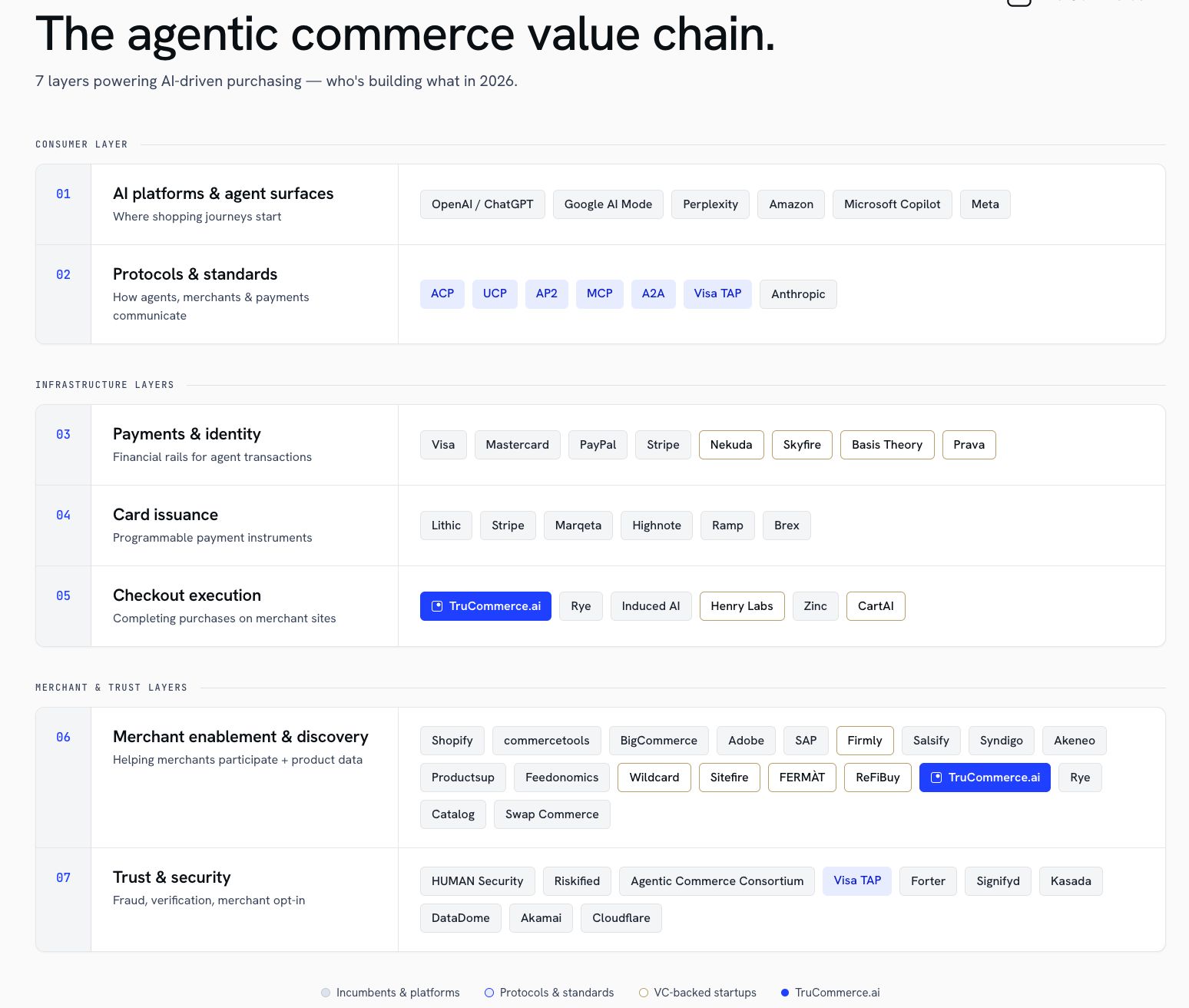
Read all seven layers and company names
The agentic commerce value chain. 7 layers powering AI-driven purchasing — who's building what in 2026. Text version of the diagram:
Consumer layer · 01
AI platforms & agent surfaces
Where shopping journeys start.
OpenAI / ChatGPT · Google AI Mode · Perplexity · Amazon · Microsoft Copilot · Meta
Consumer layer · 02
Protocols & standards
How agents, merchants & payments communicate.
ACP · UCP · AP2 · MCP · A2A · Visa TAP · Anthropic
Infrastructure layers · 03
Payments & identity
Financial rails for agent transactions.
Visa · Mastercard · PayPal · Stripe · Nekuda · Skyfire · Basis Theory · Prava
Infrastructure layers · 04
Card issuance
Programmable payment instruments.
Lithic · Stripe · Marqeta · Highnote · Ramp · Brex
Infrastructure layers · 05
Checkout execution
Completing purchases on merchant sites.
TruCommerce.ai · Rye · Induced AI · Henry Labs · Zinc · CartAI
Merchant & trust layers · 06
Merchant enablement & discovery
Helping merchants participate + product data.
Shopify · commercetools · BigCommerce · Adobe · SAP · Firmly · Salsify · Syndigo · Akeneo · Productsup · Feedonomics · Wildcard · Sitefire · FERMÀT · ReFiBuy · TruCommerce.ai · Rye · Catalog · Swap Commerce
Merchant & trust layers · 07
Trust & security
Fraud, verification, merchant opt-in.
HUMAN Security · Riskified · Agentic Commerce Consortium · Visa TAP · Forter · Signifyd · Kasada · DataDome · Akamai · Cloudflare
Diagram legend: incumbents & platforms; protocols & standards; VC-backed startups; TruCommerce.ai.
Most comparisons overstate the break. The useful version is narrower: agentic commerce changes who does the shopping, not who does the selling.
TL;DR
- Who changes: the shopper gains a machine intermediary. You remain the merchant.
- What changes most: discovery moves from a results page you influence with SEO to a generated answer you influence with citations and catalog data.
- What changes shape: conversion. Traffic arrives pre-qualified, lower in volume, and converts at a far higher rate.
- What breaks: visual merchandising. An agent does not see your hero image or your badges.
- What does not change: merchant of record, customer data ownership, refund and chargeback obligation.
The one-line difference
In traditional ecommerce, a person browses and decides. In agentic commerce, an assistant searches, compares and sometimes buys on that person's behalf.
Everything else follows from that.
Side by side
Discovery. Traditional: a ranked list of links, influenced by SEO. Agentic: a synthesised answer naming a handful of options, influenced by which sources the model retrieves and trusts. You can rank first on Google and be absent from the answer.
The unit of competition. Traditional: the page. Agentic: the sentence. Being cited as a source and being recommended as an option are different outcomes, and a brand can have one without the other.
Traffic volume. Traditional: high, broad, much of it early-stage. Agentic: lower, narrower, later-stage.
Conversion rate. Traditional: low single digits, typical for search referrals. Agentic: markedly higher, because the filtering happened before the click.
Merchandising. Traditional: imagery, layout, badges, urgency. Agentic: structured product data, reviews, third-party corroboration. The agent cannot see your design.
Attribution. Traditional: referrer is usually legible in analytics. Agentic: much of it lands as direct, which is why teams routinely underestimate the channel.
Catalog requirements. Traditional: accurate enough for a human to interpret. Agentic: accurate enough for a machine to parse without ambiguity - variants, availability and pricing have to be unambiguous or the agent will pick something it understands better.
What this means practically
Data quality becomes a growth lever, not a hygiene task. In a human-led funnel, a slightly wrong variant label costs you a few confused shoppers. In an agent-led funnel, it can remove you from consideration entirely, because the agent resolves ambiguity by choosing a product it can describe confidently.
Out of stock behaves differently. A human sees an out-of-stock item and may wait or subscribe. An agent filters it out and recommends a competitor. Availability accuracy becomes a visibility control.
Third-party sources matter more than your own copy. Agents corroborate. Reviews, comparison pages and forum threads carry weight your product description does not, because they are independent of you.
The channel looks small before it looks important. A high conversion rate on a low base is easy to dismiss. The trap is that the base is the part that grows.
What does not change
It is worth being precise about this, because a lot of commentary implies brands are ceding control wholesale. They are not:
- You are the merchant of record.
- The customer record is yours.
- Refunds and chargebacks are yours to handle.
- Pricing is yours to set.
The agent is a channel. A demanding one, with unfamiliar rules, but a channel.
Where to start
The first question is not which protocol to support. It is whether assistants name you at all for the questions your buyers actually ask. If they do not, the catalog and protocol work has nothing to carry.
Run a free Citation Rank scan to see where you currently stand.
FAQs
Q: What is the difference between agentic commerce and traditional ecommerce? A: In traditional ecommerce a person browses your storefront and decides. In agentic commerce an AI assistant does the searching, comparing and sometimes the buying, which means your product has to be legible to a machine reader before a human sees it.
Q: Does agentic commerce replace my online store? A: No. It adds a channel in front of it. Your store is still where the transaction settles and where the customer relationship lives.
Q: Why does AI-referred traffic convert better? A: The filtering happens before the click. The shopper has already narrowed by need, budget and constraint.
Q: What breaks when shoppers use agents? A: Visual merchandising. Hero imagery, badges and layout do not reach an agent - it reads structured data, reviews and third-party sources.
FAQ
In traditional ecommerce a person browses your storefront and decides. In agentic commerce an AI assistant does the searching, comparing and sometimes the buying on the shopper's behalf, which means your product has to be legible to a machine reader before a human ever sees it.
No. It adds a channel in front of it. Your store remains where the transaction settles and where the customer relationship lives; the agent is a discovery and recommendation surface that sits upstream.
Because the filtering happens before the click. A shopper who asked an assistant a specific question has already narrowed by need, budget and constraint, so they arrive closer to a decision than someone who typed a broad keyword.
Visual merchandising levers. Hero imagery, badges, layout and on-page persuasion do not reach an agent. It reads your structured product data, your reviews and third-party sources, which shifts effort from design to data quality.
Continue reading
September 17, 2026
Agentic Commerce Case Studies vs Demos: How to Tell Them Apart
A demo shows the software working. A case study shows a named merchant getting a measured outcome. Here is the five-part test, and how to apply it before you sign.
July 14, 2026
Agentic Commerce, Defined: The 7-Layer Map of How AI Buys
Most vendor pitches in this category sound interchangeable because they're describing the same problem from one layer of a seven-layer stack. The map sorts the noise. After you read it you can
October 12, 2026
How a Claude shopping agent picks products
Anthropic ships no ranking layer. A Claude for Commerce shopping agent reads compact catalog rows of 70 to 120 characters that the merchant's own search returns, adds only server-issued ids to the cart, and never sees the checkout URL. Claude in Chrome reads the page and asks before buying. What is documented, what is not, and who filled the gap.