
Research · Flagship
May 2026 · Updated September 2026 · 15 min read
The agentic commerce value chain. Here's what changes for every brand.
The agentic commerce value chain connects the AI assistant a shopper uses to the merchant that fulfills the order. This seven-layer map separates discovery, protocols, payments, card issuance, checkout, merchant enablement, and trust so brands can understand each role and its economics.
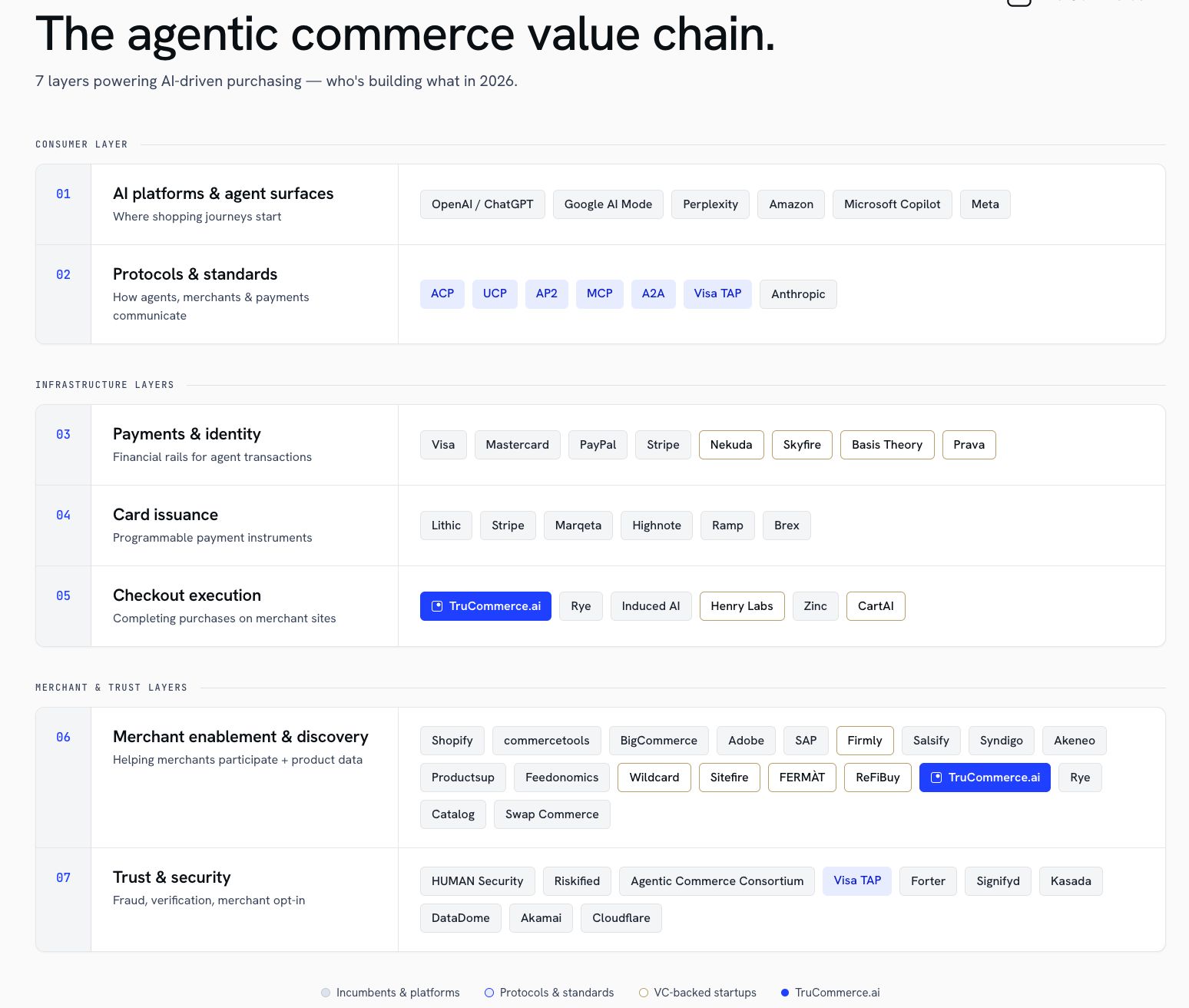
Read all seven layers and company names
The agentic commerce value chain. 7 layers powering AI-driven purchasing — who's building what in 2026. Text version of the diagram:
Consumer layer · 01
AI platforms & agent surfaces
Where shopping journeys start.
OpenAI / ChatGPT · Google AI Mode · Perplexity · Amazon · Microsoft Copilot · Meta
Consumer layer · 02
Protocols & standards
How agents, merchants & payments communicate.
ACP · UCP · AP2 · MCP · A2A · Visa TAP · Anthropic
Infrastructure layers · 03
Payments & identity
Financial rails for agent transactions.
Visa · Mastercard · PayPal · Stripe · Nekuda · Skyfire · Basis Theory · Prava
Infrastructure layers · 04
Card issuance
Programmable payment instruments.
Lithic · Stripe · Marqeta · Highnote · Ramp · Brex
Infrastructure layers · 05
Checkout execution
Completing purchases on merchant sites.
TruCommerce.ai · Rye · Induced AI · Henry Labs · Zinc · CartAI
Merchant & trust layers · 06
Merchant enablement & discovery
Helping merchants participate + product data.
Shopify · commercetools · BigCommerce · Adobe · SAP · Firmly · Salsify · Syndigo · Akeneo · Productsup · Feedonomics · Wildcard · Sitefire · FERMÀT · ReFiBuy · TruCommerce.ai · Rye · Catalog · Swap Commerce
Merchant & trust layers · 07
Trust & security
Fraud, verification, merchant opt-in.
HUMAN Security · Riskified · Agentic Commerce Consortium · Visa TAP · Forter · Signifyd · Kasada · DataDome · Akamai · Cloudflare
Diagram legend: incumbents & platforms; protocols & standards; VC-backed startups; TruCommerce.ai.
How the value chain shapes agent economics
Agent economics asks what it costs to turn an AI recommendation into a completed, profitable order. Discovery earns the opportunity; catalog data and protocols make the product actionable; checkout and payments complete the order; trust controls help manage fraud and failed transactions.
For a merchant, measure the full order journey. Revenue alone cannot tell you whether the channel creates margin. Deduct product cost, fulfillment, returns, acquisition spend, payment processing, and any platform or execution fees that apply to the order.
Contribution per agent-driven order
Net order revenue − product and fulfillment costs − acquisition costs − payment and platform fees − expected returns and fraud costs.
Use your own commercial terms and observed costs. The diagram maps roles; it does not specify vendor pricing or guarantee a return.
- Discovery: track which recommendations generate qualified visits and orders with Citation Rank.
- Execution: distinguish a checkout attempt from a completed purchase. See how unified checkout fits into the flow.
- Payments and trust: account for authorization failures, processing fees, refunds and chargebacks. Explore the agentic payments stack.
- Attribution: connect the recommendation to the order before comparing channel returns. Read the guide to dark agentic commerce traffic.
For twenty years, the value chain of online commerce sat in roughly the same place. A buyer searched. A link took her to a brand site. The brand site had a cart, a checkout, a fraud rule, a refund policy, a loyalty program, an email list. The brand controlled every step. The brand was the merchant of record. The brand owned the customer.
That value chain is being rebuilt in real time. Not by another marketplace. Not by another payments network. By the agents - the ChatGPTs and Geminis and Perplexities and Rufuses - that increasingly sit between the buyer and the brand. The buyer asks the agent. The agent does the discovery. The agent chooses what to recommend. The agent, soon, completes the purchase.
In the new chain, the brand sees almost none of it.
“Generative-AI traffic to retail is up 4,700% year over year. Most of it doesn't convert. The traffic isn't the problem. The chain is.”
The old chain - and where every step lived
In the old model, the brand stood between every link. Search drove a click. The click landed on a brand page. The brand controlled the navigation, the merchandising, the variant selector, the up-sell, the promo logic, the tax math, the address normalization, the 3DS step. The brand collected first-party data at every step. The customer relationship belonged to the brand on the way in and on the way back.
Brands optimized this chain for two decades. SEO bought the click. CRO bought the conversion. CRM bought the repeat. Returns and substitutions were built into the post-purchase relationship. The whole machine ran on the assumption that the buyer would arrive at the brand site and that the brand controlled the experience from then on.
That assumption is collapsing - fast, and quietly.
The new chain - agent → recommendation → 1-tap checkout
In the agent-mediated chain, the buyer never reaches a brand site. She asks an agent. The agent runs discovery - across product feeds, marketplaces, blog content, expert sources. The agent narrates a recommendation: this brand, this SKU, this variant, this price, this delivery window. The buyer says yes. A protocol - ACP, UCP, MCP, AP2 - completes the transaction in the same conversation.
The brand site, in this chain, is optional. Sometimes it loads in a frame; sometimes it doesn't load at all. The merchandising hierarchy, the navigation, the up-sell - none of it ran. The customer data is held by the agent, not by the brand. The relationship, by default, is between the buyer and the agent platform.
For brands that win the agent's recommendation, this is enormous: a new lever, lower friction, and measurable transactions inside surfaces where humans now spend a meaningful slice of their attention. For brands that lose the recommendation, it is invisible attrition. They show up in the analytics as direct traffic that quietly shrinks. They show up in marketplaces as flat sell-through. They never learn why.
From our data
MyMuse's GA4 reported ₹11,500 per month from AI channels. The real number was ₹81,200. A 7× attribution gap, hidden inside “direct.”
Where demand is leaking
Most brands don't know they're losing the agent moment because their tooling can't see it. GA4 collapses agent-driven sessions into “direct”. Server-side analytics report no referer. The marketing team sees flat top-of-funnel and assumes the issue is creative. The growth team sees flat conversion and assumes it's the funnel. Both are looking past the actual problem.
Three ways the leak shows up in real reporting:
- The attribution gap. What GA4 reports vs. what actually happened. MyMuse's 7× gap is not unusual. Most brands we measure see between 3× and 10× when we run DACT against their full funnel.
- The citation gap. Where competitors are cited inside AI answers and you are not - or vice versa. ITC MasterChef moved AI Share of Voice +89% in 30 days by fixing this; House of Zelena moved from #6 to #1 across three LLMs in 6 months.
- The transaction gap. The moment the agent says “buy now” and the checkout fails - SKU mismatch, dynamic pricing, coupon validation, address normalization, 3DS. Each one drops the conversion. The brand loses the sale. Often, the brand never knows the agent tried.
The six-tool stitch - what brands are doing now
Most brands trying to participate in agent-driven commerce today end up running six separate workstreams:
- One tool to track AI visibility - where the brand surfaces, where it doesn't
- Another to normalize the product catalog into something agents can read
- A third for protocol-mediated checkout - so agents can actually transact
- A fourth for on-site AI assistants that answer in-session shopper questions
- Custom analytics work to recover the attribution standard tools collapse into “direct”
- An agency to chase AI-sponsored placements as those surfaces open up
Six contracts. Six dashboards. None of them talking to each other. Discovery data lives in one tool; checkout-failure data lives in another; attribution lives nowhere good. The team running the motion spends most of its time stitching reports rather than moving numbers.
The unified alternative
The unified alternative is what becomes possible when discovery, connectivity, attribution, and transaction live in one platform - and feed each other. Citation rank tells the merchandising team which queries to win. Connectivity makes the brand transactable on those queries. Attribution closes the loop, exposing whether the changes moved real revenue. Ads buys presence on queries the brand can't earn organically.
Each component is meaningful in isolation. The compounding only happens when they share a data model. That is the wedge of a single platform - one contract, one dashboard, one transaction event, one merchant of record.
“Six vendors solve six problems. They don't solve the problem of the loop. The loop only closes when discovery, recommendation, and checkout are the same product.”
What this means for the next 24 months
Three predictions we're willing to put numbers on.
One. AI-driven traffic will move from ~5% of e-commerce referral mix today to 15-25% by 2030. Most analyst houses agree on the order of magnitude; we agree with the 20% midpoint. The brands that integrate by 2026 will compound. The brands that wait for the protocol war to settle will spend 2027 catching up to where their competitors already are.
Two. The protocol war will not have a single winner. ACP will dominate one set of surfaces, UCP another, MCP a third. Brands that bet on a single protocol will rebuild every 18 months. Brands that go protocol-agnostic - and let the platform handle the mix - will integrate once and stay integrated.
Three. Payments will consolidate fast. Tokenized, agent-aware payment instruments - Visa TAP, Stripe ACP, the next-gen Cashfree-style integrations - will become table stakes inside 24 months. The brands that pair their unified storefront with a single payment partner will collapse the integration cost to roughly zero. The brands that don't will keep paying it every quarter.
What we'd do if we were running brand growth right now
First, measure the gap. Run a DACT-style attribution layer over your existing funnel for 30 days. The number you find will likely be 3-10× what GA4 is showing you. That number is the size of the prize.
Second, take the citation rank report. Find the queries where competitors are taking the answer and you aren't. The list is usually shorter than people expect - and the edits to move it are usually specific, not strategic.
Third, get transactable. The full unified loop - connectivity + visibility + attribution + ads - does not have to ship at once. Connectivity is the wedge. Visibility tells you where to point it. The other two compound.
The brands that win agent-driven commerce in 2030 are integrated by 2026. Not because the integration is hard, but because the compounding only starts the day you turn it on.
Authored by
The Tru Commerce research team
May 2026 · v1