
Agentic Commerce, Defined: The 7-Layer Map of How AI Buys
Most vendor pitches in this category sound interchangeable because they're describing the same problem from one layer of a seven-layer stack. The map sorts the noise. After you read it you can
Tru Commerce Team · July 14, 2026 · Agentic Commerce Fundamentals
The agentic commerce value chain at a glance
Use this seven-layer map to place discovery, payments and checkout in context. Open the text version below for every layer and company shown.
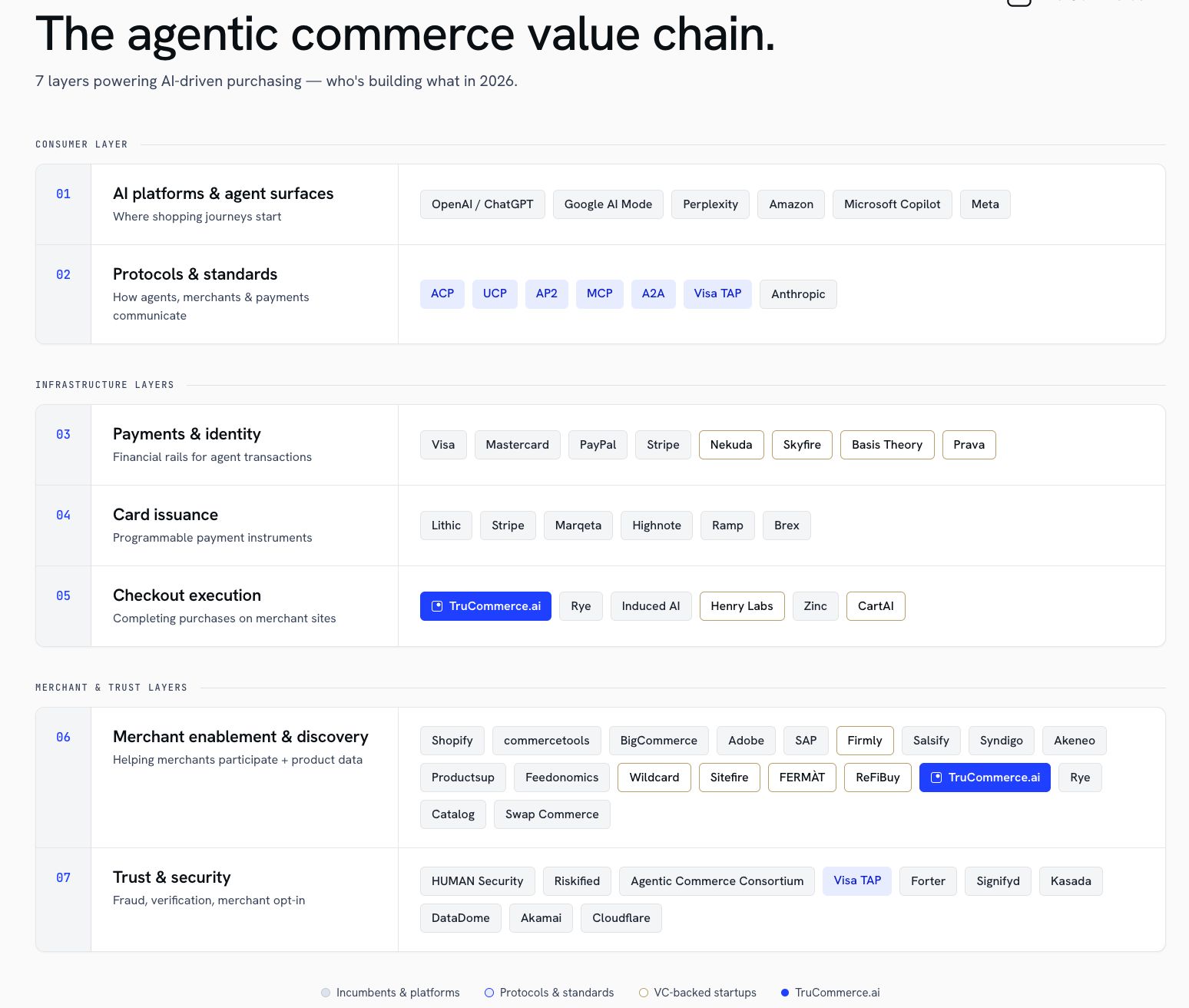
Read all seven layers and company names
The agentic commerce value chain. 7 layers powering AI-driven purchasing — who's building what in 2026. Text version of the diagram:
Consumer layer · 01
AI platforms & agent surfaces
Where shopping journeys start.
OpenAI / ChatGPT · Google AI Mode · Perplexity · Amazon · Microsoft Copilot · Meta
Consumer layer · 02
Protocols & standards
How agents, merchants & payments communicate.
ACP · UCP · AP2 · MCP · A2A · Visa TAP · Anthropic
Infrastructure layers · 03
Payments & identity
Financial rails for agent transactions.
Visa · Mastercard · PayPal · Stripe · Nekuda · Skyfire · Basis Theory · Prava
Infrastructure layers · 04
Card issuance
Programmable payment instruments.
Lithic · Stripe · Marqeta · Highnote · Ramp · Brex
Infrastructure layers · 05
Checkout execution
Completing purchases on merchant sites.
TruCommerce.ai · Rye · Induced AI · Henry Labs · Zinc · CartAI
Merchant & trust layers · 06
Merchant enablement & discovery
Helping merchants participate + product data.
Shopify · commercetools · BigCommerce · Adobe · SAP · Firmly · Salsify · Syndigo · Akeneo · Productsup · Feedonomics · Wildcard · Sitefire · FERMÀT · ReFiBuy · TruCommerce.ai · Rye · Catalog · Swap Commerce
Merchant & trust layers · 07
Trust & security
Fraud, verification, merchant opt-in.
HUMAN Security · Riskified · Agentic Commerce Consortium · Visa TAP · Forter · Signifyd · Kasada · DataDome · Akamai · Cloudflare
Diagram legend: incumbents & platforms; protocols & standards; VC-backed startups; TruCommerce.ai.
Most vendor pitches in this category sound interchangeable because they're describing the same problem from one layer of a seven-layer stack. The map sorts the noise. After you read it you can tell who owns what - and where most brands silently lose money.
Where this category actually lives
Agentic commerce is the discipline of getting an AI agent - ChatGPT, Gemini, Perplexity, Rufus, Copilot, Claude - to discover, recommend, and complete a purchase on a shopper's behalf. The shorthand is everywhere now. The infrastructure under it is not.
What's missing in the public conversation is a clean map of the stack. The pitches sound interchangeable because every vendor talks about the same end-state - "an AI agent buys your product on a shopper's behalf" - without telling you which layer they own. That's the gap this post closes.
There are seven layers. Each does a different job. Each has a different set of vendors. The unspoken rule in this market is that the layer you own is the layer you defend. We think that rule is wrong - and the rest of this post is why.
The 7-Layer Map
| Layer | What it does | Who plays here |
|---|---|---|
| 01 - AI Surfaces | The screen where the shopper asks a question | OpenAI, Google, Microsoft, Anthropic, Perplexity, Amazon, Meta |
| 02 - Protocols | How agents and merchants speak to each other | ACP (OpenAI + Stripe), UCP (Google + Shopify + 20 retailers), AP2, MCP, A2A, TAP |
| 03 - Payments | Tokenize the agent's purchase | Nekuda, Skyfire, Basis Theory, Prava |
| 04 - Card issuance | Virtual cards the agent can transact on | Lithic, Marqeta |
| 05 - Checkout execution | Complete the transaction inside the agent surface | Rye, Zinc, CartAI, Henry Labs, Induced AI |
| 06 - Discovery + merchant enablement | Make the brand showable, citable, recommendable | Nudge, FERMÀT, Wildcard, Catalog, Swap, Rankly, Profound |
| 07 - Trust + security | Verify the agent, fight agent fraud | HUMAN, Riskified, Forter, Signifyd |
Read it the way you read a network diagram. The AI surface at the top fields the shopper question. The protocols at Layer 02 carry the answer back and forth. Payments and card issuance at 03/04 turn an agent's "yes" into a settled charge. Checkout at 05 actually finishes the order. Discovery at 06 is what got the brand into the answer in the first place. Trust at 07 is the layer most vendors don't talk about until something breaks.
The category looks crowded because there are 30+ named vendors on the map. It is in fact uncrowded - per layer - because almost every vendor sits in exactly one cell.
A simple shopper journey, layer-by-layer
The map gets practical when you trace one transaction through it.
Take the case of a shopper who asks ChatGPT, "What's the best non-toxic frying pan under $200?"
- Layer 01 - The shopper's question arrives at OpenAI's surface. ChatGPT decides this is a transactional query and routes it to its shopping subsystem.
- Layer 06 - ChatGPT pulls candidate products from indexed sources. This is where your brand either appears or doesn't. If you've optimized for AI discovery, your SKU is in the candidate pool. If not, you are invisible.
- Layer 02 - ChatGPT formats the recommendation using the Agentic Commerce Protocol (ACP). The product card it shows the shopper carries a structured payload describing your SKU, price, availability, shipping, return policy.
- Layer 05 - The shopper taps "Buy." ChatGPT sends a checkout intent through ACP. Your Tru Commerce integration receives it, validates the cart, locks the inventory, and returns a checkout confirmation - all without the shopper leaving the conversation.
- Layer 03 + 04 - A tokenized agent-payment instrument settles the charge. Your payment processor sees a normal-looking transaction; the agent layer is invisible to the merchant of record.
- Layer 07 - Behind the scenes, the surface verifies the agent's identity, validates the payment token isn't reused, and runs fraud signals. If anything fails, the transaction never reaches you.
That is one transaction. Every single layer had to do its job for the order to land. Most brands have two or three of those layers wired. The other four are silently failing.
Where each competitor actually sits
Naming names matters, because the category is full of overlapping pitches that are not in fact overlapping at the layer level.
Layer 06 only (Discovery / merchant enablement):
- Nudge - measurement-led; AEO dashboards
- FERMÀT - shoppable on-site funnels; on-domain conversion
- Wildcard - SKU-level AEO + open
agents.jsonspec - Catalog - product feed structuring
- Swap Commerce - apparel/returns-first agentic surface
- Profound, Rankly - visibility monitoring
Layer 05 only (Checkout execution):
- Rye - universal product API + checkout (US-focused, dev-led)
- Zinc, Henry Labs - Amazon-adjacent agent checkout
- CartAI - publisher/affiliate-side agentic checkout
- Induced AI - general browser-driven completion
Layer 03/04 only (Payments / issuance):
- Nekuda, Skyfire - delegated-spend tokenization
- Basis Theory - tokenization infrastructure
- Prava, PayOS - compliant agentic payments
- Lithic, Marqeta - virtual card rails
Layer 02 work but no merchant-facing product:
- Stripe, Visa, Mastercard, PayPal, Adyen - protocol contributors
Tru Commerce position: We bridge Layer 02 + Layer 05 + Layer 06 in a single platform. One integration. One contract. The brand never directly manages the six protocols (ACP, UCP, AP2, MCP, A2A, TAP) - we translate. The brand never picks a checkout API per surface - we route. The brand's Citation Rank, Share of Voice, and Visibility Score (the Layer-06 measurement work) feed the same data spine that closes the loop at Layer 05.
That is the entire product thesis in one paragraph. Everything else is a feature.
Why most brands try to build this themselves and regret it
The instinct, when a brand reads the 7-Layer Map for the first time, is to assemble it themselves. Pick a Layer-06 visibility tool. Pick a Layer-05 checkout API. Pick a Layer-03 payments tokenizer. Glue with internal engineering.
We have watched this play out. Three things go wrong.
The protocols change weekly. When ACP added multi-item carts in Q4 2025, every brand that had wired against the single-item v1 schema was suddenly behind a glass wall. UCP shipped catalog endpoint + loyalty endpoints in Q1 2026. Brands keeping up with six protocols on six release cadences burn 1-2 engineers permanently on translation work that doesn't differentiate them.
Attribution falls between the cracks. Layer 05 knows the conversion happened. Layer 06 knows the agent surface that drove it. If those two are different vendors with different IDs and different export formats, the brand never knows which agent surface produced which dollar. The MyMuse case is the canonical example: GA4 reported ₹11.5K/month from AI surfaces. The real number, once the attribution was rebuilt with proper Layer-02/05/06 stitching, was ₹81.2K. A 7× gap, hidden because the layers weren't talking. We wrote this up at length in Dark Agentic Commerce Traffic (DACT).
The "merchant of record" question gets messy. Multiple vendors in this stack want to be the merchant of record for the agent purchase - because it's the position with the most pricing power. A brand that hands MoR to a checkout vendor at Layer 05 quietly loses customer data, pricing control, and the ability to issue a refund in their own brand. That is a strategic loss disguised as a tactical integration.
A single layer wired well beats four layers wired badly. A single integrated platform across the three load-bearing layers beats either.
The two layers that decide the outcome
If you only have budget for two layers this year, pick Layer 06 and Layer 05. Here's why.
Layer 06 is the demand-side gate. If you are not in the candidate pool the agent considers, no amount of checkout wiring saves you. Visibility comes first because nothing else fires until visibility fires.
Layer 05 is the supply-side gate. If the agent decides to recommend you and the checkout drops the shopper into a desktop form, your conversion rate falls by roughly an order of magnitude. (Shopify's recent webinar series quoted 49% higher conversion for AI shoppers when checkout completes inside the agent surface. Our internal measurements on a small cohort of brands sit in the 35-55% range depending on category.)
The remaining layers - protocols (02), payments (03), card issuance (04), trust (07) - matter, but they're table-stakes in the sense that almost every Layer-05 or Layer-02 vendor either provides them or integrates a partner that does. You can usually defer thinking about them.
The two-layer focus is also the budget-realistic move. A brand with $50K-$200K of annual platform spend in this category can cover Layer 06 + Layer 05 well. The same budget split across 04 vendors covering all seven layers buys you four lawn-mowers that don't talk to each other.
How to use the map this quarter
Three actions, in order, for a brand reading this for the first time.
1. Find yourself on the map. What's your current Layer-06 setup? (A monitoring tool? A feed optimizer? Nothing?) What's your Layer-05 setup? (Native to your Shopify checkout? A custom agent checkout API? Nothing?) The honest answer is usually "Layer 06 partially, Layer 05 not at all."
2. Run a free Citation Rank scan. Drop your URL. In 24 hours you'll see how you appear (or don't) across the six AI surfaces - that's your Layer-06 baseline. Three prescriptive recommendations come back with it. Free. No credit card.
3. If the citation rank surfaces a real gap, talk to us. Book a demo - we'll walk through what your stack would look like with Layer 02 + 05 + 06 unified, what changes for your conversion rate, and what the contract looks like. Pricing is public: free tier, then 2% per agent transaction above 10/month. Enterprise pricing kicks in at volume.
The 7-Layer Map isn't the whole story of agentic commerce. It's the part that tells you where to put your money.
This is measurable in weeks, not quarters: with Amazon India, Top-5 presence rose +2.4% in 6 weeks - see the Amazon case study.
FAQ
Maturity models (e.g., "Level 1: AI gives general advice → Level 5: AI shops autonomously") describe what the *shopper experience* looks like as agentic commerce matures. The 7-Layer Map describes what *infrastructure* has to exist for those experiences to work. They're complementary. Use a maturity model when you're talking about user experience. Use the 7-Layer Map when you're picking vendors.
Layer 02 (protocols - ACP, UCP, AP2, MCP, A2A, TAP), Layer 05 (checkout execution inside the agent surface), and Layer 06 (discovery and merchant enablement - Citation Rank, Share of Voice, Visibility Score, AI-Sponsored Placements). One integration covers all three. We integrate with Layer 03 (payments tokenizers like Nekuda and Skyfire) and Layer 07 (trust vendors like HUMAN and Signifyd); we don't replace them.
AEO (answer engine optimization) and GEO (generative engine optimization) are the broad disciplines - making any kind of content findable in AI answers. Agentic commerce optimization is the specifically-commercial subset - making transactional product content findable *and completable*. The first two are sub-skills inside Layer 06. The third spans Layer 06 + Layer 05. We cover all three.
No. Tru Commerce speaks both - plus AP2, MCP, A2A, and TAP. You stay on whichever ecommerce platform you're already on. We translate. The protocol war is real (OpenAI/Stripe-led ACP versus Google/Shopify-led UCP, with 20+ retailers on each side), but it's a war the brand doesn't have to fight directly. Pick a vendor that abstracts it.
For a Shopify brand on the Growth tier (2% per agent transaction, no platform fee), you connect your store and the Visibility track is live within an hour. Checkout-execution wiring depends on your existing fulfillment setup - most brands are live across all six surfaces in 7-14 days. Enterprise contracts with custom protocol work go through a 30-60 day implementation.
We add it. The Layer-02 abstraction is the moat - when a new surface ships, we wire the protocol once and every Tru Commerce customer is live on it without any work on their end. That's the load-bearing reason to be on a translation layer instead of integrating per-surface.
Continue reading
September 17, 2026
Agentic Commerce Case Studies vs Demos: How to Tell Them Apart
A demo shows the software working. A case study shows a named merchant getting a measured outcome. Here is the five-part test, and how to apply it before you sign.
September 17, 2026
Agentic Commerce vs Traditional Ecommerce: What Actually Changes
Most comparisons of agentic and traditional ecommerce overstate the break. Here is a line-by-line look at what genuinely changes when the shopper is an agent.
October 12, 2026
How a Claude shopping agent picks products
Anthropic ships no ranking layer. A Claude for Commerce shopping agent reads compact catalog rows of 70 to 120 characters that the merchant's own search returns, adds only server-issued ids to the cart, and never sees the checkout URL. Claude in Chrome reads the page and asks before buying. What is documented, what is not, and who filled the gap.